US warns Iranian civilians amid drone attacks
The US military has issued a warning on Sunday to civilians in Iran, urging them to stay indoors as Iranian forces continue launching drones and ballistic missiles from densely populated cities -- a tactic American officials say is placing millions of ordinary people at risk.
 IANS
Mar 8, 2026 11:20
0
IANS
Mar 8, 2026 11:20
0
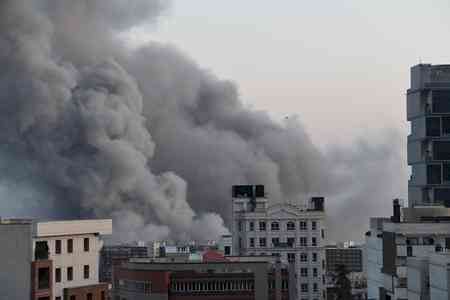
Washington, March 8 (IANS) The US military has issued a warning on Sunday to civilians in Iran, urging them to stay indoors as Iranian forces continue launching drones and ballistic missiles from densely populated cities -- a tactic American officials say is placing millions of ordinary people at risk.
US Central Command said the Iranian military had been conducting operations from crowded urban areas, including the cities of Dezful, Esfahan, and Shiraz, where drones and missiles have been launched in recent days.
“The Iranian regime is using heavily populated civilian areas to conduct military operations, including launching one-way attack drones and ballistic missiles,” CENTCOM said in a statement.
American officials warned that using residential neighbourhoods for military operations could expose those areas to retaliation under international law.
“This dangerous decision risks the lives of all civilians in Iran since locations used for military purposes lose protected status and could become legitimate military targets under international law,” the command said.
The statement urged civilians across Iran to remain inside their homes as fighting intensifies.
“US forces strongly urge civilians in Iran to stay at home,” the statement said, adding that the Iranian government was “knowingly endangering innocent lives".
American officials also accused Iranian forces of targeting civilian infrastructure elsewhere in the region.
According to CENTCOM, Iranian forces have “deliberately and indiscriminately targeting civilian airports, hotels, and residential neighborhoods” across parts of the Middle East, putting innocent people in neighbouring countries at risk.
Adm. Brad Cooper, commander of US Central Command, said Tehran’s actions were placing both its own population and regional partners in danger.
“Iran’s terrorist regime is blatantly disregarding civilian lives by attacking Gulf partners while compromising the safety of their own people,” Cooper said.
U.S. officials said Iran had launched hundreds of ballistic missiles and thousands of one-way attack drones since February 28. But they added that the pace of those launches has begun to slow after sustained military pressure.
“Launch rates have drastically declined as US and partner forces decimate Iran’s military capabilities,” the command said.
The US military said it was taking steps to minimise civilian harm but cautioned that it could not guarantee safety near facilities used by Iranian forces.
“The US military takes every feasible precaution to minimize harm to civilians but cannot guarantee civilian safety in or near facilities used by the Iranian regime for military purposes,” the statement said.
“Unlike the Iranian regime, US forces do not target or intentionally risk the safety of civilians.”
At the same time, the US State Department said it has been carrying out a large effort to help Americans leave the region as tensions escalate.
Assistant Secretary Dylan Johnson said more than 32,000 Americans have already returned to the United States since the crisis began.
“Since February 28, over 32,000 American citizens have safely returned to the United States from the Middle East,” Johnson said.
The State Department said it had organised nearly two dozen charter flights and evacuated thousands of Americans from the region, while commercial flight availability across the Middle East gradually improves.
Through its round-the-clock task force, the department said it has directly assisted more than 19,000 Americans abroad by providing security guidance and travel support.
The evacuation programme covers Americans in Oman, Kuwait, Bahrain, the United Arab Emirates, Qatar, Saudi Arabia and Israel who may require assistance leaving the region.
Officials also noted that more than half of the Americans who asked for help ultimately declined government-arranged transport when contacted. Some chose to remain in the region, while others preferred to arrange their own departures.
--IANS
int/lkj/pgh