US Supreme Court blocks Trump's order to end automatic birthright citizenship
The US Supreme Court on Tuesday struck down President Donald Trump's executive order seeking to end automatic birthright citizenship for children born in the United States to undocumented immigrants and many temporary visa holders, ruling that such children are citizens at birth under the Fourteenth Amendment.
 IANS
Jun 30, 2026 10:15
0
IANS
Jun 30, 2026 10:15
0
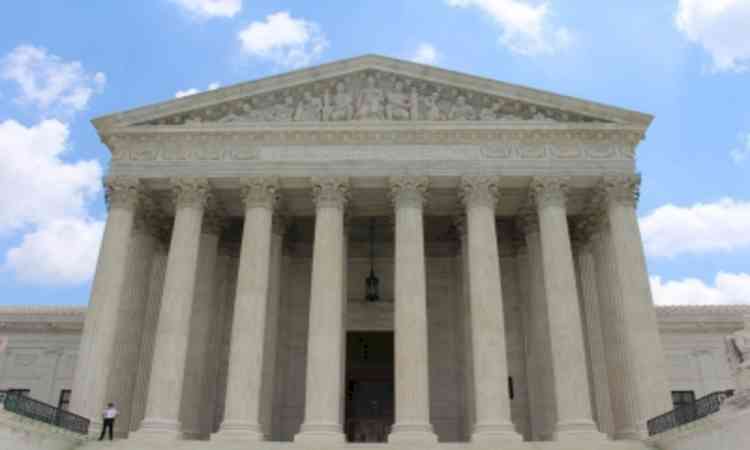
Washington, June 30 (IANS) The US Supreme Court on Tuesday struck down President Donald Trump's executive order seeking to end automatic birthright citizenship for children born in the United States to undocumented immigrants and many temporary visa holders, ruling that such children are citizens at birth under the Fourteenth Amendment.
The Supreme Court held that children born in the United States to parents who are unlawfully or temporarily present in the country are "subject to the jurisdiction" of the United States and therefore entitled to citizenship under the Constitution.
Chief Justice John Roberts, writing for the majority, said: "Citizenship, then and now, was the right to have rights -- to freely participate in our political community."
"The Framers of the Fourteenth Amendment extended that promise to 'every free-born person in this land.' We keep that promise today," he wrote.
In an executive order signed on January 20, 2025, the first day of his second term, Trump directed federal agencies not to recognise US citizenship for children born in the country if their mothers were either in the United States unlawfully or present only temporarily on visas, and the father was neither a US citizen nor a lawful permanent resident.
The order was never implemented after multiple legal challenges led to nationwide injunctions.
The White House order argued that the Fourteenth Amendment "has never been interpreted to extend citizenship universally to everyone born within the United States" and maintained that children born to undocumented immigrants or temporary visitors were not automatically entitled to citizenship.
The Supreme Court rejected that argument, concluding that the Citizenship Clause must be understood in light of its historical origins, the common law, the Civil Rights Act of 1866 and longstanding constitutional precedent. The court held that children born in the United States to parents who are unlawfully or temporarily present remain subject to US jurisdiction and therefore acquire citizenship at birth.
Democratic lawmakers welcomed the ruling.
The Congressional Tri-Caucus said: "Today's decision affirms a fundamental constitutional principle that has defined our nation for generations: every child born in the United States is a citizen of the United States."
The lawmakers added: "While President Trump believes he is above the law, today's ruling serves as a reminder that he cannot override the Constitution or deny people the rights it guarantees with a stroke of a pen."
California Attorney General Rob Bonta, who helped lead a multistate legal challenge against the order, said: "Today's decision affirms a foundational tenet of American democracy: that every child born in this country, no matter their background, is equal under the law and can pursue the American Dream."
Former White House adviser Ajay Bhutoria called the ruling "a historic victory for justice, the US Constitution, and the American Dream." He said the decision "reaffirms the foundational promise that has made our nation a beacon of freedom and opportunity for two and a half centuries."
Birthright citizenship is rooted in the Citizenship Clause of the Fourteenth Amendment, adopted in 1868 after the Civil War, according to which all persons born or naturalised in the United States, and subject to its jurisdiction, are citizens of the United States. For more than a century, it has been widely understood to guarantee citizenship to almost everyone born on US soil.
--IANS
lkj/ksk/uk