US says it controls Gulf shipping lanes
The US on Thursday asserted that it controls maritime traffic in and out of the Strait of Hormuz, dismissing Iranian claims of dominance over the strategic waterway as tensions remain high despite a fragile ceasefire.
 IANS
Apr 16, 2026 11:19
0
IANS
Apr 16, 2026 11:19
0
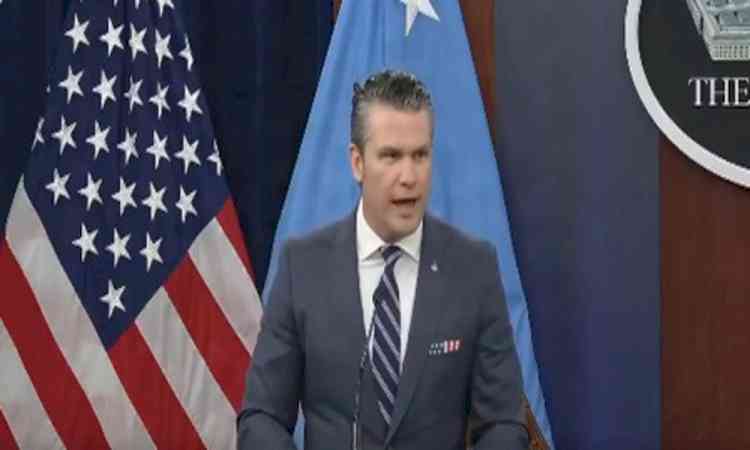
Washington, April 16 (IANS) The US on Thursday asserted that it controls maritime traffic in and out of the Strait of Hormuz, dismissing Iranian claims of dominance over the strategic waterway as tensions remain high despite a fragile ceasefire.
Defence Secretary Pete Hegseth said Iran lacked the naval capability and situational awareness to control shipping routes, accusing it of resorting to threats against commercial vessels.
"You'd like to say publicly, Iran, that you control the Strait of Hormuz, but you don't have a Navy or real domain awareness," he added.
He said that any attempt to target civilian shipping would amount to criminal activity.
"Threatening to shoot missiles and drones at ships, commercial ships that are lawfully transiting international waters... that's not control, that's piracy, that's terrorism," he added.
Hegseth was joined at the Pentagon briefing by Air Force General Dan Caine, Chairman of the Joint Chiefs of Staff, and Admiral Bradley Cooper, who leads US military operations across the Middle East as Commander of US Central Command.
The assertion comes as the US enforces a naval blockade targeting Iran's ports and coastline, part of a broader effort to restrict Tehran's economic and military capabilities following recent combat operations.
Hegseth said the US Navy was managing traffic flows through the strait using a fraction of its global fleet.
"We're doing this blockade... with less than 10 per cent of America's naval power," he said, adding that Iran effectively had "zero per cent of your Navy that's real control".
Military officials said the blockade applies to all vessels transiting to or from Iranian ports, regardless of nationality, with enforcement extending into both territorial and international waters.
Caine outlined the scale of the operation, noting that more than 10,000 personnel, including sailors, Marines and airmen, along with multiple ships and aircraft, were involved in maintaining the blockade.
He said US forces had issued warnings to vessels attempting to approach restricted areas, resulting in multiple ships reversing course.
"Do not attempt to breach the blockade... if you do not comply... we will use force," a standard transmission said.
According to the Pentagon, 13 vessels have already turned back, and no ship has yet forced a confrontation requiring boarding or seizure.
Despite the ceasefire that has paused major combat operations, US officials said forces remain fully prepared for escalation.
Caine said the joint force could "resume major combat operations at literally a moment's notice".
Hegseth also criticised allies for failing to contribute more actively to maritime security.
He said while some regional partners had supported US efforts, others had "talked a lot and haven't done anything" when the situation escalated.
He added that the burden of securing global waterways should not fall solely on Washington.
"We should live in a world where other countries can defend waterways, not just the United States Navy," the US Defence Secretary said.
--IANS
int/lkj/khz