US presses allies to share Gulf security burden
The US on Thursday called on allies to do more to secure critical maritime routes in the Gulf, saying Washington cannot be expected to shoulder the burden alone amid escalating tensions with Iran.
 IANS
Apr 16, 2026 11:08
0
IANS
Apr 16, 2026 11:08
0
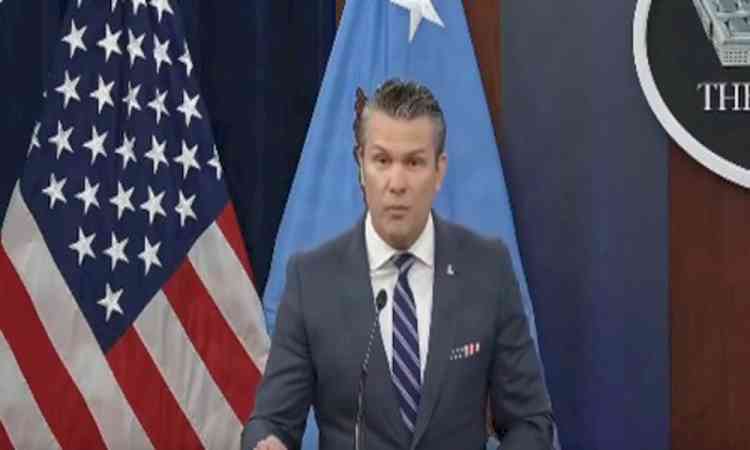
Washington, April 16 (IANS) The US on Thursday called on allies to do more to secure critical maritime routes in the Gulf, saying Washington cannot be expected to shoulder the burden alone amid escalating tensions with Iran.
Defence Secretary Pete Hegseth said while some regional partners had supported US efforts, many countries had failed to act when needed.
"Other allies have talked a lot and haven't done anything," he added, referring to the response during recent hostilities.
Hegseth was speaking at a Pentagon briefing alongside Air Force General Dan Caine, Chairman of the Joint Chiefs of Staff, and Admiral Bradley Cooper, who leads US military operations across the Middle East as Commander of US Central Command.
He said that the responsibility for securing global waterways should be shared more broadly, particularly by countries that depend heavily on energy shipments through the region.
"We should live in a world where other countries can defend waterways, not just the United States Navy," Hegseth added.
The remarks come as the US enforces a naval blockade targeting Iran's ports and coastline, part of a broader effort to pressure Tehran following recent combat operations.
Hegseth noted that the US itself does not rely heavily on energy flows through the Strait of Hormuz, in contrast to other regions.
"This is a waterway that the American commerce doesn't use all that much... but Asia does, and Europe does, and large parts of the rest of the world do," he said.
He noted that countries benefiting from the stability of the route should be prepared to contribute to its security.
"Their ability to muster a collective defence or a clearing of the straits would be a wonderful thing," Hegseth said, adding that such support had not materialised during the crisis.
Military officials said US forces continue to maintain a strong presence in the region, including naval, air and intelligence assets supporting the blockade and broader operations.
Caine said the joint force remained ready to escalate if necessary, with the capability to "resume major combat operations at literally a moment's notice".
Admiral Cooper said US troops deployed across the Middle East were maintaining a high level of readiness during the ceasefire period.
"We're rearming, we're retooling, and we're adjusting our tactics," he added.
He also highlighted cooperation with regional partners, including Gulf states and Israel, describing them as "exceptional teammates" who had supported joint operations and defence efforts.
Despite that support, Hegseth said broader international participation in maritime security remained limited, particularly from countries outside the immediate region.
He added that while the US would welcome greater involvement in the future, it could not rely on others stepping in during critical moments.
"We're not counting on it, but it would be wonderful to see it if it ever materialised," he said.
The Strait of Hormuz remains one of the world's most important energy corridors, carrying a significant share of global oil shipments.
Disruptions in the area can quickly affect supply chains and fuel prices worldwide.
For India, which depends heavily on crude imports from the Gulf, the issue of maritime security is closely tied to energy stability and economic planning.
Any prolonged disruption or escalation could have direct implications for import costs and supply continuity.
--IANS
int/lkj/khz