UN envoy Gill addresses Panjab University Colloquium
Under-Secretary-General and United Nations Secretary-General’s Envoy on Technology, Dr Amandeep Singh Gill, today delivered the Panjab University Colloquium on “Technology’s Promise and Peril: What role for the United Nations?” at the Seminar Hall (CIL) Building of Panjab University.
 City Air News
Feb 16, 2026 04:49
0
City Air News
Feb 16, 2026 04:49
0
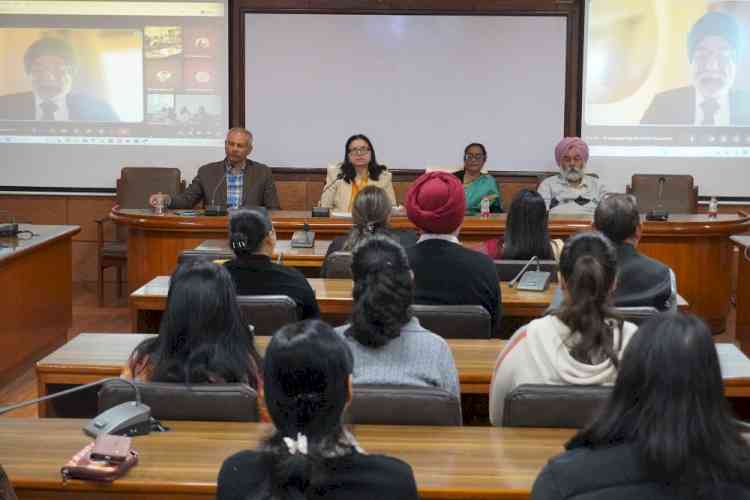
Chandigarh, February 16, 2026: Under-Secretary-General and United Nations Secretary-General’s Envoy on Technology, Dr Amandeep Singh Gill, today delivered the Panjab University Colloquium on “Technology’s Promise and Peril: What role for the United Nations?” at the Seminar Hall (CIL) Building of Panjab University.
PU Vice Chancellor Prof Renu Vig presided over the prestigious PU Colloquium. Director RPC Prof Meenakshi Goyal, PU Colloquium Coordinator Prof Desh Deepak Singh and Director CIL/SAIF/USIC/UCIM Prof Gaurav Verma, Faculty members, researchers and students also participated.
Delivering the Live Online lecture under the PU Colloquium series, Dr Gill said institutions like Panjab University can play a significant role in technology development by combining domain expertise with artificial intelligence. He said that even during his student days he admired the PU campus and believes that through curriculum reform, start-ups and individual research contributions, the university has a vital role in shaping future tech leadership.
He urged teachers and students not to see AI as confined to elite technical institutions. Future leaders from PU, he said, can integrate legal, scientific and social science knowledge with AI applications to build solutions relevant for national development. He cited emerging PU start-ups that bridge law, intellectual property and AI as examples of interdisciplinary innovation.
Dr Gill underlined the responsibility of educators in shaping curriculum frameworks that embed AI literacy across disciplines. Domain experts, he said, can develop their own AI-enabled solutions rather than relying solely on external platforms.
Speaking on the broader theme, Dr Gill said emerging technologies are reshaping economic activity and social relations. While AI promises productivity gains and faster scientific discovery, he cautioned that concentration of technological power in a few private hands can create dependencies, challenge national sovereignty and risk erosion of fundamental freedoms.
He stressed the need for regulatory frameworks for AI. As the technology evolves, protocols and safeguards will be put in place, he said, adding that there is no reason for undue concern if nations cooperate. International coordination is necessary to address risks such as cybercrime, mass surveillance and unregulated digital spaces.
Referring to the 80th anniversary of the United Nations, Dr Gill said multilateralism is under strain but remains essential. The UN platform, built on decades of international law, provides every nation a seat at the table and remains central to global dialogue on AI governance, including discussions around a Global Fund for AI capacity building.