UDF returns to power in Kerala with big mandate, needs bigger balancing act
The emphatic return of the Congress-led United Democratic Front (UDF) to power after a decade marks a decisive political shift in Kerala.
 IANS
May 4, 2026 11:16
0
IANS
May 4, 2026 11:16
0
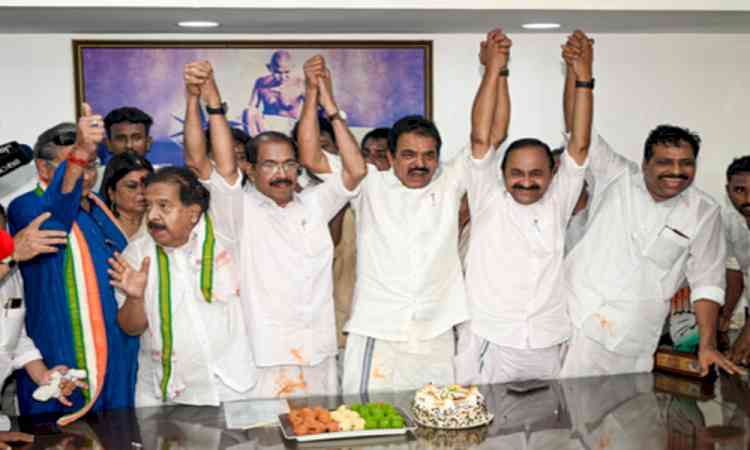
Thiruvananthapuram, May 4 (IANS) The emphatic return of the Congress-led United Democratic Front (UDF) to power after a decade marks a decisive political shift in Kerala.
Having missed the opportunity in 2021, when CPI-M's Pinarayi Vijayan scripted history with a rare consecutive term, the alliance has now staged a sweeping comeback, securing 102 seats.
At the heart of this victory is the stellar performance of the Congress, which has clinched a record 63 seats, placing it firmly in the driver’s seat.
Yet, the scale of the mandate brings with it a complex set of challenges, beginning with the most immediate and sensitive decision, the choice of Chief Minister. Unlike earlier eras defined by towering figures such as K. Karunakaran, A. K. Antony and Oommen Chandy, the current Congress leadership in Kerala is more diffused and faction-driven.
Leader of the Opposition V. D. Satheesan, his predecessor Ramesh Chennithala, and Congress General Secretary K.C. Venugopal all represent influential power centres.
Traditionally, the Leader of the Opposition has gone on to become Chief Minister, a pattern that would favour Satheesan.
However, Chennithala’s experience and Venugopal’s proximity to the central leadership complicate what might otherwise have been a straightforward decision.
Satheesan has, for now, deferred to the party high command, emphasising that due process will be followed, a signal that the final call will likely be made in New Delhi rather than Thiruvananthapuram.
Once the leadership question is settled, the next hurdle is cabinet formation, arguably an even more delicate exercise.
Kerala allows a maximum of 21 ministers, including the Chief Minister, making portfolio allocation a tight balancing act among allies and factions.
The Indian Union Muslim League, the second-largest UDF constituent with 22 seats, will expect a significant share, potentially mirroring or exceeding the five cabinet berths it secured in 2011.
The Kerala Congress-Joseph, with seven seats, is almost certain to seek two cabinet positions, while the Revolutionary Socialist Party (RSP), which has won three seats, will press for one.
The real test, however, lies in accommodating smaller allies and influential individuals such as K.K. Rema, Mani C. Kappan, Anoop Jacob and C.P. John, each heading their own outfits.
Whether they are granted independent cabinet berths or asked to share rotational terms, as seen in Left governments, remains an open question.
Adding another layer of complexity is the presence of former CPI-M heavyweights like G. Sudhakaran and ‘giant killers’ T.K. Govindan and V. Kunjikrishnan, who contested under the UDF banner.
Rewarding them with cabinet positions could strengthen the coalition’s breadth but may also trigger resentment within Congress ranks.
For the UDF and the Congress high command, the road ahead is clearly fraught with political trade-offs.
The victory has handed them a rare opportunity to govern decisively, but how they manage competing ambitions and expectations will determine whether this mandate translates into stable governance or internal discord.
--IANS
sg/vd