Trump may not be President of two nations but incidents of dual transnational leadership not unknown
Even as the week began, global media buzzed with the news of US President Donald Trump declaring himself the "Acting President of Venezuela" in a post on his social media site Truth Social.
 IANS
Jan 12, 2026 11:01
0
IANS
Jan 12, 2026 11:01
0
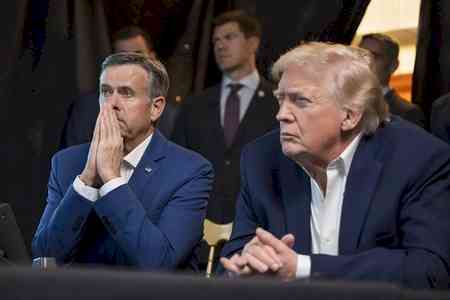
New Delhi, January 12 (IANS) Even as the week began, global media buzzed with the news of US President Donald Trump declaring himself the "Acting President of Venezuela" in a post on his social media site Truth Social.
The post featured, featuring the President’s “Official portrait, 2025”, named him “Acting President of Venezuela Incumbent January 2026” along with the “45th 47th President of the United States” who “Assumed Office January 2025”.
The post, on the platform launched by Trump himself four years ago, has expectedly sparked widespread reactions, ranging from disbelief to sharp criticism. The declaration comes days after the US conducted a raid into Venezuela and captured its President, Nicolas Maduro.
Meanwhile, Delcy Rodriguez, who was the country’s Vice President, took the oath as interim President as per Venezuela’s constitution. She has rejected Washington’s claims of authority, demanding the immediate release of Maduro, as per reports.
Though there is no similar precedent in today’s international politics, there have been some incidents of dual leadership in either informal or sequential arrangements.
Among the incidents of sequential ascension are examples of Prime Ministers of erstwhile British-era Bengal going on to become Prime Ministers or other Ministers in Pakistan after the Partition of India. Among them were Abul Kasem Fazlul Huq (1873-1962), the first and longest-serving Prime Minister of Bengal (1937–1943) during British rule, who became the Chief Minister of East Bengal and then Home Minister of Pakistan. However, he did not become Pakistan’s Prime Minister.
Then, Khawaja Nazimuddin (1894-1964), the second Prime Minister of undivided Bengal, was coincidentally the second Prime Minister of Pakistan as well.
While Huseyn Shaheed Suhrawardy (1892-1963), who was the last Prime Minister of Bengal between 1946 and 1947, served as the fifth Prime Minister of Pakistan from 1956 to 1957, Pakistan's third Prime Minister, Syed Mohammad Ali Chowdhury Bogra, had served as the Health, Finance, and Local Government Minister in Suhrawardy's government in undivided Bengal.
Incidentally, Pakistan's first Prime Minister, Liaquat Ali Khan, was the last Finance Minister of undivided India.
Elsewhere, there are occasions where monarchs have ruled multiple countries, like King George VI, who was simultaneously monarch of the United Kingdom and of several independent Commonwealth realms. There is also an understanding, though not officially imposed, that the British monarch symbolically holds the highest office as the state head of some Commonwealth countries.
However, this was a legitimate constitutional arrangement, not a unilateral declaration.
In other historical instances, some revolutionary figures claimed authority across borders, but rarely with international recognition. Like Simon Bolívar (1783-1830), a leader of the South American independence movement, who served as president of Gran Colombia and also held leadership roles in Peru and Bolivia. However, in the case of President Trump, he has formally not held office in Venezuela, where there already is an interim replacement for the office of the President.
--IANS
jb/vd