The World’s Longest ‘Infinite Sari’ Rises Against Marital Rape
A Four-Kilometre Fabric of Courage, Consent and Justice
 Anil Bedag
Jan 29, 2026 08:22
0
Anil Bedag
Jan 29, 2026 08:22
0
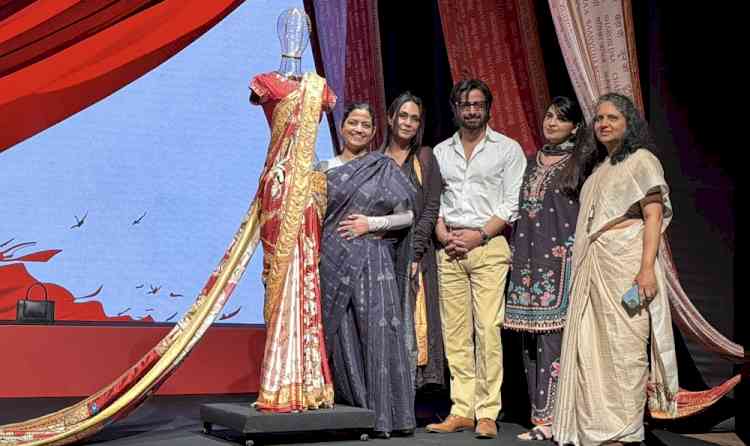
Mumbai (anil bedag): That evening at Mumbai’s Royal Opera House was not merely about unveiling a sari—it was about weaving history, courage and justice into an unending narrative. Stretching over four kilometres, the Infinite Sari not only earned the distinction of being the longest sari ever created, but also emerged as a powerful voice for millions of women whose consent continues to be ignored under the guise of marriage. By transforming one of India’s oldest cultural symbols into an instrument of resistance, the initiative directly challenged a legal system that still hesitates to recognise marital rape as a crime.
Designed by renowned fashion designer Nivedita Saboo, the four-kilometre-long sari is a striking visual petition for justice. Through intricate embroidery, bold colours and meaningful prints, the sari carries hundreds of signatures—each one a demand for dignity and legal reform. Its sheer length is so vast that it could wrap around the base of the Taj Mahal twice, symbolically reflecting how widespread, yet overlooked, the issue of consent within marriage remains.
The Infinite Sari draws inspiration from a nearly 2,000-year-old mythological tale in which a woman is protected by her sari taking on an endless form. Reimagined in a contemporary context, the sari becomes a reminder that even within marriage, a woman’s bodily autonomy and right to say “no” must remain inviolable.
Supreet K. Singh, Co-Founder and CEO of the Red Dot Foundation, said, “Every signature on the Infinite Sari is a thread of courage, and every fold bears witness to a woman’s right to say yes or no by her own will. Consent is not a marital privilege—it is a fundamental human right. There is no room for further delay.”
Designer Nivedita Saboo added, “This sari uses culture to question and reform culture itself. Indian traditions are not obstacles to progress; they can be its foundation. I am proud that this creation has transformed our most symbolic garment into a symbol of justice and equality.”
Data from the National Family Health Survey and recent reports underscore the urgency of this movement. Nearly one in three women in India has experienced physical or sexual violence at the hands of her husband. Yet over 90 percent of survivors neither seek help nor report the abuse—largely because the law continues to deny them full protection.
Survivor-activist Zariya Patni emphasised the power of collective action, stating,
“When survivors, civil society and lawmakers stand together, change becomes not just possible but inevitable. Marital rape can no longer remain hidden behind the institution of marriage.”
Actor and campaign ambassador Rahul Bhatt described the issue as a question of humanity, noting that a home must be the safest place for a woman—regardless of what the law currently allows or overlooks.
Following its unveiling at the Royal Opera House, the Infinite Sari will be showcased at the Kala Ghoda Arts Festival 2026. The exhibition will be held at Elphinstone College from January 31 to February 8, where the sari will stand not merely as an artwork, but as a living, uncompromising question posed to society. The Infinite Sari serves as a powerful reminder: marriage does not nullify consent, and the right to say “no” never expires.