The play "Sandal Baar" brilliantly performed in Punjabi on the second day of ‘Bharangam’
The 25th edition of the world's largest theatre festival, Bharat Rang Mahotsav (Bhararangam), is being organized by the National School of Drama (NSD) at the Dada Lakhmi Chand State University of Performing and Visual Arts (DLC SUPVA), Rohtak.
 Girish Saini
Feb 10, 2026 09:46
0
Girish Saini
Feb 10, 2026 09:46
0
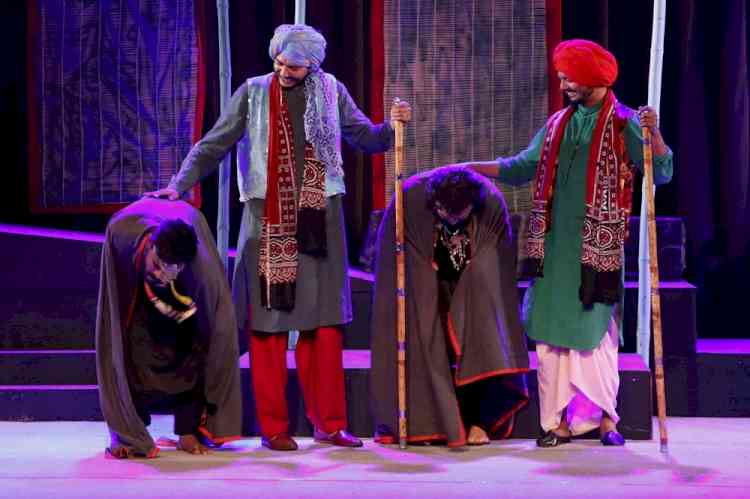
Rohtak, February 10, 2026: The 25th edition of the world's largest theatre festival, Bharat Rang Mahotsav (Bhararangam), is being organized by the National School of Drama (NSD) at the Dada Lakhmi Chand State University of Performing and Visual Arts (DLC SUPVA), Rohtak.
On Tuesday, the second day of this four-day theatre festival witnessed the staging of the play "Sandal Baar," written by Dr. Harjeet Singh and directed by Kewal Dhaliwal. Rohtak Divisional Commissioner Rajiv Ratna, Superintendent of Police Surendra Singh Bhauria, actor Jatin Sarna, Cyber Security expert Amit Dubey, Gulshan Bhatia, Vice Chancellor Dr. Amit Arya, Registrar Dr. Gunjan Malik Manocha, and other dignitaries were present on the occasion.
This play, lasting approximately one hour and 25 minutes, was presented by artists from the Manch Rangmanch group from Amritsar, Punjab. This play, which tells a story buried in the pages of history, highlighted contemporary issues such as identity, belonging, and human values. Performed in Punjabi, the language was never a barrier; the actors' performance and expressions completely overcame the linguistic obstacle.
‘Sandal Baar’ tells the tragic story of those indigenous people whose homes and lands were taken away by the British government to give to its supporters. These people had lived by the rivers for generations, fed themselves, and lived their lives peacefully, but the British government took their land, claiming that they did not have any written proof of ownership.
The play shows that undivided Punjab had a very fertile area between Sandal Forest, the Ravi River, and paddy fields, which was filled with dense forests. Tribal people lived in these forests and raised camels, buffaloes, cows, horses, sheep, and goats. Because they lived in forests, they were called 'wild.' It is said that their ancestors came from the desert and even fought against Alexander's armies. There was no religious fanaticism among these people. For them, gods, saints, prophets, and religious customs were all the same. They lived their lives on this land, given by nature, according to God’s will, but suddenly a storm came that destroyed their centuries-old peaceful lifestyle. These people were separated forever from their forests, rivers, and land.
The play illustrates that the tragedy of the indigenous people of Sandal Bar also provides a glimpse into the plight of minority communities today. When the British government demanded proof of land from people who had lived there for centuries, this story seems relevant not just to the past but also to the present. This play explains how much injustice humans have done to themselves and nature in the name of civilization and industrialization.
The play features Kewal Dhaliwal, Harpreet Singh, Yuvnish Sharma, Gurdit Pal Singh, Nishan Singh, Jaswant Singh, Emmanuel Singh, Kushagra Kalia, Shivam, Akashdeep, Raja, Harshit, Harmeet Singh, Jujhar Singh, Paramveer Singh, Navjeet Kaur, Gurleen Kaur, Akashdeep Singh, Jasveen Kaur, Joy Sharma, and Gurvinder Singh.
Vice Chancellor Dr. Amit Arya announced that on Wednesday, the Department of Performing and Fine Arts of the Central University of Punjab, Bathinda, will stage the play ‘Umar Ka Parwana.’ Based on a folk tale, this play depicts a story of love, grief, and justice. This play is written by Vijaydan Detha and directed by Dr. Adish Kumar Verma.