TCS launches India’s first lights-out factory lab to advance AI-first manufacturing
This futuristic facility, based in Pune, will demonstrate how a manufacturing assembly line can use AI, digital twins, robotics and factory systems to operate and optimise functions
 City Air News
Sep 9, 2026 08:45
0
City Air News
Sep 9, 2026 08:45
0
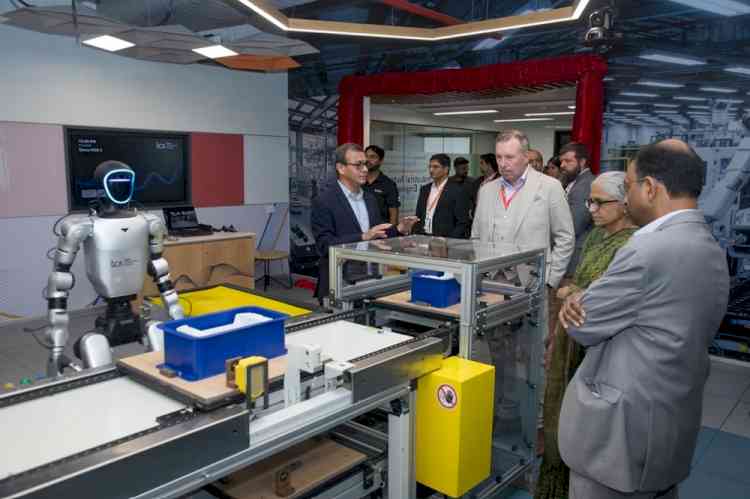
Pune / Mumbai, September 9, 2026: Tata Consultancy Services (TCS), a global leader in IT services, consulting, and business solutions, has launched the TCS Industrial Autonomy & Engineering Lab – Lights-Out Factory, at its Sahyadri Park campus in Pune. As India’s maiden lights-out factory lab, this facility will simulate how self-optimising factories can automate operations using the TCS Human+AI Service Autonomy Model. It brings together technologies such as digital twins, robotics, industrial AI, factory control systems and real-time operational intelligence and seamlessly combines them for live manufacturing environments.
A lights-out factory is a manufacturing unit where autonomous systems can run production with minimal human intervention. The Pune lab houses a fully robotic battery pack assembly line, making it India's first lab to demonstrate the principles of lights-out manufacturing. Simulations on this live set-up which has multiple stages of production will help manufacturers prototype, validate and scale AI-first production systems. The Pune lab addresses a key challenge faced by manufacturers: translating Industry 4.0, AI, and robotics concepts into practical operating models. It gives customers a controlled setting to explore industrial scenarios, assess their suitability for production environments, and reduce deployment risk.
The TCS Industrial Autonomy & Engineering Lab – Lights-Out Factory, is the latest addition to TCS' Industrial Autonomy & Engineering innovation footprint. Earlier this year, TCS launched the TCS Industrial Autonomy & Engineering Lab Powered by NVIDIA in Bengaluru to accelerate Physical AI innovation for industrial and mobility applications.
As part of TCS’ Industrial Autonomy & Engineering capabilities, the facility supports a range of industry use cases including predictive maintenance, automated quality inspection, real-time process optimisation, human-machine collaboration, and autonomous factory operations.
Joakim Landholm, SVP Commercial & Operations Development, SKF, said, “Reducing friction has always been central to industrial progress, and the next wave of manufacturing will depend on smarter, more energy-efficient, and more reliable operations. We see TCS Industrial Autonomy & Engineering Lab – Lights-Out Factory as an important step in helping industry translate advanced automation and industrial AI into measurable operational value.”
Sreenivasa Chakravarti, Global Head & Vice President of Industrial Autonomy and Engineering, TCS, said, “When we think of a manufacturing facility, we picture legacy factories and heavy equipment, that run on intense manual effort. At TCS, we are reimagining those environments and building factories for the future. With our state-of-the-art TCS Industrial Autonomy & Engineering Lab – Lights-Out Factory, we are advancing TCS' vision of engineering AI-first production systems. We have built a facility that can help customers turn their aspiration of lights-out manufacturing into a reality. The lab provides a tangible demonstration of how the Human + AI model can help enterprises progress from digitally enabled operations to increasingly autonomous production systems.”
Today, manufacturers are under increasing pressure to stay agile and improve outcomes, while keeping pace with evolving operational complexities. The new lab addresses this need by enabling customers to move beyond isolated automation initiatives and explore integrated approaches to engineering, manufacturing, and operations.
The Pune facility focuses on a set of interconnected capabilities that span engineering, manufacturing and factory operations, providing a practical environment to explore emerging industrial technologies and operating models. These include:
• Autonomous Factory Concepts: AI-enabled production optimisation, predictive maintenance, quality inspection, and resilient operations.
• Digital Twin and Simulation Environments: Virtual models and test environments to validate factory scenarios before real-world deployment.
• Vision AI, Robotics, and Industrial Automation: Use cases that support machine perception, adaptive workflows, and human-machine collaboration.
• Sensor-to-Cloud Industrial Intelligence: Connecting shop-floor signals with edge and cloud platforms to enable real-time, context-aware decision-making.
• Software-Defined Engineering: Engineering capabilities that help industrial systems evolve continuously through software, data, and AI-driven automation.
The lab is part of TCS’ ongoing work in industrial autonomy, smart manufacturing, engineering transformation, and AI-led enterprise modernisation. With the launch of this facility in Pune, TCS continues to work towards its commitment to build a more intelligent, connected and sustainable tomorrow by enabling manufacturers to reimagine products, plants and operations.