Tanjore paintings: JEEViKA empowers Bihar’s Krishna Devi to combine art with livelihood
Krishna Devi’s story is a testament to women’s empowerment and self-reliance if given the right help and direction. She and her husband Praveen Kumar credit the JEEViKA program for enabling their success in introducing South India's famed Tanjore paintings to Bihar, acknowledging that without its support, their journey would have remained incomplete.
 IANS
Jan 29, 2026 10:39
0
IANS
Jan 29, 2026 10:39
0
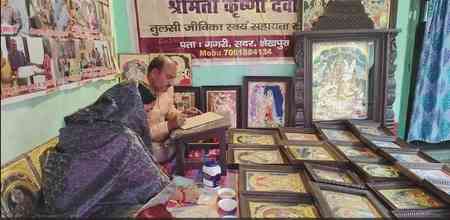
Sheikhpura (Bihar), Jan 29 (IANS) Krishna Devi’s story is a testament to women’s empowerment and self-reliance if given the right help and direction. She and her husband Praveen Kumar credit the JEEViKA program for enabling their success in introducing South India's famed Tanjore paintings to Bihar, acknowledging that without its support, their journey would have remained incomplete.
The Government of Bihar, through the Bihar Rural Livelihoods Promotion Society (BRLPS), an autonomous body under the Department of Rural Development, is spearheading the World Bank-aided Bihar Rural Livelihoods Project (BRLP), locally known as JEEViKA, with the objective of social and economic empowerment of the rural poor.
Subsequently, the Livelihoods Restoration and Enhancement component of Bihar Kosi Flood Recovery Project (BKFRP) was also taken into the fold of JEEViKA.
Krishna Devi, who studied only till 8th-grade at her tiny village of Gunhesa in Sheikhpura, Bihar, has carved a unique identity for herself by mastering the art of making India’s traditional Tanjore paintings.
Despite limited resources, little formal education, and social skepticism, she proved that skill, perseverance, and determination can overcome any obstacle.
Her journey began when Krishna Devi and her husband, Praveen Kumar, moved to Tamil Nadu in search of employment, taking up a job that paid just ₹4,000 per month. Life was difficult, but a chance meeting introduced them to the southern state's famed Tanjore paintings, an intricate art form adorned with 22-carat gold foil.
Praveen Kumar spent nearly ten years mastering its nuances, learning patience, precision, and dedication along the way.
The COVID-19 pandemic in 2020 disrupted their lives, forcing the family to return to Bihar. With no stable income, Krishna Devi turned to JEEViKA, taking a loan to start creating Tanjore paintings in her village — a craft that was virtually unknown there. She faced skepticism from locals, who questioned how art could sustain her family.
Despite these challenges, Krishna Devi and her husband persevered. Sourcing raw materials often required trips back to Tamil Nadu, but their commitment never wavered. Gradually, their work gained recognition through government fairs and exhibitions, including events in Patna, Bhubaneswar, Indore, Gurugram, and Haryana.
Today, Krishna Devi’s paintings are admired across India, with two works alone selling for ₹3.30 lakh. Large Tanjore paintings take 5–6 months to complete, while smaller pieces can be completed in about 15 days.
Beyond their aesthetic appeal, these artworks are deeply spiritual, often depicting gods like Krishna, Ram, Vishnu, Lakshmi, and Shiva, crafted with raised figures on wooden boards and vibrant colours of red, green, blue, and gold.
--IANS
sn/rad