Successful Conclusion of 4-Day Online Workshop on Applications of Artificial Intelligence in the Printing Industry (AAIPI)
The Department of Printing Technology, Regional Institute of Printing Technology, successfully concluded its four day online workshop on Applications of Artificial Intelligence in the Printing Industry, which was conducted over two weekends (11th, 12th, 18th and 19th April 2026) and brought together academic experts, industry professionals, researchers, and participants interested in the emerging role of intelligent technologies in printing and production.
 City Air News
Apr 19, 2026 07:16
0
City Air News
Apr 19, 2026 07:16
0
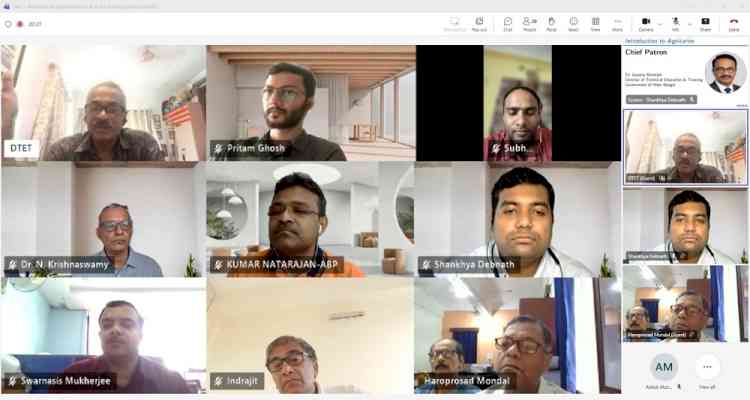
The Department of Printing Technology, Regional Institute of Printing Technology, successfully concluded its four day online workshop on Applications of Artificial Intelligence in the Printing Industry, which was conducted over two weekends (11th, 12th, 18th and 19th April 2026) and brought together academic experts, industry professionals, researchers, and participants interested in the emerging role of intelligent technologies in printing and production. The workshop served as a timely academic and professional platform for understanding how artificial intelligence is transforming print workflows, quality control, automation, analytics, and decision making across the industry.
The workshop was inaugurated by Jayanta Banerjee, Director of Technical Education and Training, Government of West Bengal, with the patronage of Haroprosad Mondal, Principal in Charge, Regional Institute of Printing Technology. Their support and encouragement set the tone for a meaningful and forward looking programme dedicated to technological advancement and skill development in the printing sector. The workshop was coordinated by Shankhya Debnath, Head of the Department and Lecturer, Department of Printing Technology, Regional Institute of Printing Technology. The event reflected the institute’s continuing commitment to bridging academic learning with industrial innovation and preparing learners and professionals for the evolving future of print technology.
The first two days of the workshop were highly enriching and intellectually engaging, offering participants strong foundational and applied perspectives on artificial intelligence in print production. On Day 1, Pritam Ghosh of the Regional Institute of Printing Technology delivered an excellent introduction to the fundamentals of machine learning, supported by hands on learning components that helped participants connect theoretical principles with practical understanding. This was followed with a session by Manu Choudhury of CDC Printers, who demonstrated the capabilities of modern AI tools in process automation within print production facilities and highlighted their growing relevance in real industrial settings. Day 2 included session by Prof Dr Arpitam Chatterjee of Jadavpur University, who presented an insightful discussion on the role of computational intelligence in modern digital halftoning and its future possibilities, opening new avenues of thought for participants interested in research and innovation.
The final two days of the workshop further deepened this engagement through a rich blend of academic insight and industrial application. On Day 3, Avijit Kar, Senior Research Fellow, Department of Printing Engineering, Jadavpur University, shared his research on predictive maintenance in print production facilities and provided participants with a valuable perspective on data driven maintenance strategies in industrial environments. Parmeshwar Patidar of Indus Analytics took the discussion forward and demonstrated the application of intelligent MIS systems for print facilities and illustrated how analytics based tools can improve operational efficiency and management practices. On the final day, Indukalpa Saikia and Mohamed Ameenurrahaman of Heidelberg India discussed and demonstrated the Prinect workflow automation system, offering participants direct insight into advanced workflow integration and automation practices used in the industry. This was followed by Das Damodaran of Farb Technologies, who delivered an engaging session on the scope of intelligent systems in different areas of print workflow and helped participants appreciate the broader potential of AI enabled solutions across the printing value chain.
Across all four days, the workshop created an active and stimulating learning environment marked by thoughtful interaction, enthusiastic participation, and strong academic interest. Participants benefited from exposure to emerging ideas, advanced tools, and practical case oriented discussions that broadened their technical understanding and encouraged critical engagement with the future of print technology. The sessions successfully connected theory, research, and industry practice, making the programme highly relevant for learners, professionals, and institutions seeking to keep pace with technological change.
Feedback received from participants was reflected the strong impact of the workshop. Many described the programme as informative, well structured, and highly relevant to current industry needs. Participants appreciated the opportunity to learn about important topics such as AI in print quality prediction, automated colour correction, workflow automation, intelligent management systems, and predictive maintenance. The workshop was widely seen as a valuable learning experience that enriched professional knowledge and offered meaningful exposure to new technologies and contemporary industrial practices. The enthusiastic response also reflected a clear interest among participants in continuing to engage with similar industry oriented training initiatives in the future.
The successful completion of this workshop marks an important academic and professional milestone for the Department of Printing Technology, Regional Institute of Printing Technology. By bringing together leading voices from academia and industry, the programme fostered awareness, skill development, and thoughtful dialogue on the growing role of artificial intelligence in the printing industry. The institute expressed its sincere gratitude to all distinguished speakers for their generous contributions and to all participants for their active involvement, which collectively made the workshop a highly rewarding and memorable success.