Special lecture titled “Pakistan and Emerging Geo-Political Situations”
The Department of Defence and National Security Studies, Panjab University, organised a special lecture titled “Pakistan and Emerging Geo-Political Situations”, delivered by R.K. Kaushik, IAS.
 City Air News
Mar 19, 2026 09:31
0
City Air News
Mar 19, 2026 09:31
0
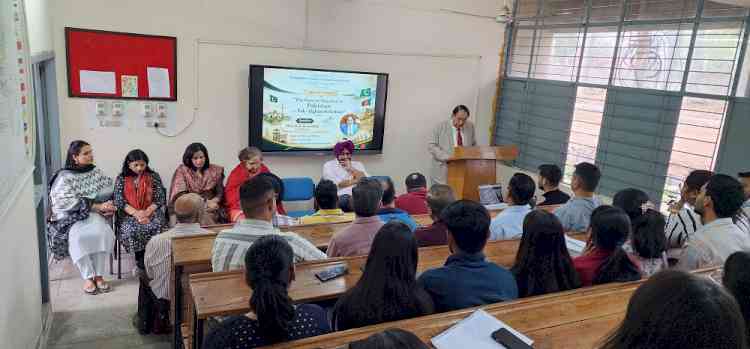
Chandigarh, March 19, 2026: The Department of Defence and National Security Studies, Panjab University, organised a special lecture titled “Pakistan and Emerging Geo-Political Situations”, delivered by R.K. Kaushik, IAS.
Prof. Jaskaran Singh Waraich, Chairperson of the Department, welcomed the distinguished speaker, faculty, research scholars, and student officers, while setting the stage for an insightful discussion on the systemic failure of the Pakistani state.
R.K. Kaushik began his discourse by tracing the historical roots of political instability in Pakistan, noting that the country saw seven Prime Ministers and four Presidents within its first eleven years. He identified February 1951 as a turning point, when rapid promotions saw Ayub Khan rise from Colonel to Commander-in-Chief, eventually leading to the first decade of military rule in 1958. This established a recurring pattern of military intervention that defined the tenures of Yahya Khan, Zia-ul-Haq, and Pervez Musharraf.
A significant portion of the lecture focused on the rise and fall of Imran Khan and his complex relationship with Pakistan’s establishment. He specifically pointed to the events of 2019 as a catalyst for current tensions, citing a personal rift between Imran Khan and then ISI Chief (now Army Chief), General Asim Munir. He argued that the current judicial and political crackdown in Pakistan, including the 26th and 27th Amendments, has effectively muzzled the judiciary and isolated the PTI leadership.
Turning to regional dynamics, Kaushik highlighted the deteriorating relations between Pakistan and Taliban-led Afghanistan. Despite Pakistan’s initial celebration of the Taliban’s 2021 victory, the relationship has soured over border disputes and the mass deportation of Afghan refugees. He noted a surprising geopolitical shift, wherein the Taliban has increasingly sought engagement with India, Russia, and China, leaving Pakistan strategically squeezed.
The speaker concluded with a sobering assessment of Pakistan’s international commitments, mentioning reported promises made by the Pakistani leadership to the United States regarding the recognition of Israel and the use of airbases. He warned of a doomsday scenario in the Middle East, noting that the ongoing conflict involving Iran could have unpredictable consequences for Pakistan’s nuclear posture. He assessed the current situation in Pakistan as one without a clear resolution, adding that turbulent times lie ahead for the country.
The lecture concluded with an engaging question-and-answer session. It was attended by faculty, research scholars, students, and student officers of the department.