Sanitation Is a ‘Super Vaccine’: experts call for Investment, Innovation and Behavioural Change
Emphasising that sanitation is fundamental to public health, disease prevention and sustainable development, the newly formed Rotary Club of One Hyderabad organised a panel discussion titled “Sanitation: A Super Vaccine” on the eve of its Charter Presentation Ceremony.
 City Air News
Oct 17, 2026 09:14
0
City Air News
Oct 17, 2026 09:14
0
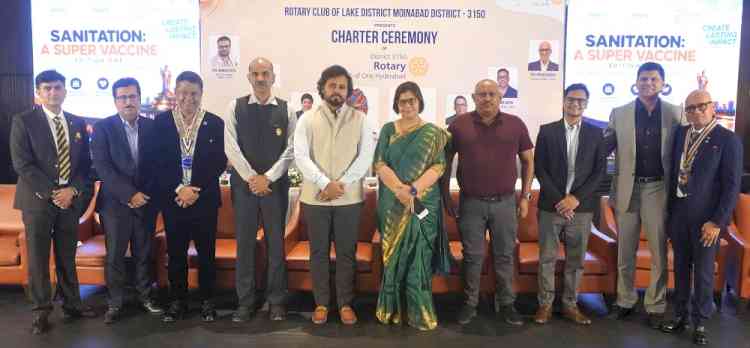
Hyderabad, October 17, 2026: Emphasising that sanitation is fundamental to public health, disease prevention and sustainable development, the newly formed Rotary Club of One Hyderabad organised a panel discussion titled “Sanitation: A Super Vaccine” on the eve of its Charter Presentation Ceremony. The discussion brought together senior government officials, development-sector representatives and industry leaders to explore how improved sanitation systems, behavioural change and technological innovation can transform public health outcomes, particularly in rapidly urbanising communities.
Held at The Leela, Banjara Hills, Hyderabad, the discussion was moderated by Prof. V. Srinivas Chary, former Director of the Administrative Staff College of India (ASCI) and Advisor to T-Works, Dasra and the Gates Foundation, along with Abhishek Nath, Founder of LooCafe and ReFlow.
In his opening remarks, Prof. V. Srinivas Chary recalled his recent visit to Japan, where he observed that sanitation receives priority even before major infrastructure projects such as highways, roads and bullet train networks.
“In India, we often tend to reverse these priorities. We need to revisit our development priorities and recognise sanitation as an essential foundation for a healthy society,” he said.
Dr. T. K. Sridevi, Secretary, Municipal Administration Department, and Commissioner and Director of Municipal Administration (CDMA), Government of Telangana, observed that while everyone appreciates cleanliness, there is often a lack of clarity about who is responsible for ensuring it. This ambiguity, she said, frequently pushes sanitation into the background.
Recalling Mahatma Gandhi’s emphasis on sanitation during the freedom struggle as a means of mobilising people and uniting the nation, she noted that economic growth and wealth creation had often taken precedence over sanitation in the post-Independence period.
However, she pointed out that public behaviour has gradually changed, with open urination and defecation declining. She called for a further shift in attitudes, particularly away from the “flush and forget” approach.
“Sanitation requires greater investment and sustained behavioural change. Rotary can play an important role in creating awareness and encouraging people to adopt responsible sanitation practices,” she said.
Dr. Zelalem Birhanu Tafesse, Chief of Field Office, UNICEF India, described sanitation as a “super vaccine”, explaining that just as vaccines prevent diseases, effective sanitation and handwashing practices can prevent illness and protect communities.
He highlighted Rotary’s pivotal role in the global fight against polio and emphasised the historic collaboration between UNICEF and Rotary. He noted that the partnership went beyond financial contributions, with Rotary providing critical volunteer support to advance public health initiatives.
In Uttar Pradesh and Bihar alone, he said, Rotary facilitated the services of more than 7,000 volunteers, demonstrating the power of community mobilisation in achieving large-scale public health outcomes.
Vivek Pandey, WASH Professional and Consultant to the Gates Foundation, highlighted the close relationship between sanitation, public health and societal well-being. He observed that sanitation technologies have remained largely unchanged in many cities for more than 160 years, underscoring the need for innovation and a fundamental rethink of conventional wastewater management.
He drew attention to the disproportionate use of water in conventional sanitation systems, pointing out the inefficiency of transporting small quantities of human waste over long distances using large volumes of water that may themselves have been transported from distant sources.
He advocated treating wastewater as close as possible to where it is generated and reusing the treated water for purposes such as toilet flushing. Such decentralised and circular sanitation systems, he said, could significantly reduce freshwater consumption and the burden on conventional sewerage infrastructure.
Citing the ReFlow Model toilet installed at Lumbini Park, Hyderabad, he highlighted an innovative approach to public sanitation in which wastewater is treated on-site and recovered water is reused. The system is designed to reduce freshwater requirements and dependence on conventional sewage connections by treating waste as a resource that can be recovered and reused rather than simply discarded.
Rohit Chandragiri, FCDO, British Deputy High Commission, highlighted the far-reaching contribution of sanitation to the United Nations Sustainable Development Goals (SDGs).
“The 17 SDGs encompass 169 targets, and sanitation has a direct or indirect impact on 130 of them. That is the power of investing in sanitation,” he observed.
He emphasised that sanitation extends far beyond toilets, influencing public health, access to clean water, gender equality, education, environmental protection, human dignity and sustainable development.
“Invest in sanitation. Transform lives,” he said, underlining the need to recognise sanitation as a strategic investment in the well-being of present and future generations.
Girish Mallpani, Chairman and Managing Director of MPM Group, highlighted the importance of effective Effluent Treatment Plants (ETPs) and wastewater management systems in residential communities, calling for greater awareness among Resident Welfare Associations (RWAs).
He observed that modern residential projects increasingly offer luxurious amenities, some of which, including high-water-consumption showers, can significantly increase water demand. Responsible wastewater management, he stressed, must therefore become an integral part of sustainable residential development.
He urged RWAs to ensure that wastewater treatment systems are adequate, functional and properly maintained, with sewage and wastewater treated before discharge or reuse in accordance with applicable standards.
“Whenever you buy a villa or a luxury apartment, do not ask only about amenities and luxuries. Ask the builder: What is your wastewater treatment plan? Is the treatment plant adequate, functional and properly maintained?” he suggested.
He emphasised that informed homebuyers and responsible residential communities could encourage sustainable construction practices, conserve water and protect the environment.
Col. M. Chandan Kumar, Head of Engineering at T-Works, spoke about emerging sanitation technologies, their applications and availability. He stressed the need to develop affordable, practical and scalable solutions that can be adopted widely across communities.
He highlighted the importance of bridging the gap between technological innovation and ground-level implementation to ensure that effective sanitation solutions are accessible to all, rather than remaining limited to high-cost or specialised projects.
District Governor Uday Pilani, Rotary District 3150, emphasised Rotary’s commitment to community service and its ability to mobilise collective action to address pressing societal challenges.
He observed that sanitation is not merely an infrastructure issue but a public health priority requiring sustained investment, public awareness and behavioural change. He highlighted Rotary’s potential to bring together government agencies, industry, civil society and communities to promote innovative sanitation solutions and build healthier, cleaner and more sustainable communities.
The panel discussion underscored the need to move beyond conventional approaches to sanitation and embrace a comprehensive strategy combining infrastructure, technology, wastewater recycling, behavioural change and institutional collaboration.
The discussion also highlighted the importance of treating sanitation as an investment in public health, environmental sustainability and human dignity, with coordinated action from governments, businesses, community organisations and citizens essential to achieving lasting change.