Rohit, Kohli should keep playing if they're enjoying it: Syed Kirmani
Few voices carry the weight of perspective like Syed Kirmani’s. A 1983 World Cup winner from an era when Indian cricket was still carving its identity, the former wicketkeeper has witnessed the game’s evolution, from instinct-driven leadership to data-backed decision-making, from conservative batting to fearless intent.
 IANS
Jan 5, 2026 03:12
0
IANS
Jan 5, 2026 03:12
0
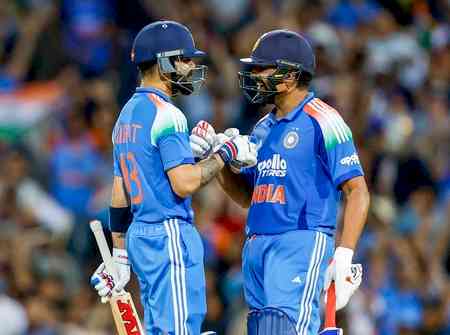
New Delhi, Jan 5 (IANS) Few voices carry the weight of perspective like Syed Kirmani’s. A 1983 World Cup winner from an era when Indian cricket was still carving its identity, the former wicketkeeper has witnessed the game’s evolution, from instinct-driven leadership to data-backed decision-making, from conservative batting to fearless intent.
As a relatively young Indian team prepares to defend the T20 World Cup title, Kirmani reflected on the squad’s balance, the pressure points of knockout cricket, debatable selection decisions, and the enduring value of senior players like Rohit Sharma and Virat Kohli.
Speaking exclusively to IANS, Kirmani offered both reassurance and reflection on where Indian cricket stands today.
Excerpts:
IANS: Both Rohit and Kohli have been in great form in ODIs. They also performed brilliantly in the Vijay Hazare Trophy, scoring centuries for their respective teams. While that surely is a boost for them, do they need to keep participating in domestic game?
SK: Yes, they should keep playing if they're enjoying cricket. Critics will always criticise, and they want new blood in the game. Everyone desires fresh players, so there's no reason for concern. Let them decide for themselves. Their experience is a valuable support to the team, and seasoned players are always needed. We should not discourage them.
Leave the decision of when to retire to them. Domestic cricket also helps young players aiming for the national team. Experienced domestic players, whether in Vijay Hazare or other tournaments, can guide these aspiring cricketers.
As long as they are contributing, let them be. Cricket is played extensively through various tournaments. It's up to the players how they conduct themselves and maintain their fitness. They should focus on competitions where they can excel and get selected. They should also decide when to take rest.
IANS: For major tournaments like the World Cup, key players can be chosen based on their form and fitness. Ultimately, their consistency and performance are crucial.
SK: The ODI WC is over a year away and the duo play only ODIs and IPL, majorly. What would be your suggestion to them as they prepare for the World Cup with limited game time in their hand. Also, how important it is for senior players like them to continue featuring in ODIs- not just for performance, but for guiding the next generation?
SK: Let them play as long as they want, whether in domestic cricket or other one-day formats. They've already announced their retirement from Test cricket. So, they are primarily interested in ODIs, but they should be allowed to play as much as they can. They are iconic players with impressive records. You can't just overlook them. As I said, leave the decision to them—let them decide when to retire.
IANS: Both Rohit Sharma and Virat Kohli have delivered iconic performances in ODI World Cups. How do you think their World Cup contributions shape their overall legacy in Indian cricket?
SK: They have set a great example for young players to follow. With impressive records behind them, they serve as a source of inspiration and motivation for aspiring cricketers while they are active. Young players should study how capable they are and the records they have set. Instead of merely wishing to be like players A, B, C, or D, they should aim to be better than them. That should be their primary focus and guiding principle.
IANS: As someone who has seen Indian cricket evolve across generations, how do you assess the balance and mindset of India’s current T20 World Cup squad? Do you see it as a squad capable of defending the title?
SK: Indeed, there is no doubt that cricket has undergone significant changes from our era to the current one. The game’s system and players’ mindsets have evolved considerably. There has been more aggression both on and off the field, and technology has played a much larger role than it did during our time. Back then, there were no coaches or support staff. We did win the World Cup, after all, so change is necessary.
New concepts, innovations, and systems are essential for progress. Regarding that, I believe the current T20 team selected for the World Cup is very well balanced. The captain often gets the spotlight when the team wins, but it’s truly a team effort. Recognition goes to the captain, the coach, and the entire squad, as all contribute to the success. It’s the collective effort that influences the overall result.
Team has a strong batting order and three or four all-rounders. In limited-overs cricket, having more all-rounders is crucial, since any of them could be the key to success. So, it's a very balanced squad, and a remarkable effort by the Indian team.
Regarding players who haven't been selected, there's an incredible pool of talent in our country, so much so that we could form four Indian teams, if you ask me. Everyone is competing for a spot, and if you don't perform in a couple of innings, someone else gets the chance. This fierce competition within our country is a positive sign.
There's no doubt- you need an immediate replacement, whether it's an all-rounder, a bowler, a spinner, a batsman, or a captain, you have them. Currently, there are two or three captains in the team alongside Surya Kumar Yadav. I commend the selection committee for their efforts because they faced tough competition in choosing players. They've done an excellent job in selecting the teams for the World Cup and the series against New Zealand.
IANS: What, in your view, is the biggest strength of this Indian T20 side and what is the one area that could potentially hurt them in high-pressure knockout matches?
SK: It's crucial to understand your own capabilities and strengths to lead the team through a crisis. Knowing how to fight and lift the team during challenging times is very important. You should select a player, preferably at number 7 or 8, who can handle pressure and help the team escape trouble. Identifying such a player is now essential.
I find it difficult to talk about myself, but I started as a stroke player. As I improved to a higher level of the game, I was often sent in during times of crisis, and I was able to handle that pressure. It's important for a team to have one or two such players, and I believe they are present. Right, they are.
Many players are capable of withstanding pressure, but our main strength lies in our batting. Our batting is effectively supported by our spinners and medium pacers. They perform well at various points in the game, and then our spinners step in, which is crucial. This balance makes our team very strong and well-rounded.
IANS: Many say that India are too conservative in ICC tournaments. Does this squad reflect a more fearless T20 approach, now that we have moved towards the younger generation, or are we still cautious by nature?
SK: Criticism will always exist, even if we're performing well, as it cannot be controlled. However, we are not conservative; we are much ahead and moving with the wind. Based on this, we are doing a great job. We've overcome crises several times. As I mentioned, the team was in bad shape but recovered after losing the first two games and levelling the series. These are the thrilling uncertainties that make cricket such a great game. So yes, the squad does reflect a fearless approach.
IANS: There were a lot of talks around the management not considering Shubman Gill for the World Cup. With him being the captain of the ODI and Test teams, and also being the vice-captain of the T20I side in the recent South Africa home series, is this the right call?
SK: Shubman Gill has been in poor form recently. Despite his past achievements- such as his outstanding performance in England 2024-25, where he set records as both a captain and an opening batsman- he was overlooked due to his slump. It's important to recognise that everyone, even the greatest players, faces good and bad times. Bad form is a regular part of every athlete's journey, regardless of their consistency or greatness.
You can't ignore when he's in poor form. So, that was a bit disappointing, for sure. There might be personal reasons behind Shubman Gill’s unavailability, which he could have communicated. However, there should be clarity when a player is not selected or is dropped. There's a difference between not being chosen and being dropped, and reasons—such as personal issues—should be shared, similar to how foreign players or the selection committee communicate.
Considering such great form, suddenly dropping into poor form requires resilience. You must withstand and overlook these fluctuations without sidelining a player who performed well in earlier matches.
Correct? His excellent form, outstanding innings, especially the iconic one in England against England, shouldn't be ignored. You see, as poor form occurs, that doesn't necessarily mean removing the player from the team. So, if he was dropped because of his form, don’t think it was the right call.
IANS: Rishabh Pant was also not considered for the T20 World Cup and he’s been a bit on and off in the international setup now. He played in the Vijay Hazare Trophy and is now named in the ODI squad. Do you think this is the player’s approach or a tactical strategy by the selectors?
SK: He has got a lot of age behind him, and he is a talent in abundance. There is no two ways about it. So he cannot be overlooked. But at the same time, there is so much competition for him. There are four or five wicket-keepers. You cannot overlook their performance either. And off and on, he has not been very consistent in meeting the team's requirements. So that doesn't mean that he should be sidelined totally. As and when he is in good form, he can be brought in at any time.
--IANS
vi/bc