Rahul Gandhi claims India-US deal will 'destroy' textile sector, BJP MP dares him to debate
Lok Sabha Leader of Opposition Rahul Gandhi on Saturday launched a sharp attack on the Centre over the trade agreement with the United States, alleging that the deal would "destroy" India's textile industry as well as its cotton farmers.
 IANS
Feb 14, 2026 09:39
0
IANS
Feb 14, 2026 09:39
0
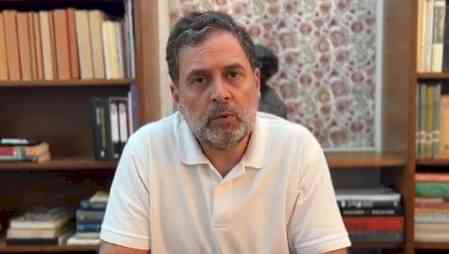
New Delhi, Feb 14 (IANS) Lok Sabha Leader of Opposition Rahul Gandhi on Saturday launched a sharp attack on the Centre over the trade agreement with the United States, alleging that the deal would "destroy" India's textile industry as well as its cotton farmers.
In a video message shared on X, Gandhi claimed that millions of livelihoods are at stake. "India's textile sector employs 50 million families. Narendra Modi's US deal has destroyed India's textile sector. Narendra Modi knows this, the whole of India knows this," he said.
The Congress leader argued that the tariff structure under the agreement placed India at a disadvantage compared to Bangladesh.
"I explained in the Parliament House that Bangladesh gets a free pass, 0 per cent tax, and India gets 18 per cent tax. The result of this will be that Bangladesh's textile industry will destroy India's textile industry," he said.
Gandhi further referred to remarks made by a Union Minister suggesting that importing US cotton could bring comparable benefits.
Rejecting that argument, he said, "One of Narendra Modi's ministers said that if we also import US cotton, we will also get the same benefits. But the truth is that our cotton goes to Bangladesh. Our cotton runs India's textile mills. So if we choose the Bangladesh route, our entire cotton farmers and the cotton industry will be destroyed. And if we don't choose, our textile industry will be destroyed. That's the truth. Piyush Goyal shouldn't lie. That's why I call it surrender, because this deal will either kill the cotton farmer, kill the textile industry, or destroy both."
He also alleged that the government had failed to anticipate potential shifts in Bangladesh's sourcing strategy. "And now, their Minister does not even know that Bangladesh will stop cotton imports from India and start buying it from the US. This is Narendra Modi's US deal," Gandhi added.
Describing cotton cultivation and textile manufacturing as the "backbone of livelihoods" in the country, Gandhi said weakening these sectors would have far-reaching consequences. "Damaging these sectors means pushing millions of families into unemployment and economic crisis," he asserted.
He contrasted the current agreement with what he described as a more responsible approach. "A visionary and nationally minded government would have struck a deal that would protect the interests and ensure prosperity for both cotton farmers and textile exporters. But in sharp contrast, Narendra 'Surrender' Modi and his ministers have struck a deal that could prove to be deeply damaging to both sectors," he said.
Gandhi's remarks drew a swift response from BJP MP Nishikant Dubey, who accused the Congress leader of spreading misinformation and challenged him to a public debate on the issue.
Dubey questioned what he termed the "actual need and scale" of US cotton imports for India's textile industry, India's domestic cotton production in comparison with imports, the prevailing condition of Indian cotton farmers and textile mills, and alleged links between Gandhi's narrative and "naxalite movements" supported by external figures such as George Soros.
"Cotton farming, how much is needed for textiles, and how much production. Condition of textile mills and Rahul Gandhi's Naxalite movement with Soros. What a big lie I challenge you to debate on any forum," Dubey posted on X, directly addressing the Leader of Opposition.
The challenge comes amid heightened political tensions, including Dubey's recent substantive motion in Lok Sabha seeking Rahul Gandhi's disqualification over broader allegations of unethical conduct and anti-national links. Dubey referenced the 1978 precedent where a similar motion led to Indira Gandhi's expulsion from Parliament.
--IANS
sd/skp