PlastIndia International University to build future-ready talent for India’s Plastics Industry: Dr. Raju Desai
Education, research and industry collaboration will be critical to making India a global plastics and sustainability hub, says PlastIndia Foundation President
 City Air News
Aug 9, 2026 08:09
0
City Air News
Aug 9, 2026 08:09
0
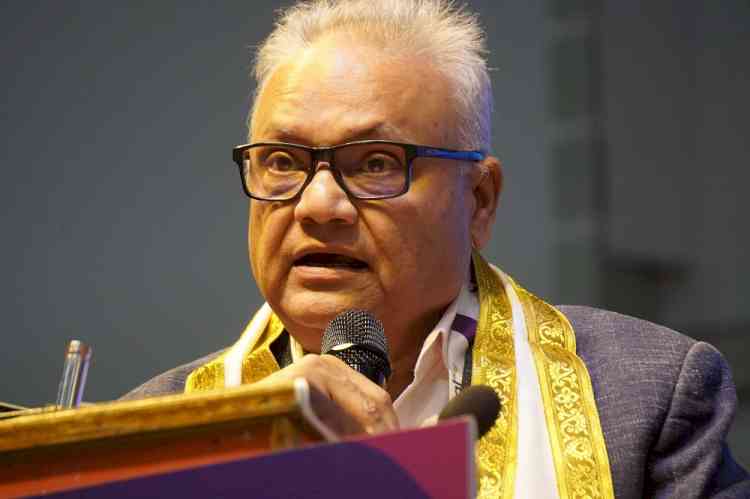
Hyderabad, August 9, 2026: India’s plastics industry needs a strong talent and knowledge ecosystem to sustain its rapid growth and emerge as a global manufacturing and innovation hub, said Dr. Raju Desai, President, PlastIndia Foundation, speaking at the inauguration of HIPLEX 2026 in Hyderabad in the presence of Telangana Minister for IT and Industries D. Sridhar Babu.
Dr. Desai highlighted the role of PlastIndia International University (PIU), promoted by the PlastIndia Foundation, in developing the next generation of professionals, technologists, researchers and entrepreneurs for the plastics and polymer industry.
PlastIndia International University represents a unique global model of an industry-led university dedicated to building specialised talent for the plastics and sustainability sector. PlastIndia International University is the world’s first university established by a plastics industry body with a dedicated mandate to create specialised professionals for the plastics sector, Dr Raju Desari speaking on the sidelines of the Hiplext 2026.
PlastIndia Foundation has invested in PlastIndia International University (PIU), in joint venture with University of Massachusetts Lowell (UMass Lowell), USA which is among the first institutions for plastics processing anywhere in the world, Dr. Raju Desai declared while addressing the at Hiplex 2026
“The future of the plastics industry will not be shaped by machines and technology alone. It will be shaped by people who have the knowledge, skills and vision to use technology responsibly and sustainably. PlastIndia International University is our commitment to building that talent and knowledge ecosystem for the future of the industry,” Dr. Desai said.
He said the plastics industry was undergoing a fundamental transformation, driven by advanced materials, automation, Industry 4.0, recycling, circular economy, sustainable materials and new applications across healthcare, agriculture, packaging, infrastructure and other sectors.
“We need to move from an industry that primarily produces plastics to an industry that creates solutions through plastics. This requires continuous investment in education, research, innovation and sustainability,” he said.
PlastIndia International University, located at Vapi in Gujarat, has been established with the vision of creating a specialised academic and research ecosystem for plastics and sustainability. The university offers B.Tech. in Plastics and Polymer Engineering and B.Tech. in Computer Science & Engineering, besides specialised programmes for working professionals.
The university's research focus includes plastic recycling, biodegradable and compostable polymers, polymeric biomaterials, sustainable polymeric materials from renewable sources, plastics processing, polymer synthesis and polymer composites and nanocomposites.
PIU also emphasises industry interaction, applied learning, research and international collaboration. The university has entered into a long-term technical engagement with the University of Massachusetts Lowell, USA, aimed at supporting the development of world-class engineering programmes.
Dr. Desai said that India's ambition to become a global manufacturing destination would require a corresponding expansion of specialised technical manpower.
“As the Indian plastics industry moves towards higher-value products, advanced manufacturing and sustainable solutions, the demand will not merely be for more manpower. The industry will need specialised knowledge, multidisciplinary skills and research capabilities. That is where institutions like PlastIndia International University can make a transformational contribution,” he said.
He also emphasised the need for closer collaboration between universities, industry and government.
“The classroom, laboratory and factory can no longer function as separate worlds. The problems of industry must become subjects of research, and research must find its way into industry. Government, academia and industry must work together to create this ecosystem,” Dr. Desai said.
Dr. Desai said the industry's future would depend on its ability to demonstrate that plastics can be part of sustainable solutions.
“The debate should not be about plastics versus sustainability. The challenge is to make plastics sustainable. That requires science, technology, responsible design, recycling, innovation and a new generation of professionals who understand the entire lifecycle of a product,” he said.