PHDCCI Organizes Hydrocarbons Summit on Strengthening India’s Energy Resilience
The PHD Chamber of Commerce and Industry (PHDCCI) successfully organised the Hydrocarbons Summit on “India’s Energy Resilience: Integrating Upstream Strength with Downstream Excellence for Sustainable Growth” at PHD House, New Delhi. The Summit provided a focused platform for policymakers, industry leaders, and experts to deliberate on strengthening India’s hydrocarbon ecosystem through integrated upstream, downstream, and clean energy pathways amid evolving global and domestic energy dynamics.
 City Air News
Feb 7, 2026 11:37
0
City Air News
Feb 7, 2026 11:37
0
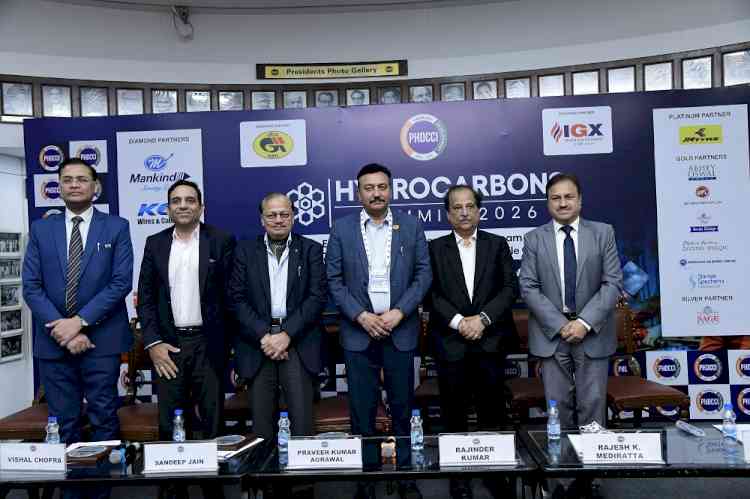
New Delhi, February 7, 2026: The PHD Chamber of Commerce and Industry (PHDCCI) successfully organised the Hydrocarbons Summit on “India’s Energy Resilience: Integrating Upstream Strength with Downstream Excellence for Sustainable Growth” at PHD House, New Delhi. The Summit provided a focused platform for policymakers, industry leaders, and experts to deliberate on strengthening India’s hydrocarbon ecosystem through integrated upstream, downstream, and clean energy pathways amid evolving global and domestic energy dynamics.
Addressing the Summit, Vinod Seshan, Joint Secretary (Exploration), Ministry of Petroleum and Natural Gas, Government of India highlighted the Government renewed focus on upstream exploration and incentivisation reforms. Referring to the Samudra Manthan initiative announced by the Hon’ble Prime Minister, he emphasized the Government’s commitment to unlocking deep-water hydrocarbon potential and translating policy intent into tangible outcomes through enhanced industry participation, manufacturing, drilling activities, and collaboration with industry bodies such as PHDCCI.
Sharing the industry perspective, Sandeep Jain, Former Executive Director (Gas), Indian Oil Corporation Ltd., underscored India’s rapid economic growth trajectory and the need for a resilient energy system to support the nation’s aspiration of becoming a USD 30 trillion economy by 2047. He highlighted that resilience in India’s energy system has been built on strong public sector institutions, diversified sourcing strategies, and consistent policy alignment. He elaborated on the core pillars of energy security availability, accessibility, and affordability while emphasizing the growing importance of sustainability. He further noted that India’s robust downstream infrastructure, including refineries, pipelines, and LNG facilities, has significantly strengthened supply-chain resilience despite high import dependence.
Dr. Jatinder Singh, Deputy Secretary General, PHDCCI, highlighted the transformation underway in India’s energy basket alongside the country’s accelerated clean energy transition. He emphasized that recent strategic international partnerships and trade agreements are reshaping India’s energy and trade landscape by strengthening supply-chain diversification, enhancing technology exchange, and enabling new transition pathways aligned with global carbon benchmarks.
Speaking on market development and downstream integration, Rajesh K. Mediratta, Managing Director & CEO, Indian Gas Exchange (IGX), emphasized the need to complement physical infrastructure with efficient market mechanisms. He highlighted that transparent and competitive gas markets are essential for optimal price discovery and consumer benefit, while stressing the need for regulatory reforms, rationalised taxation structures, and improved tariff mechanisms to facilitate wider gas adoption across the country.
Vishal Chopra, Chief Policy & Regulatory Officer, Cairn India, highlighted India’s rapidly growing energy demand and the critical interdependence between upstream production and downstream operations. He emphasized that while India remains import-dependent, strong policy support, technological advancements, and ease-of-doing-business reforms are encouraging greater upstream participation. He underscored the importance of strengthening refining capacity, accelerating deep-water exploration, and enhancing domestic production to meet the country’s projected hydrocarbon demand.
Praveer Kumar, Executive Director, GAIL (India) Limited & Chairman, CGUL, highlighted the role of hydrogen and biogas in achieving a low-emission energy future. He emphasized the potential of biogas blending with natural gas to reduce emissions and improve environmental outcomes, while underscoring the need for policy incentives and rationalized taxation to support wider adoption of alternative fuels.
The technical sessions deliberated on geopolitical challenges, downstream resilience, public sector leadership in City Gas Distribution, LNG and pipeline infrastructure, energy transition initiatives, and Total Quality Management practices for MSMEs within the oil and gas ecosystem.
The technical sessions speakers included Kumar Biswas, Former Joint Director, Petroleum Planning and Analysis Cell (PPAC), Ministry of Petroleum & Natural Gas; M. K. Biswas, Executive Director (Risk Management & TQM), GAIL (India) Limited; Anandh Mathew, Co-founder, Caliche; Vishal Chopra, Chief Policy & Regulatory Officer, Cairn India; V. K. Mishra, Former Director (Finance), Petronet LNG Limited and Arindam Mitra, AVP Business Development, Indian Gas Exchange (IGX).
The Summit was supported by GAIL (India) Limited as the Associate Partner and Indian Gas Exchange (IGX) as the Exchange Partner, reflecting strong industry participation in advancing India’s energy security and transition objectives.
Concluding the Summit, Rupesh K. Pandey, Senior Secretary, PHDCCI, reiterated the Chamber’s commitment to fostering constructive dialogue between government, industry, and stakeholders to strengthen India’s hydrocarbon sector. The Summit reaffirmed the collective resolve to build a resilient, diversified, and sustainable energy ecosystem aligned with India’s long-term growth and energy security goals.