PHDCCI organises “IBC Pulse: Trends, Transitions & Trajectories” – Highlights IBC Amendment Act 2026 and the Future of India’s Insolvency Ecosystem
PHD Chamber of Commerce and Industry (PHDCCI) successfully organised a high-level conference on “IBC Pulse – Trends, Trajectories & Transitions” at PHD House, New Delhi, focusing on the recently enacted Insolvency and Bankruptcy Code (IBC) Amendment Act, 2026.
 City Air News
Apr 18, 2026 05:34
0
City Air News
Apr 18, 2026 05:34
0
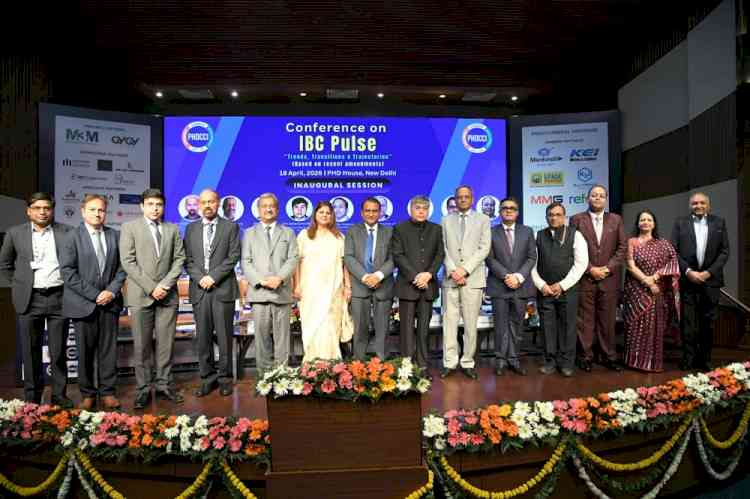
New Delhi, April 18, 2026: PHD Chamber of Commerce and Industry (PHDCCI) successfully organised a high-level conference on “IBC Pulse – Trends, Trajectories & Transitions” at PHD House, New Delhi, focusing on the recently enacted Insolvency and Bankruptcy Code (IBC) Amendment Act, 2026.
The conference brought together key policymakers, legal experts, industry leaders, and insolvency professionals to deliberate on the evolving insolvency framework in India.
Delivering the welcome address, Sanjay Singhania, Vice President, PHDCCI, observed that while business successes are widely celebrated, failures were historically deferred, leading to value erosion. He noted that the IBC has fundamentally transformed this approach by enabling timely resolution and restoring asset value. Highlighting sectoral examples, he emphasized that the Code has strengthened credit discipline and investor confidence, while also calling for greater speed, flexibility, and a shift towards value preservation and business revival.
Addressing the gathering, Justice Rakesh Kumar Jain, Former Member (Judicial), NCLAT, traced the evolution of insolvency laws in India and highlighted the transition from fragmented mechanisms to a unified, creditor-driven and time-bound framework under the IBC. He noted that the IBC Amendment Act, 2026 seeks to reduce delays, enhance creditor confidence, and introduce key reforms such as group insolvency and cross-border provisions. While acknowledging improvements in recovery and credit discipline, he emphasized the need to address persistent challenges including delays, high haircuts, and capacity constraints.
Ashok Kumar Bhardwaj, Hon’ble Member (Judicial), NCLT, emphasized the dynamic nature of law and the need for continuous legislative evolution to address emerging economic realities. He highlighted that amendments to the IBC are essential to resolve ambiguities and implementation challenges, and stressed that the objective of insolvency law should remain focused on resolution and value maximization rather than mere recovery.
In his address, Chetan Sharma, Additional Solicitor General, Delhi High Court, underscored the centrality of time in insolvency proceedings, stating that “delay is not neutral, it is destructive,” as asset value erodes silently over time. He noted that the IBC has brought a significant cultural shift in credit discipline and suggested the adoption of AI-enabled, pre-litigation mediation frameworks to reduce pendency and improve efficiency.
Dr. RJR Kasibhatla, Joint Secretary, Ministry of Law & Justice, highlighted the historical foundations of insolvency jurisprudence and described the IBC as a modern, structured response to a globalised economy. He outlined key features of the 2026 amendments, including provisions for reasoned orders, group insolvency, cross-border mechanisms, and penalties for frivolous proceedings, while reiterating that legal frameworks must continuously evolve with changing economic dynamics.
Debajyoti Ray Chaudhuri, Managing Director & CEO, National E-Governance Services Ltd (NeSL), described the IBC as a dynamic legislation that has evolved through multiple amendments. He emphasized the growing importance of Information Utilities, noting that authenticated records of default can significantly reduce delays and enhance transparency. He also highlighted their role in empowering MSMEs and improving credit discipline.
Welcoming the dignitaries, G.P. Madaan, Chair, NCLT & IBC Committee, PHDCCI, highlighted the Committee’s proactive role in policy advocacy and stakeholder consultations. He noted that while the 2026 amendments aim to streamline processes and strengthen creditor rights, key implementation challenges persist, particularly in terms of infrastructure gaps, shortage of benches, and procedural delays, calling for enhanced institutional capacity.
Rachit Mittal, Co-Chair, NCLT & IBC Committee, PHDCCI, conveyed his sincere appreciation to all speakers, partners, and participants for their valuable contributions in making the conference a highly insightful and impactful engagement. He also acknowledged the collaborative efforts of all stakeholders in fostering meaningful dialogue and driving forward-looking discussions for strengthening the insolvency ecosystem.
The NCLT IBC Committee Co-Chairs, Ranjana Roy Gawai, Mr. Abhishek Anand and Harish Taneja moderated the technical session.
A key highlight of the event was the announcement of a strategic Memorandum of Understanding (MoU) between PHDCCI and National E-Governance Services Limited (NeSL) to promote awareness and adoption of Information Utility services. The collaboration aims to build stakeholder capacity, simplify processes, and establish a structured feedback mechanism to further strengthen India’s insolvency ecosystem.
The conference witnessed active participation from policymakers, legal experts, insolvency professionals, and industry representatives, fostering meaningful dialogue on strengthening India’s insolvency framework and shaping its future trajectory.
The event was supported by Principal Partners including M3M India Pvt. Ltd. and GYGY Group; Associate Partners comprising Aartha Corporate & Management Advisors LLP, Devika Group, Era Infra Engineering Limited, Indian Institute of Insolvency Professional of ICAI, KNM & Partners, and Omkara Assets Reconstruction Pvt. Ltd.; Supporting Partners including Anandtex India Pvt Ltd, ASV Legal LLP, Noida Holdings Pvt. Ltd., IRR Insolvency Professionals Private Limited, Loan Bazaar, Pankaj Aggarwal & Associates, Singla’s Sweets, and Strategia Legal; with Indian Institute of Corporate Affairs (IICA) as the Academia Partner, and Knowledge Partners including Madaan Law Offices, Law Offices of A. Anand, RM Law Chambers, RRG & Associates, and HT Legal.