Panjab University Hosts 7th DGSIC International Camp at English Department
Two-Day Camp Explores ‘Fabulating the New’ in Deleuze-Guattari Studies
 City Air News
Feb 26, 2026 08:53
0
City Air News
Feb 26, 2026 08:53
0
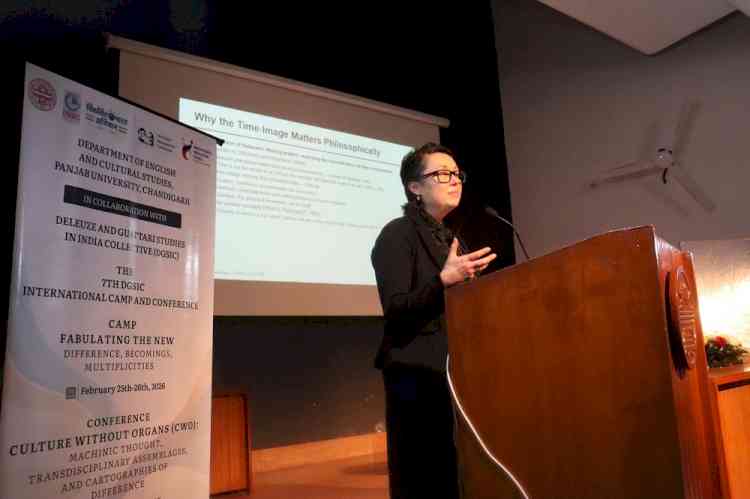
Chandigarh, 26 February 2026: Panjab University (PU) conducted the two-day camp segment of the 7th Deleuze and Guattari Studies in India Collective (DGSIC) Camp and Conference at the Department of English and Cultural Studies, drawing scholars from 18 states and Union Territories for sustained engagement with contemporary philosophical and cultural inquiry.
Jointly organised by the Department of English and Cultural Studies, PU, and the Deleuze and Guattari Studies in India Collective, the Two-Day academic camp is themed “Fabulating the New: Difference, Becomings, Multiplicities.” The camp laid the conceptual foundation for the international conference themed "Culture Without Organs" (CWO) scheduled from February 27 to 28, 2026.
Opening the camp, Dr. Manoj N.Y., General Secretary, DGSIC, described the initiative as an encounter between Deleuze and India, positioning it as a collaborative academic experience rather than a conventional conference. Prof. Meenu Gupta, Chairperson, Department of English and Cultural Studies, PU and Vice President, DGSIC, delivered the welcome address, underlining sustained institutional commitment and international collaboration.
Prof. Deepti Gupta introduced the University’s academic legacy to delegates, while Dr. Swatie, Coordinator and Co-Convener, outlined the thematic orientation, elaborating on the rhizome as a non-hierarchical model of knowledge production.
The inaugural plenary was delivered by Prof. David R. Cole, Associate Professor, Western Sydney University, who examined the philosophical and geopolitical implications of the Anthropocene for education. Conceptualising the threshold between the Holocene and the Anthropocene as a site of pedagogical experimentation, he challenged linear models of progress and called for experimental, planet-responsive pedagogies.
Subsequent plenary sessions expanded the scope across film theory, linguistics, ontology, ethics, science, and authorship. Prof. Felicity Colman engaged Deleuze’s movement-image and time-image, arguing that cinema produces thought by generating new perceptions of time and embodiment beyond representational frameworks.
Prof. Joff P. N. Bradley of Teikyo University examined language, power, and regimes of signs, critiquing structural linguistics and proposing language as flux and becoming. He also reflected on intersections between Deleuze and Indian philosophy.
Dr. Manoj N.Y. presented on Deleuze, Foucault and the Diagram, while Mr. Yuuki Tanaka explored “What is Science in the Papers of What is Philosophy?”
The second day commenced with an online plenary by Prof. George Varghese K, President, DGSIC, who proposed a threefold articulation of history through Constructionist, Reconstructionist, and Deconstructionist distinguishing stratified historical record from creative becoming.
Prof. Joff P. N. Bradley of Teikyo University, Japan in the second plenary session offered a philosophical inquiry into language, power and regimes of signs. Opening with references to Alain Badiou and Bernard-Henri Lévy, he critically engaged structural linguistics and proposed language as flux and becoming rather than a neutral system.
Prof. Meenu Gupta further introduced Deleuzian ontology as cartography rather than a foundational system, presenting it as generative, machinic, and diagrammatic across the registers of the actual and the virtual.
In the fourth plenary session, Prof. Felicity Colman, Dean of Research, University Arts, London UK; extended her earlier reflections on cinema by foregrounding Deleuze’s theory of the time-image. Contrasting it with the Aristotelian narrative model and Paul Ricoeur’s configuration of time through plot, she argued that post-World War II cinema presents time directly rather than through action.
Dr. Wahida Khandker of Manchester Metropolitan University extended the debate to ethics through her lecture, “Rethinking Ethics as Ethology in A Thousand Plateaus,” foregrounding relationality and affect and Yuuki Tanaka on “Who is the Writer Here? - Friends and Otherness,” expanding the thematic scope to ethics, relationality and authorship.
The camp concluded with a plenary panel discussion chaired by Dr. Manoj N.Y., bringing together all speakers in dialogue with delegates, research scholars, and faculty members. A valedictory session formally marked the completion of the two-day intensive camp.
With the camp segment concluded, PU now proceeds to the international conference phase on 27th and 28th February, continuing deliberations on the contemporary relevance of Deleuze and Guattari across disciplines and reinforcing the University’s role as a site for advanced philosophical scholarship.