Panic in Khalistani circles as India-EU deal boosts counter-terror cooperation
The India-European Union Free Trade Agreement has been called the mother of all trade deals. While both sides have plenty to benefit, the Khalistanis are clearly unhappy with this deal. They feel that close ties between the European Union (EU) and India mean that the latter gains more leverage to target Khalistani elements.
 IANS
Jan 28, 2026 09:50
0
IANS
Jan 28, 2026 09:50
0
Vicky Nanjappa
New Delhi, Jan 28 (IANS) The India-European Union Free Trade Agreement has been called the mother of all trade deals. While both sides have plenty to benefit, the Khalistanis are clearly unhappy with this deal. They feel that close ties between the European Union (EU) and India mean that the latter gains more leverage to target Khalistani elements.
The Khalistan groups, which have made countries such as Canada, Germany, and the United Kingdom their base, believe that this proximity between India and the EU would harm their movement. The Khalistani groups, such as the Babbar Khalsa International (BKI) and Sikhs for Justice (SFJ), have had a field day as successive governments in Europe have been soft on such groups.
These countries have also cited free speech to allow such elements to operate freely and spread hate against India. India, on the other hand, has repeatedly told these nations that these elements are dangerous and have been proscribed as terror groups under Indian law.
The fear among these elements is evident in the statement issued by SFJ head Gurpatwant Singh Pannun. He goes on to say, “What the EU celebrates today as a Free Trade Deal will lead to a Free Transnational Terrorism Agreement.”
An Intelligence Bureau official explains that, while on one hand, there is panic that has set in due to this deal, the other aspect of issuing such statements is to incite violence and hatred towards the Indians living in the European countries. They want elements sympathetic to the cause to hurt Indians living in these countries.
The experts say that countries such as the United Kingdom and Canada have been acting against these elements after India provided them with ample proof regarding the terrorist nature of these groups. The deal with the EU makes matters worse for them as both sides have also decided to cooperate and work closely on terrorism related matters, officials say.
Another official said that Pannun and his cronies have attempted multiple times to ensure traction for the movement. What was meant to be a mass movement against India is in reality just a fringe activity. By targeting India and the EU, the Khalistanis are trying to internationalise the issue. It is just a cheap shot at publicity by Pannun, the official added.
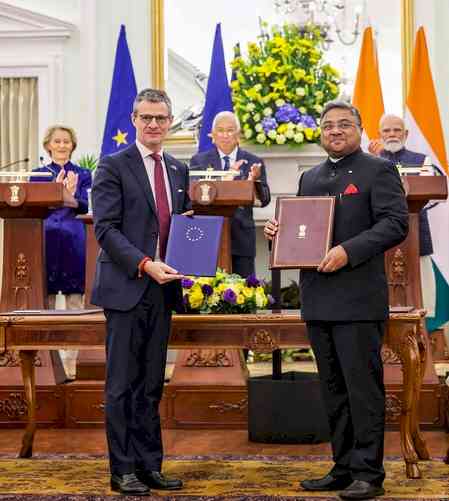
After signing the deal, Prime Minister Narendra Modi said that the security and defence partnership between India and the EU will deepen cooperation in counter terrorism, maritime, and cyber security. A joint statement by the two sides said the leaders welcomed the signing of the EU-India Security and Defence Partnership, the first such overarching defence and security framework between the two sides that will deepen ties in the domains of maritime security, defence industry and technology, cyber and hybrid threats, space, and counter-terrorism, among others.
They also welcomed the launch of negotiations on a Security of Information Agreement that will facilitate the exchange of classified information and pave the way for a stronger cooperation in areas related to security and defence.”
Counter terrorism experts say that with so much emphasis on security cooperation, the Khalistan forces are bound to be worried. After being apprehensive and showing fear in his statement, Pannun got back to issuing threats against India. He warned that the Beating Retreat Ceremony on January 29 would be targeted. He has also warned of more attacks in India, while adding that the EU should be mindful of the so-called oppression of the Sikh community.
The Khalistanis have been falsely spreading information that the Sikhs are under threat in India. Had this been the case, the movement would have taken off in no time in Punjab. There is no traction because there is no oppression, as claimed by these terror groups.
Meanwhile, the ISI has been attempting to revive the movement in Punjab. It has been attempting to drop off a large cache of arms and ammunition using drones. Further, the drug routes too are bustling as the ISI seeks to raise funds both for the Khalistan movement as well as for the terror groups operating in Jammu and Kashmir.
--IANS
vn/skp