Northeast sees decade of transformation, says Arunachal CM Pema Khandu
Arunachal Pradesh Chief Minister Pema Khandu on Friday highlighted the Northeast’s remarkable transformation over the past decade, noting that a region once viewed through the lens of insurgency, underdevelopment, and isolation is now emerging as a key driver of India’s growth story.
 IANS
May 1, 2026 10:59
0
IANS
May 1, 2026 10:59
0
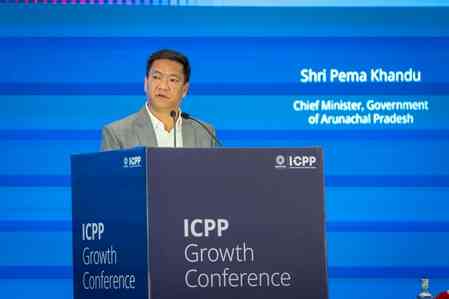
New Delhi/Itanagar, May 1 (IANS) Arunachal Pradesh Chief Minister Pema Khandu on Friday highlighted the Northeast’s remarkable transformation over the past decade, noting that a region once viewed through the lens of insurgency, underdevelopment, and isolation is now emerging as a key driver of India’s growth story.
Khandu credited Prime Minister Narendra Modi for placing the Northeast at the heart of the country’s development agenda, saying sustained policy focus, infrastructure expansion, and improved connectivity have reshaped the region’s economic and social landscape.
He noted that regular visits by Union Ministers and senior officials to the Northeast have played a crucial role in identifying issues on the ground and ensuring timely resolution, thereby accelerating development.
Addressing a gathering of policymakers, academicians, and thought leaders at the Isaac Centre for Public Policy (ICPP) Growth Conference 2026 held in New Delhi, Khandu described Arunachal Pradesh as one of the most beautiful and strategically significant states of the country, being the largest in the Northeast as well as the easternmost and Northernmost state in the region.
Providing a brief historical perspective, the Chief Minister traced the state’s evolution from the North East Frontier Agency (NEFA) to a Union Territory in 1972, and finally to full statehood in 1987. He highlighted the state’s rich cultural diversity, with 26 major tribes and over a hundred sub-tribes, noting that Hindi serves as a vital link language that unites people across different communities.
Highlighting Arunachal Pradesh’s vast natural and economic potential, the Chief Minister described the state as a “powerhouse of India” in terms of hydropower generation. He informed that hydropower projects with a cumulative capacity of around 19,000 MW are currently under various stages of development, with a long-term target of achieving 40,000 MW by 2047, contributing significantly to the vision of a developed India.
The Chief Minister also spoke about the rapid growth in the tourism, agriculture, and horticulture sectors, attributing this progress to improved connectivity and infrastructure. The expansion of road networks, including access to remote and border areas, has opened up new avenues for economic growth and tourism in the state.
Khandu highlighted key governance reforms undertaken by his government, particularly in ensuring transparency and accountability in recruitment. He informed that the establishment of a robust and transparent Staff Selection Board for Group C and D recruitments, along with reforms in the Public Service Commission, has significantly enhanced public trust in the system and ensured that merit remains the sole criterion for government jobs.
On education, the Chief Minister underlined the government’s focus on improving quality over quantity. He shared that a comprehensive overhaul of the education system is underway in line with the National Education Policy 2020, with a target for full implementation by 2030.
Khandu noted that difficult but necessary decisions, including the rationalisation of over 600 non-viable schools, were taken to improve educational outcomes. Emphasising community participation, he said that education must be a collective responsibility involving society at large, especially in remote areas.
He also highlighted the expansion of higher education and healthcare infrastructure, including the establishment of new medical colleges in the state. The Chief Minister further spoke about Arunachal Pradesh’s rich biodiversity and the government’s commitment to environmental sustainability.
Referring to India’s commitments made at COP26, he informed that the state has adopted a structured approach with defined pillars and strategies to balance economic development with environmental conservation, ensuring community participation in preserving forests and natural resources.
Khandu also highlighted initiatives aimed at strengthening grassroots governance and public service delivery, such as “SevaAapkeDwar” and “Sarkar AapkeDwar”, through which government services and schemes are delivered directly to people in remote villages. These initiatives, he said, have strengthened trust between the government and citizens by ensuring last-mile connectivity and efficient service delivery.
He also spoke about national initiatives like the Vibrant Villages Programme, expansion of highways, and hydropower development, which are contributing to building stronger, more connected communities in the frontier state.
The Chief Minister reiterated that Arunachal Pradesh is steadily transforming through sustained reforms, infrastructure development, and people-centric governance. He emphasised that investing in people, education, and opportunities is key to long-term growth and nation-building.
“When we invest in people and create opportunities, we move forward together,” he said.
The conference served as a platform for meaningful discussions on public policy, education, and inclusive growth, bringing together diverse perspectives from across the country.