Nobel Laureate Michael Spence Launches ‘Iron Pillar Initiative in Global Learning’ at Ashoka University
Initiative to expand pathways for global experiential learning, research and career development, with partnerships spanning CERN, Lindau Nobel Laureate Meetings, Asian Development Bank Institute (ADBI), among others
 City Air News
Sep 29, 2026 03:20
0
City Air News
Sep 29, 2026 03:20
0
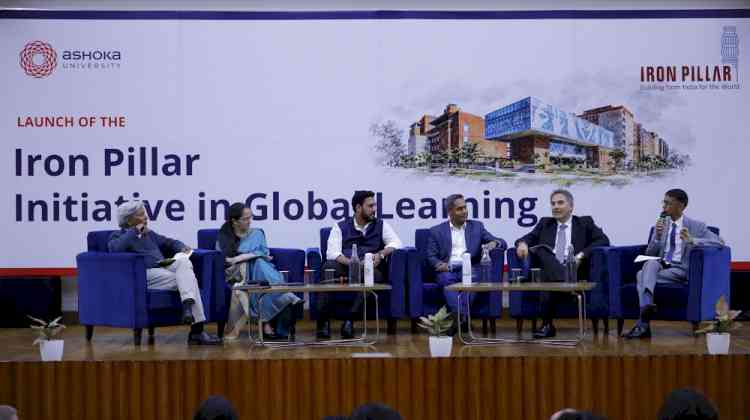
New Delhi, September 29, 2026: Ashoka University, in collaboration with Iron Pillar, launched the ‘Iron Pillar Initiative in Global Learning’ at the University campus, a joint initiative aimed at creating new pathways for international experiential learning, interdisciplinary education, research collaboration and career development for students.
The initiative will build on Ashoka University’s existing portfolio of global internships, academic programmes, research opportunities and public engagement initiatives, further expanding pathways for students to engage with international institutions, industry, policy and emerging areas of knowledge.
As part of IGL’s global learning ecosystem, the initiative is developing a pilot partnership with CERN, offering four Ashoka University undergraduates a four-month research and advanced-learning experience in Geneva and Europe. IGL also includes a partnership with the Lindau Nobel Laureate Meetings, providing undergraduates an opportunity to engage with Nobel Laureates and leading young researchers from around the world.
The initiative will also connect Ashoka University students with leading global institutions, and industry practitioners, through partnerships with organisations such as the Asian Development Bank Institute (ADBI) in Tokyo, Druk Holdings & Investments (DHI) and Gelephu Mindfulness City (GMC) in Bhutan. These will enable students to secure internships around research and policy projects, exposure to innovation, technology, sustainability and emerging development models across regions.
The launch event was graced by Nobel Laureate Michael A. Spence, who delivered the Iron Pillar Distinguished Lecture, highlighting the importance of research and innovation in India’s evolving economic landscape, and the need to create greater access to global opportunities for the next generation of talent. Michael Spence said, “AI and data have the potential to dramatically change the impact of economic growth by bringing more people along. Across emerging economies, there are millions of people who remain underserved by traditional channels of credit, financial services, healthcare and education, particularly in lower-income or remote communities. Technology can make it possible to reach these populations in ways that were previously not economically viable. For India, the opportunity is particularly significant: the challenge is not simply to generate growth, but to ensure that the portfolio of high-growth sectors is broad enough to create powerful employment engines and bring people into the modernising economy. India’s growth path will be its own hybrid, combining services, manufacturing, domestic demand and inclusive growth.”
This was followed by a panel discussion on Economics, Technology & Global Learning, featuring Alain Bifani, Founder - Chair of the Board of Directors, Hemera, Anand Prasanna, Managing Partner, Iron Pillar, Sushant Palakurthi Rao, Managing Director, Global External Relations, Agility, Archish Mittal, Vice-President, Iron Pillar & Co-Chair, IGL Advisory Council, Ashoka University, Prachi Mishra, Dean, Rakesh Jhunjhunwala School of Economics and Finance Professor of Economics, Ashoka University. The Panel was moderated by K. Vijayraghavan and explored the changing relationship between technology, economics, skills and global learning.
During the discussion, Archish Mittal, said, “Technology, research and innovation are increasingly shaping the way economies grow and compete, making it important to create platforms that bring these domains into closer conversation. Global learning can play a significant role in this process by connecting students and researchers with institutions, industry and ideas across geographies.”
Speaking about the importance of global collaboration in strengthening research capabilities, K. VijayRaghavan, Chair, Science Advisory Council, Ashoka University, said, “Building strong research capabilities requires investment in people, institutions and infrastructure, and importantly collaboration across disciplines and sectors, and engagement with the global research community. Universities have an important role to play in creating these connections and preparing young people to participate in this ecosystem.”
IGL will further support interdisciplinary learning through the Global Investments, Geopolitics, and Leadership course, while its partnership with The Coretta & Martin Luther King Institute for Peace will create opportunities for student internships, mediation and conflict-transformation programmes, joint publications and cross-cultural learning.
Speaking about the significance of the initiative and its alignment with Ashoka University’s broader academic and research vision, Rishikesha T. Krishnan, Vice-Chancellor, Ashoka University, said, “Ashoka University has been deeply committed to building a culture of research, inquiry and intellectual curiosity, and to creating an environment where students and faculty can engage with ideas that have relevance well beyond the university campus. The Iron Pillar Initiative in Global Learning takes this vision a step further by creating meaningful pathways for our students to learn, research and collaborate with institutions, practitioners and scholars around the world.”
As part of its broader focus on knowledge creation and public engagement, IGL will also launch the first workshop from the Storytelling Lab at Ashoka University, led by Prasenjeet Yadav, NatGeo Explorer. The Lab will focus on creating, teaching, mentoring and advancing science storytelling in India, bringing together science, image-making, teaching, experimentation and public engagement through original work, workshops, fellowships and public storytelling.