New definition of good governance in Uttarakhand: Historic public outreach campaign led by CM Dhami
Under the leadership of Chief Minister Pushkar Singh Dhami, the Uttarakhand government’s flagship public outreach initiative “Jan-Jan Ki Sarkar, Jan-Jan Ke Dwar” (Government for every citizen, at every doorstep) has emerged as a powerful symbol of good governance, sensitive administration, and swift grievance redressal.
 IANS
Jan 2, 2026 09:46
0
IANS
Jan 2, 2026 09:46
0
Dehradun, Jan 2 (IANS) Under the leadership of Chief Minister Pushkar Singh Dhami, the Uttarakhand government’s flagship public outreach initiative “Jan-Jan Ki Sarkar, Jan-Jan Ke Dwar” (Government for every citizen, at every doorstep) has emerged as a powerful symbol of good governance, sensitive administration, and swift grievance redressal.
The programme has definitely brought a qualitative transformation in administrative functioning, according to officials. It has also effectively bridged the long-standing gap between the government and the common citizen.
The daily progress report of the programme dated January 2 clearly reflects that the state government has moved beyond paperwork and policy announcements to deliver tangible, ground-level results.
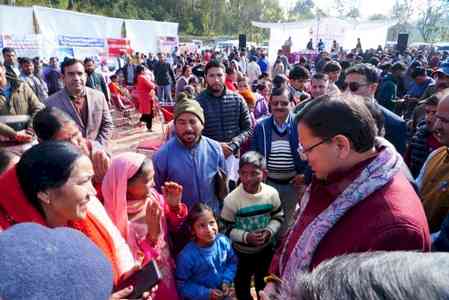
On a single day, the programme was implemented across all 13 districts of the state, with the organisation of 204 public service camps. More than 1,35,194 citizens participated directly in these camps. Such extensive public participation highlights the programme’s strong relevance to real public needs and the high level of trust people have placed in this initiative.
For the first time, governance reached directly to the doorsteps of citizens, particularly benefiting residents of rural, mountainous, and remote areas, who were spared the need to travel repeatedly to district or tehsil headquarters for resolving their issues.
During the camps, a total of 17,747 complaints and applications were received. Out of these, 12,776 cases were resolved on the spot or through immediate action, indicating that nearly 75 per cent of grievances were addressed promptly, officials informed. This achievement stands as a strong testament to the administration’s efficiency, decision-making capacity, and accountability, officials added.
According to them, the remaining cases have been forwarded to the concerned departments under a time-bound action plan and are being continuously monitored to ensure no grievance remains unresolved.
Remarkably, 19,734 applications related to essential certificates such as income, caste, residence, and social category documents were received at the camps. This reflects a major improvement in service delivery, ensuring that citizens no longer face unnecessary delays or procedural hurdles for basic administrative services.
The poor and marginalised have drawn immense benefit from the programme. Residents of remote regions also benefited from it.
Under various government welfare schemes, 77,203 citizens received direct benefits during the programme. This substantial figure clearly demonstrates that government schemes are no longer limited to announcements but are effectively reaching eligible beneficiaries.
Benefits related to various areas such as social security, pensions, healthcare, education, and other welfare schemes were made available on a single platform. This way, convenience, transparency, and efficiency were enhanced.
The success of this large-scale initiative is rooted in the clear, firm, and result-oriented directives issued by the CM, say officials. From the outset, the Chief Minister emphasised that officials must go to the field instead of summoning citizens to offices.
He mandated the presence of decision-making officers at every camp and directed that grievances be resolved at the primary level wherever possible.
Regular monitoring of pending cases at district and state levels, priority for senior citizens, persons with disabilities, economically weaker sections, and residents of remote areas, and strict accountability for administrative negligence have collectively made the governance system more responsive and people-centric.
Speaking on the occasion, CM Dhami stated, “Jan-Jan Ki Sarkar, Jan-Jan Ke Dwar is a campaign that is transforming the very mindset of governance in Uttarakhand. We believe that democracy is strengthened when the government itself reaches the people. Through this programme, we have ensured that even the person standing at the last mile can access government services and schemes without any barriers. This is the Uttarakhand Model of Good Governance, which is based on trust, solutions, and sensitivity.”
He further asserted that the initiative has strengthened public trust in the administration, effectively curbed the role of middlemen, and helped control corruption. Direct interaction between the government and citizens has fostered a culture of swift problem resolution and significantly enhanced transparency and credibility in governance.
--IANS
brt/dan