Nepal elections: Top leaders of traditional political parties stare at defeat
Most of the top leaders of traditional political parties are facing a tough contest in the parliamentary elections, with candidates from the Rastriya Swatantra Party (RSP) taking significant leads in two-thirds of the seats under the First-Past-the-Post (FPTP) system.
 IANS
Mar 6, 2026 11:01
0
IANS
Mar 6, 2026 11:01
0
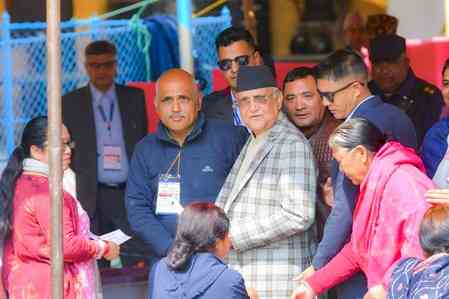
Kathmandu, March 6 (IANS) Most of the top leaders of traditional political parties are facing a tough contest in the parliamentary elections, with candidates from the Rastriya Swatantra Party (RSP) taking significant leads in two-thirds of the seats under the First-Past-the-Post (FPTP) system.
In Nepal’s 275-member House of Representatives, 165 members are elected through the FPTP system, while 110 seats are filled through the proportional representation system. According to the latest data from the Election Commission Nepal, RSP candidates are currently leading in 110 seats, with the party already securing victories in three constituencies.
Based on vote counting till late Friday evening, Balen Shah, the RSP’s prime ministerial candidate, is leading by a wide margin against former Prime Minister K P Sharma Oli at the latter’s traditional stronghold in Jhapa-5 in eastern Nepal.
According to the latest vote count, Shah has secured 13,694 votes, while Oli trails with 3011 votes.
Nepali Congress President Gagan Thapa is also trailing RSP candidate Amaresh Kumar Singh in the Sarlahi-4 constituency.
Fresh from being elected party president through a special general convention held in January, Thapa was expected to make a strong showing in the parliamentary elections in what has traditionally been a Nepali Congress stronghold.
However, Singh, a former lawmaker from the Nepali Congress party, is ahead with 4496 votes, followed by Thapa with 2530 votes.
While top leaders of the two parties that were part of the government toppled by the GenZ movement in September last year are struggling in the polls, former Prime Minister Pushpa Kamal Dahal, coordinator of the Nepal Communist Party (NCP), secured victory from Rukum East, his party’s traditional stronghold in western Nepal. Dahal has been accused of abandoning Gorkha-2, from where he was elected in the 2022 elections, due to the higher risk of losing the seat.
Nepali Congress General Secretary Pradip Paudel is trailing RSP candidate Sasmit Pokharel from Kathmandu-5 by a wide margin. According to the latest vote tally, Pokharel has secured 18,051 votes, while Paudel has received only 5,627 votes.
Former Deputy Prime Minister and vice-chairperson of the Communist Party of Nepal (Unified Marxist–Leninist) (CPN-UML), Bishnu Prasad Paudel, is also trailing RSP candidate Sulav Kharel by a wide margin. Kharel had secured 24,741 votes by Friday evening, while Paudel had received only 5,231 votes.
Former Deputy Prime Minister Narayan Kaji Shrestha of the NCP is also trailing RSP candidate Narendra Sah Kalwar in Sarlahi-3 in Madhesh Province by a wide margin. Kalwar has so far received 5,424 votes, followed by Shrestha with only 720 votes.
Voters appear to have overwhelmingly turned away from traditional political parties, whose seasoned as well as new leaders are facing setbacks.
“One of the main reasons behind the poor performance of traditional political parties is anti-incumbency, as people were tired of the same parties and the same leaders for years and did not see a marked improvement in their lives during their rule,” political analyst Arun Subedi told IANS.
“Even though the Nepali Congress recently tried to forcefully change itself by electing new leadership through a special general convention, it had already become too late to convince voters of the party’s transformation,” he added.
--IANS
/as