Nagpur win gives beleaguered Congress face-saving foothold in MLC polls
The Congress has reasons to celebrate the lone victory in the biennial Legislative Council (MLC) elections held for 28 seats across four states, though the strike rate converts into a meagre 3.57 per cent, with many of its regional allies faring better.
 IANS
Oct 29, 2026 08:29
0
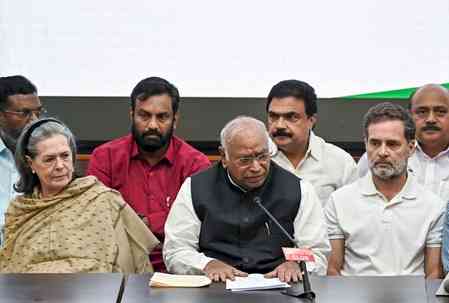
New Delhi, Oct 29 (IANS) The Congress has reasons to celebrate the lone victory in the biennial Legislative Council (MLC) elections held for 28 seats across four states, though the strike rate converts into a meagre 3.57 per cent, with many of its regional allies faring better.
In these elections across Uttar Pradesh, Bihar, Maharashtra, and Karnataka, the Congress won only one seat, in Maharashtra's Nagpur Graduates' constituency.
It has thus avoided a complete washout, a fear writ large before the Nagpur result was official, even as several leaders of the Bharatiya Janata Party (BJP) made snide, sometimes amusing, social media comments on its “zero” achievement.
The Congress can now argue that it still holds “pockets of support”, with Abhijeet Wanjari having retained the Nagpur “bastion”. So what if in Karnataka it was wiped out despite being in power, where the Bengaluru Teachers’ constituency was perhaps the highest-profile Congress loss.
Though faring comparatively weaker in general polls of late, the BJP-led National Democratic Alliance (NDA) constituent Janata Dal (Secular) candidate A. P. Ranganath defeated sitting Congress MLC Puttanna by around 900 votes.
Losing an incumbent seat in the capital region was a major setback, with Puttanna being a veteran leader and the sitting member of the Council. Nagpur was the proverbial sobering balm for another loss, that at the Darbhanga Teachers’ constituency.
New entrants like the Prashant Kishor-founded Jan Suraaj Party (JSP) managed breakthrough victories at Congress expense. This loss too was arguably among its most painful, with Congress candidate Madan Mohan Jha, a sitting MLC and two-time winner, losing the seat to the JSP’s Suresh Prasad Rai in a closely fought contest.
Interestingly, reports noted that the INDIA Bloc vote was split because Laloo Yadav’s Rashtriya Janata Dal (RJD) fielded its own candidate, “hurting” the Congress's traditional support base.
Yet, without Nagpur, a zero-seat tally would have made the narrative far more damaging politically, where the grand old party of India has been lately struggling to reach a three-digit figure in the Lok Sabha and slipping in consecutive Assembly elections. It has increasingly been relying on support from regional parties in general elections, being relegated to an inconsequential position in many states.
For the local satraps, a tie-up is tactical, with a few seats allocated to the Congress, so that vote banks are not fractured, and a similar equation can be sought at the national level.
As in Legislative Assemblies, every MLC seat in the six bicameral states adds to a party's representation in the Legislative Council.
For the Congress, even a single additional member can show presence by participating in debates, committees, and legislative coordination. The lone victory can also be hailed as a possible psychological and organisational boost for the Congress after its poor performances in multiple constituencies. It has given the beleaguered party one win to rally workers and local leaders around.
Congress leaders add that the victory, coming from Nagpur, a politically prominent region in Maharashtra, allows the party to claim that it still influences specific voter groups such as graduates.
The single win gives Congress a basis to argue that the results were “mixed” rather than a complete rejection. However, the broader takeaway was that Congress performed weakly overall, while the BJP and its allies won a majority of the seats contested.
For the Opposition bloc, the main contest shifted to the RJD in Bihar, Samajwadi Party in Uttar Pradesh, and the Nationalist Congress Party – Sharadchandra Pawar and Shiv Sena (Uddhav Balasaheb Thackeray) in Maharashtra, among others, showing Congress’ reduced influence.
--IANS
jb/dan