MDU VC Prof. Milap Punia Emphasizes Capacity Building in AI and Drone Technology at ISRO Program
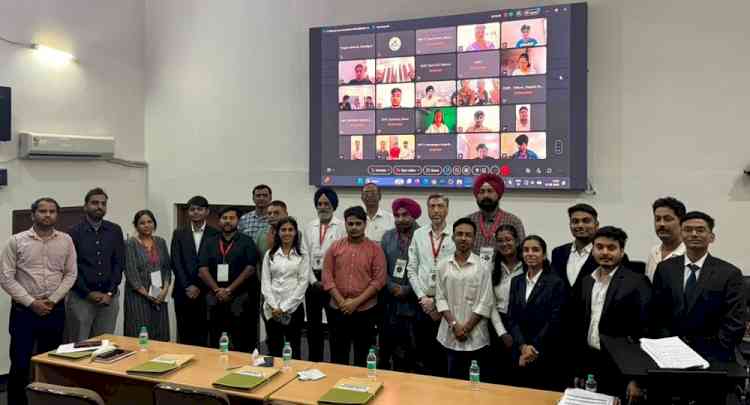
Prof. Milap Punia, Vice-Chancellor of MDU, Rohtak, attended as the Chief Guest at a Scientific and Faculty Development Program organized by the Indian Institute of Remote Sensing—an internationally renowned institute under the Indian Space Research Organisation (ISRO). Scientists, researchers, and educators from across the country participated in this program, which was sponsored by the National Natural Resources Management System (NNRMS) under ISRO.
 Girish Saini
May 18, 2026 11:37
0
Girish Saini
May 18, 2026 11:37
0
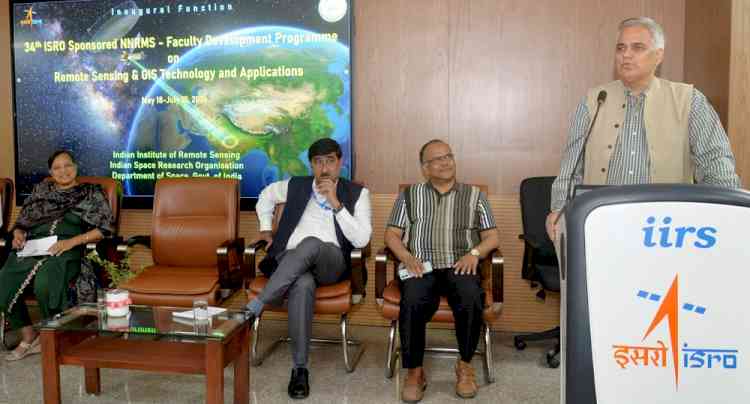
Rohtak, May 18, 2026: Prof. Milap Punia, Vice-Chancellor of MDU, Rohtak, attended as the Chief Guest at a Scientific and Faculty Development Program organized by the Indian Institute of Remote Sensing—an internationally renowned institute under the Indian Space Research Organisation (ISRO). Scientists, researchers, and educators from across the country participated in this program, which was sponsored by the National Natural Resources Management System (NNRMS) under ISRO.
Sharing his views on the topic "National Education Policy-2020 and National Geospatial Policy-2022: Challenges and Opportunities," Vice-Chancellor Prof. Milap Punia stated that India is rapidly emerging as a global power in the field of geospatial technologies. He noted that the country's geospatial ecosystem is advancing at an annual growth rate of approximately 14 percent, and its economic potential has reached ₹60,000 crore.
VC Prof. Milap Punia remarked that the National Geospatial Policy-2022 is providing a new direction to education and skill development in emerging fields such as Artificial Intelligence (AI), Machine Learning, drone technology, and data science. He emphasized that the new National Education Policy-2020 does not limit the youth merely to obtaining degrees; rather, it inspires them to become technologically empowered, innovative, and creators of employment opportunities.
He added that while India has made significant progress toward adopting the United Nations Integrated Geospatial Information Framework (UN-GGIM-IGIF), developing a reliable and integrated data mechanism remains a challenge. Addressing this requires institutional collaboration, improved communication, capacity building, and enhanced partnerships at the global level.
Prof. Milap Punia said that, in order to build a robust geospatial ecosystem, India must bring about a shift in institutional mindset alongside technological investment, so as to foster a culture of innovation, standardization, and collaboration.
The inaugural session of the program was presided over by Dr. R.P. Singh. Present on the occasion were senior scientists—including Dr. Harish Shankar Srivastava, Dr. Anil Kumar, and Shefali Agarwal—along with numerous other scientists and experts from ISRO.