India's approach shifts from disaster response to landslide prevention: Dr Jitendra Singh
Union Minister of State for Science & Technology and Earth Sciences Dr. Jitendra Singh on Monday said India's approach is progressively shifting its landslide management approach from post-disaster relief to prevention, preparedness and risk reduction.
 IANS
Nov 23, 2026 08:37
0
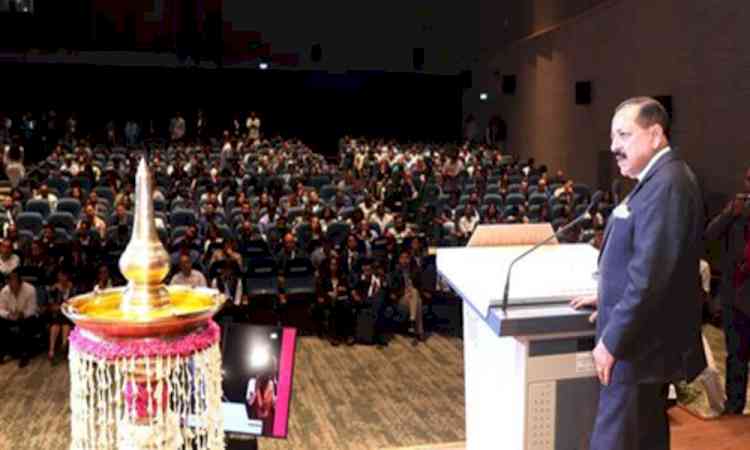
New Delhi, Nov 23 (IANS) Union Minister of State for Science & Technology and Earth Sciences Dr. Jitendra Singh on Monday said India's approach is progressively shifting its landslide management approach from post-disaster relief to prevention, preparedness and risk reduction.
Addressing the inaugural session of the 7th World Landslide Forum at Amrita Vishwa Vidyapeetham in Faridabad, the minister said national landslide susceptibility mapping has been completed across 4.3 lakh square kilometres, while the landslide inventory database has compiled information on nearly 91,000 historical landslides by the end of 2025.
India was moving away from a model of responding to disasters after they occur, towards one focused on anticipating risks, strengthening early warning systems and preventing avoidable loss of lives and infrastructure.
The six-day forum, being hosted in India for the first time from November 22-27, has drawn scientists, policymakers and experts from over 75 countries to discuss landslide risk reduction and resilience strategies.
The minister said a high-level committee has recently approved Rs 1,115.67 crore for disaster mitigation and capacity-building exercises, along with Rs 1,000 crore for the National Landslide Mitigation Project covering 15 states, including 10 Himalayan states and five other landslide-vulnerable states.
Dr. Singh said India's diverse geological and geophysical landscape, encompassing the Himalayas, Western Ghats, northeastern region and other vulnerable mountain areas, makes landslide risk reduction a critical national priority.
Recalling major landslide disasters in Wayanad, Kerala, Chamoli in Uttarakhand, Sikkim, Himachal Pradesh and Jammu and Kashmir, the minister stressed the need for interdisciplinary research, continuous monitoring and coordinated scientific efforts to minimise the impact of such disasters.
The minister said the Department of Science and Technology has been engaged in geospatial technologies and natural resource data management since 1982 through the Natural Resources Data Management System (NRDMS). The National Geospatial Policy and National Geospatial Programme introduced in 2019 have further strengthened India's geospatial ecosystem by leveraging contemporary technologies.
The Department has supported landslide warning and early detection systems, low-cost AI-based and video-based monitoring solutions, geological and geophysical investigations, vulnerability mapping and related research initiatives.
—IANS
aar/pk