India’s 2025 Free Trade Agreements and Export Missions: Unlocking Export Opportunities and Market Access, says PHDCCI
As the year 2025 draws to an end, India’s export policy landscape reflects a pivotal change toward global integration. Launch of the Market Access Support (MAS) Intervention under the Export Promotion Mission (EPM) by the Government of India marks a strategic shift in country’s export strategy, aimed at strengthening international market access for India’s exporters, particularly micro, small and medium enterprises (MSMEs), and first-time exporters said President of PHD Chamber of Commerce and Industry (PHDCCI), Rajeev Juneja.
 City Air News
Dec 31, 2025 05:24
0
City Air News
Dec 31, 2025 05:24
0
New Delhi, December 31, 2025: As the year 2025 draws to an end, India’s export policy landscape reflects a pivotal change toward global integration. Launch of the Market Access Support (MAS) Intervention under the Export Promotion Mission (EPM) by the Government of India marks a strategic shift in country’s export strategy, aimed at strengthening international market access for India’s exporters, particularly micro, small and medium enterprises (MSMEs), and first-time exporters said President of PHD Chamber of Commerce and Industry (PHDCCI), Rajeev Juneja.
Market Access Support Intervention, implemented under the NIRYAT DISHA sub-scheme of EPM, addresses structural constraints that have limited India’s exporters participation in global value chains. By providing institutional and financial support for international trade fairs, Buyer–Seller Meets (BSMs), Reverse Buyer–Seller Meets (RBSMs), MAS lowers entry barriers and improves buyer discovery for Indian firms, he said.
Export Promotion Mission, with a total outlay of ₹25,060 crore for FY 2025–26 to FY 2030–31, consolidates previously uneven export support schemes into a single, integrated framework. It combines financial support under Niryat Protsahan—such as interest subvention, collateral support, and credit enhancement—with non-financial support systems under Niryat Disha, including quality certification, branding, logistics facilitation, and market access initiatives. Together, these measures aim to improve market readiness, reduce compliance complexity, and enhance global competitiveness, he added.
Within MAS, cost-sharing mechanisms and a mandatory minimum of 35 per cent MSME participation, and special support for priority sectors are intended to create opportunity for diversified export growth. Partial airfare support for small exporters with turnover up to ₹75 lakh further eases participation problems. This signals a shift toward outcome-based, data-driven export promotion, he said.
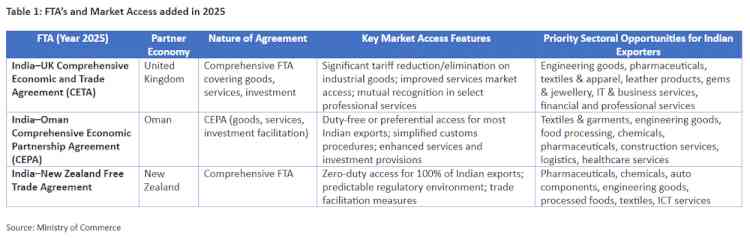
To further amplify support to exporters India’s evolving international trade strategy in 2025, is marked by the signing of several major Free Trade Agreements (FTAs), a list is provided in Table 1. A key milestone was the India–United Kingdom Comprehensive Economic and Trade Agreement (CETA), signed in July 2025, with an eye on expanding market access across goods and services in a major G7 economy. The agreement is expected to lower export costs and improve competitiveness in sectors such as engineering goods, textiles, pharmaceuticals, and professional services, he said.
In December 2025, India also signed a Comprehensive Economic Partnership Agreement (CEPA) with Oman. This agreement strengthens India’s trade entry in the Gulf region, particularly for labour-intensive goods and services. Additionally, the conclusion of a Free Trade Agreement with New Zealand secured zero-duty access for 100 per cent of Indian exporters, opening new opportunities in the Oceania region.
These FTAs collectively expand India’s preferential trading network and reduce tariff and non-tariff barriers in key markets. When combined with Market Access Support, exporters will benefit from both domestic institutional support and enhanced external market access. MAS will play a critical role in enabling Indian exports including MSMEs to convert tariff concessions into actual orders and long-term commercial relationships said Dr. Ranjeet Mehta, CEO & Secretary General, PHDCCI.
Convergence of export facilitation reforms and new trade agreements will deepen global integration, and strengthen competitiveness with ultimate goal of expanding exports to USD 2 trillion by 2030. As an end-of-year assessment, 2025 stands out, he added.