IndianOil Chairman A S Sahney delivers IIM Bangalore's 53rd Foundation Day lecture on India's energy journey
In his Foundation Day lecture at IIMB on ‘India’s Energy Journey’, IndianOil Chairman highlights that people are the backbone of successful organizations and that strong institutions boost a country’s success
 City Air News
Oct 29, 2026 02:36
0
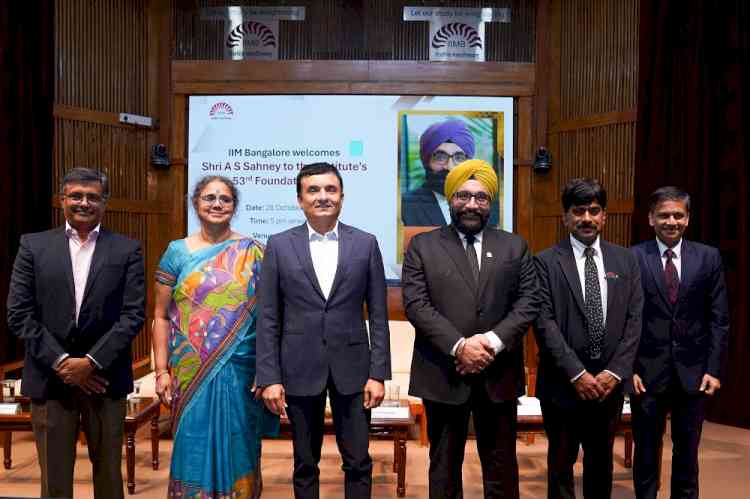
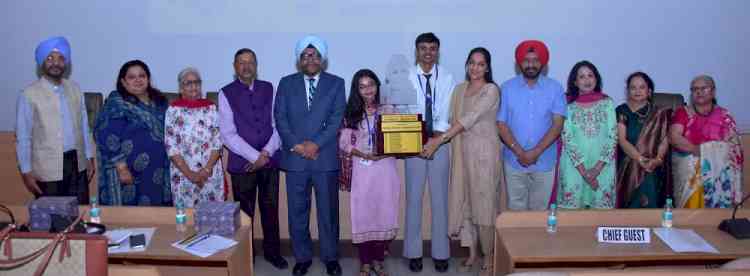
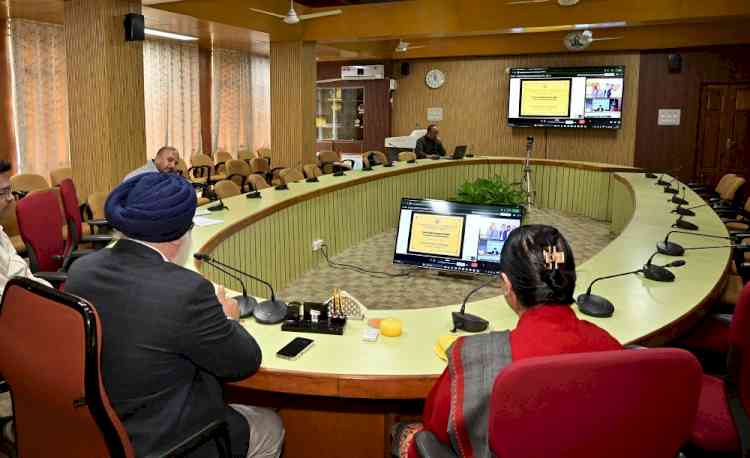
Bengaluru, October 29, 2026: “India's journey towards Viksit Bharat will depend on the collective strength of its institutions – industry, infrastructure, research, academia and young innovators – working together to build new capabilities and shaping a more resilient future. And as you step out of this remarkable institution, remember that strong foundations help withstand storms and give people the confidence to dream bigger – and the courage to achieve what once seemed impossible. So, build teams that believe in one another and never allow today's limitations to define tomorrow's achievements”, urged Shri A S Sahney, Chairman, IndianOil, while delivering the Foundation Day lecture on, ‘India’s Energy Journey: IndianOil’s Role in Securing Energy, Navigating Geopolitics and Building Resilience’, during IIM Bangalore’s 53rd Foundation Day celebrations, earlier today. The entire IIMB community – comprising students, faculty, former faculty, alumni and staff – were part of the event which included speeches, awards, and much more.
Purpose, resilience, trust, investing in future and transformation: Elements holding organizations together
A firm believer in people-centric leadership, Shri Sahney cited the example of the spirit in India's women's hockey triumph this year in the Asian Games, which, after a wait of 44 years, brought home gold. “It is a matter of immense pride for us that half the players in this victorious Indian team are IndianOil employees. But the glory belongs entirely to these remarkable women – their determination, their teamwork and their refusal to give up.”
Having worked across five of IndianOil’s nine refineries, and with over three decades of experience in refining and petrochemicals, he shared that most of his learnings about business and management happened on the job, through experience, mistakes and the people he worked with. Drawing attention to the profound changes around us in current times, he added, “Today, technology and AI help us track energy movements, optimize operations and make decisions that were unimaginable before. But the fundamentals of what holds organizations together remain unchanged.”
Stating that purpose is always tested during an emergency, he spoke of the times when the world faced the Covid crisis, during which his team displayed extraordinary courage, commitment and service to the nation – when duty took precedence over personal comfort and safety. “The core purpose of IndianOil as an organization is compassion with a nation-first attitude. And during the devastating second wave, IndianOil stepped forward to help meet the nation's desperate need for the life-saving Liquid Medical Oxygen – supporting its production, procurement and transportation. That experience taught me that an institution's strength lies not merely in its assets or technology, but in its people. To the future leaders here, your defining moments will come when circumstances are difficult, information is incomplete and others look to you for direction. Purpose is not what you say in good times, but what you do in bad times.”
Pointing out that in the current geopolitical scenario, building resilience will be the key, he added, “In an interconnected world, economic dependence itself can become an instrument of geopolitical power. For India, the answer is diversification, indigenous capability and strategic resilience, the ingredients of a well-functioning supply chain, especially when lives, livelihoods and national defence are concerned. During the recent LPG disruption, there was a very well-coordinated response from all our stakeholders to mitigate the crisis – from refinery engineers, procurement teams, railway personnel, truck drivers and distributors alike. IndianOil has effective policies to handle chokepoints, which have always received vital support from the government. Remember, we can model risks, but cannot always anticipate the next disruption. As future managers, you will repeatedly face a trade-off – between optimizing costs today and preparing for disruptions tomorrow. Just-in-time is efficient; but just-in-case is resilient.”
He also stressed on the importance of building resilient institutions through trust. “Employees must be granted the freedom to take decisions, challenge established practices, experiment and, occasionally, get things wrong. Leadership is not simply about getting the best out of people, but helping people discover the best within themselves. When people feel trusted, they move from compliance to commitment. A great institution's contribution is measured not only by the business it builds, but also by the leaders it gives to the nation. As you make your career choices, look beyond the conventional paths; consulting, finance and technology offer exciting opportunities, but some of India's greatest challenges and opportunities lie in energy, infrastructure, manufacturing, agriculture and the institutions that power our economy. Remember, targets may be achieved in a quarter; but the teams you build can shape an institution for generations.” Terming leadership development an institutional priority for IndianOil, he shared details about the company’s ‘Leaders of Tomorrow’ programme, which aims to groom promising executives for senior leadership roles.
His next advice to the students community was about investing in the future when the future itself is uncertain. “Preparation for facing the unimaginable is crucial. Our own investments are now progressively bearing fruit, reinforcing our belief in an energy future where conventional and emerging sources grow together. The essence of institution-building and nation-building lies in making decisions whose benefits extend far beyond our own tenure. Such investments also strengthen Atmanirbharta – building indigenous capabilities, creating opportunities for import substitution and reducing dependence on external supply chains. Commercial success and national responsibility can, and must, reinforce each other. And for the young managers here, there is a personal lesson as well. Invest in yourself before the rewards are visible. Take difficult assignments, learn unfamiliar skills and step beyond your comfort zone.”
He cautioned the young students against becoming prisoners of their own successes. “History tells us that no competitive advantage lasts forever. The very capabilities that made an organization successful can eventually become barriers to change. The best time to transform is when you are doing well, not when circumstances force you to. For those of you who will lead organizations tomorrow, remember that transformation does not always require dramatic restructuring or breakthrough technology. Longevity is not about preserving yesterday's success, it is about remaining relevant tomorrow. Do not let the definition of your success become your prison; do not allow your degree, your first job or your early success to define your future. The greatest risk is not that the world will change, it is that we will fail to change with it. IndianOil's own journey, its ability to adapt and remain relevant through changing times, reinforces this. Today, it is not merely an oil company, but an energy company. Your industry is not your identity. Your capabilities are.”
In this context, he discussed Project SPRINT launched by Indian Oil, which is a three-year transformation roadmap anchored in the 3Cs: Core, Cost and Customer and the 3Ts: Technology, Talent and Transition. “The 3Cs strengthen today's business; while the 3Ts prepare it for tomorrow. We also sought to institutionalize SMART goals, translating strategic priorities into measurable commitments and clear accountability. The important outcome of the project was beginning to change how we think and work”, he explained. Shri Sahney champions operational excellence, cost consciousness, customer-centricity, innovation and talent development. Under his leadership, IndianOil is pursuing Project SPRINT, a company-wide transformation initiative to build a more agile, competitive and future-ready organization. Moreover, under his leadership, IndianOil is also accelerating its energy transition journey, with a strong thrust on biofuels, Compressed BioGas (CBG), Green Hydrogen and Sustainable Aviation Fuel (SAF).
Address by the Director In-charge
Prof. U Dinesh Kumar, Director-in-charge, IIM Bangalore, during his address, acknowledged and expressed gratitude for the support that the Institute continues to receive for all its activities and initiatives from the Central Government, particularly the Ministry of Education, and the Government of Karnataka, which includes the IIMBx FinTech Certificate Programme for Young Professionals. “Our collaboration with the Ministry of Minority Affairs as well as the National Minorities Development and Finance Corporation, Govt. of India, reflects our commitment to applying our expertise in public policy, entrepreneurship and innovation to create inclusive and sustainable economic opportunities, across the nation.”
Discussing IIMB’s newly-launched undergraduate programmes at the Jigani campus, he said, “The Tata Trusts have been instrumental in establishing the IIMB-Dorabji Tata School of Undergraduate Studies, while Axis Bank, with a generous contribution, has established a Centre of Excellence in Economics in our UG School and supports faculty development, research and student scholarships.”
Talking about IIMB’s valuable partnerships, he said, “Our incubation centre, NSRCEL, has also signed an MoU with IIT Kanpur to accelerate deep-tech start-ups and help translate emerging technologies into market-ready ventures.”
He went on to highlight IIM Bangalore’s major accomplishments over the past year, including its brilliant rankings, pathbreaking sustainability initiatives, and more. He also made special mention of the Institute’s faculty, students and alumni for their commitment to academic excellence, impactful research and institutional development, and for carrying the IIM Bangalore legacy forward with their myriad achievements.
Prof. Dinesh Kumar observed that the Institute’s responsibility was not merely to sustain excellence, but to continually redefine it. “We must remain relevant in a changing world, deepen our contribution to business and public policy, advance knowledge through research, and prepare leaders who create lasting value for society. It is a privilege to be part of an institution whose ambitions extend beyond its own success – to the advancement of management education, the development of responsible leadership and the progress of our nation.” He also upheld the value of compassion as the most powerful resource in the world, during his address.