Gujarat to build 1st BSL-4 lab to fight against deadly viruses
Gujarat is set to significantly strengthen its biosecurity infrastructure with the construction of its first Biosafety Level-4 (BSL-4) laboratory, a high-security facility designed to handle the world's most dangerous and highly infectious pathogens.
 IANS
Jan 15, 2026 10:05
0
IANS
Jan 15, 2026 10:05
0
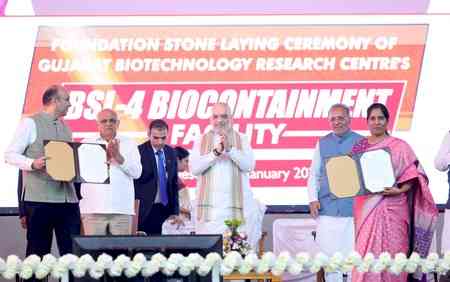
Ahmedabad, Jan 15 (IANS) Gujarat is set to significantly strengthen its biosecurity infrastructure with the construction of its first Biosafety Level-4 (BSL-4) laboratory, a high-security facility designed to handle the world's most dangerous and highly infectious pathogens.
The advanced biocontainment complex will aid in the development of vaccines, rapid diagnostics and critical research against life-threatening viruses for which no cure or treatment currently exists.
The move comes in the wake of repeated outbreaks of animal-to-human diseases in recent years, most notably the Covid-19 pandemic.
During the pandemic, India relied solely on the country's only BSL-4 lab in Pune for sample testing and pathogen analysis.
Gujarat has also witnessed cases of Chandipura virus in humans and Lumpy Skin Disease in animals -- both requiring BSL-3 or higher facilities.
With the rising threat of viruses such as Crimean-Congo Hemorrhagic Fever (CCHF), Nipah, Chandipura and Lumpy Skin Disease, the need for another high-level containment laboratory has become urgent.
The upcoming BSL-4 and Animal BSL-4 (ABSL-4) laboratory is being developed by the Gujarat Biotechnology Research Centre (GBRC) in Gandhinagar, adjacent to the Animal Vaccine Institute in Sector-28.
Spread across 14.21 acres, the facility will include a 271.90 square metre BSL-4 and ABSL-4 unit, BSL-3 and BSL-3 ISO7 laboratories, ABSL-3 units, BSL-2 labs, and specialised systems for effluent decontamination and waste management.
The BSL-4 laboratory will be equipped with multiple protective layers, including a fully airtight environment, HEPA-filtered air systems, positive-pressure "space suits" for scientists, chemical decontamination showers, and effluent treatment systems that sterilise all liquid and solid waste before disposal.
These safeguards ensure no pathogen escapes into the environment under any circumstances.
Once operational, the facility will enable pathogen isolation, sequencing, advanced testing, and vaccine research, dramatically reducing Gujarat's dependency on national laboratories and enabling faster response during outbreaks.
It will also support the monitoring of zoonotic diseases -- those transmitted from animals to humans.
With this development, Gujarat will become home to India's second BSL-4 lab and position itself as an emerging global hub for biomedical research.
The facility will not only enhance the state's preparedness for future pandemics but also bolster national security by improving India's ability to counter bio-threats and bioterrorism risks.
--IANS
janvi/khz