Governor Shiv Pratap Shukla, inaugurates the annual meeting of the paper traders - FPTA 65th AGM & Conference 2026
The three-day FPTA 65th Annual General Meeting & Conference 2026; hosted by The Federation of Paper Traders’ Association (FPTA), the apex national body representing paper traders; in collaboration with the Telangana Paper Merchants’ Association (TPMA), was inaugurated by Shiv Pratap Shukla, Governor of Telangana; today at the Novotel HICC, Madhapur.
 City Air News
Oct 3, 2026 07:48
0
City Air News
Oct 3, 2026 07:48
0
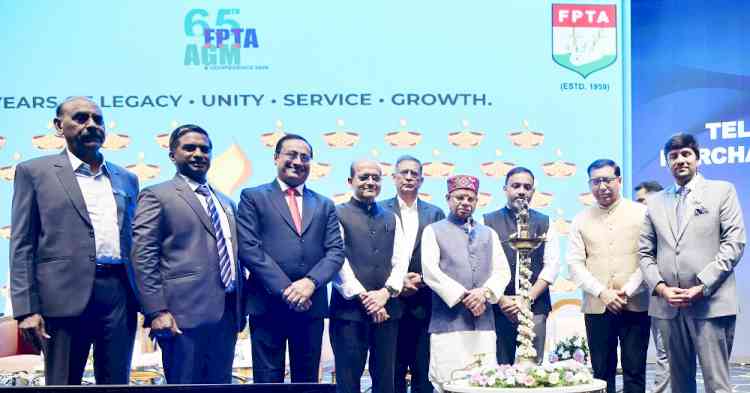
Hyderabad, October 3, 2026: The three-day FPTA 65th Annual General Meeting & Conference 2026; hosted by The Federation of Paper Traders’ Association (FPTA), the apex national body representing paper traders; in collaboration with the Telangana Paper Merchants’ Association (TPMA), was inaugurated by Shiv Pratap Shukla, Governor of Telangana; today at the Novotel HICC, Madhapur.
Chief Guest Rajesh Ponnuru, CEO, ITC Ltd. (PSPD); Guests of Honour Sri Pawan Agarwal, President, IPMA & CMD, Naini Papers Ltd.; A.S. Mehta, President & Director, JK Paper Ltd.; and Sushil Kumar Khetan, CEO & Whole Time Director, Emami Paper Mills Ltd., graced the occasion. The meeting was presided over by Rajesh Jain, President, FPTA and joined by T. Kishan Singh, President Nominee, FPTA; Abhishek Vijaywargiya, President, TPMA; Prasad RG, Chairman, Reception Committee, FPTA 65th AGM; and Ashish Jain Bhansali, Hon. Secretary, TPMA.
More than 1,000 paper traders from across India are attending the Conference, being held from October 3rd to 5th, 2026. The prestigious event returns to Hyderabad after 19 years and has added significance for the city as T. Kishan Singh, Managing Director, Tirumala Balaji Paper Pvt. Ltd., Hyderabad, is set to take over as Nominee President of FPTA.
Shiv Pratap Shukla, Governor of Telangana; addressing the gathering said, The paper industry does not deplete natural forests, as raw timber is ethically sourced from fast-growing agroforestry crops like poplar, cultivated specifically by farmers for quick harvest cycles. Popular slogans like "Save Paper, Save Trees" misinform the public; therefore, industry leadership must actively educate society that paper production supports rural farming economies rather than destroying natural forest habitats. While broadcast and digital channels produce fleeting news that is quickly forgotten or recycled, physical newsprint remains the trusted, authentic medium for daily reflection, focused reading, and public dialogue. Although digitization may lead to a "less paper" world, a completely "paperless" society is impossible because history, culture, official governance, and formal representations will always be anchored on physical paper. To address tax discrepancies, such as an 18% GST on paper alongside 0% on notebooks, the industry must pursue constructive representation over hostile agitation. As a ₹1-lakh-crore tax-paying sector, trade bodies should present clear, structured memorandums to state representatives, the Finance Minister, and the GST Council to achieve tax equity across states through persistent, strategic engagement. Beyond commercial interests, public campaigns should advocate for responsible usage, teaching younger generations to respect and preserve paper rather than waste it. Paper remains the fundamental driver of literacy, publishing, and cultural continuity, guiding learners from childhood slates to complex educational and intellectual pursuits. Ultimately, paper safeguards India's rich intellectual tradition, carrying forward a legacy of global knowledge leadership that traces back to ancient learning centers like Taxila and Nalanda. As India advances toward becoming a developed nation and global leader by 2047, the paper industry serves as an essential engine for commerce, education, and national pride.
Reflecting on an impactful tenure, the outgoing FPTA President Rajesh Jain, highlighted nation-wide engagement after visiting 35 of 36 affiliated associations. He said, the key initiatives included eight educational webinars, the FPTA Champions Cricket Trophy, an international study tour to China, the inaugural Regional South Meet in Kodaikanal, and celebrating Paper Day at Bharat Mandapam alongside industry leaders and government dignitaries. To strengthen the paper ecosystem, FPTA built strong collaborative ties with mill organizations like IPMA and IRMA while partnering with major trade bodies including ASSOCHAM, FICCI, and CAIT. Demonstrating active policy advocacy, the leadership submitted formal representations to Finance Minister Nirmala Sitharaman and Nitin Gadkari to resolve the inverted GST duty structure affecting notebook manufacturers. Concluding with gratitude to the FPTA team, host associations, family, and TPMA for organizing the 65th AGM, leadership was warmly handed over to incoming President Kishan to drive future progress.
Sushil Kumar Khetan, Ceo & Whole Time Director, Emami Paper Mills Ltd.; said, The Indian paper industry has a promising future, with rising consumption and significant headroom in per-capita usage. Paper remains essential across education, publishing, printing, pharmaceuticals and packaging. The dealer and distributor is not merely a link between mills and customers but the eyes and ears of the industry, with a growing role as a market developer. Packaging, particularly for FMCG, food, pharmaceuticals, retail and e-commerce, will be a major growth engine, while specialty and value-added papers offer further opportunities. Customers increasingly demand quality, consistency and service, not merely competitive pricing. The industry must embrace sustainability, recycling, automation, digitalisation, AI and process innovation to become globally competitive. Mills and dealers need to move from transactional relationships to strategic partnerships, jointly understanding customer needs and creating new demand. The future lies not merely in selling more paper, but in creating more reasons for India to use paper, while building an innovative, sustainable and globally competitive industry.
A.S. Mehta, President & Director, Jk Paper Ltd.; said, the paper ecosystem is around four "minars", like the minars in Charminar: manufacturing, distribution, selling, and customers. While geopolitical volatility and raw material constraints cause prolonged market impacts, the core lesson is building self-reliance, Atmanirbhar. To stay competitive, paper distribution and sales must evolve alongside manufacturing by adopting digital tools, AI, and deep customer insights. Additionally, the industry must prioritize sustainability through raw material security and resource-efficient technology. Despite global uncertainties, India’s rising income levels present massive long-term market potential for paper and packaging applications. Rather than dwelling on negative headlines, paper trade stakeholders must rethink traditional models and discover "another way" of selling to create and realize sustainable value across the entire ecosystem.
Chief Guest Rajesh Ponnuru, Ceo, Itc Ltd. (Pspd); The Indian paper industry is a vital pillar of national progress and employment, supported by over 5 lakh farmers, 600 mills, 6,000 traders, and 1 lakh printers. Reimagining its raw material model, the sector is deeply inclusive and sustainable sourcing 75% of fiber from recycled materials, 8% from agro-residues, and 20% from tree-based farming, while matching top global resource-efficiency standards. Paper traders play a crucial role in managing complex supply chains, supporting MSMEs, and facilitating the shift from single-use plastics to eco-friendly packaging. However, to maintain global competitiveness and safeguard domestic investments, structural challenges must be addressed. Key among these is rectifying the inverted duty structure under GST and implementing protective trade measures against unfair foreign competition. As India progresses economically, sustained growth relies on nurturing this farmer-partner model through continuous innovation, trade policy alignment, and collaborative industry leadership.
Abhishek Vijaywargiya, President, Telangana Paper Merchants’ Association, said, When historians write the story of civilisation, they speak of great nations, leaders and inventions. Yet, behind them all was paper, the medium that preserved ideas, recorded discoveries and carried knowledge across generations. Before a scientist made a breakthrough, a doctor earned a degree, an entrepreneur built an enterprise or a leader governed a nation, each first learned from a book and recorded thoughts on paper. A notebook may cost only a few rupees, but the future written in it is priceless. We are not merely trading a product; we are moving knowledge, opportunity and aspiration. In the age of AI and digital transformation, the future is not paper versus digital, it is paper and digital together. Growth and sustainability must move hand in hand.
Ashish Jain Bhansali, Hon. Secretary, TPMA, said, The Telangana Paper Merchants' Association (TPMA) anchors its identity in community service, member empowerment, and active industry advocacy. Demonstrating social commitment, TPMA annually distributes 12,000 notebooks, supports Ekal Vidyalaya, has adopted over seven schools for 25 years, and funds healthcare and educational infrastructure. To navigate evolving market dynamics, TPMA offers regular seminars on GST and regulations, organizes annual mill visits, and operates an arbitration committee to resolve commercial disputes. The association also actively champions trade concerns before government authorities on critical policy and tax issues. Combining heritage with technological innovation, TPMA’s vision centers on unity, youth empowerment, and collaborative growth. With this spirit, TPMA warmly welcomes the entire paper trade fraternity to the 65th FPTA AGM & Conference 2026 in Hyderabad to collectively write the next chapter of the Indian paper industry.
T. Kishan Singh, President Nominee, FPTA, said, paper traders serve as the vital link between paper mills and consumers, supplying publishers, notebook manufacturers, printers, converters and several other industries. Paper is not just another commodity; it is part of our lives, our economy and nation-building. Our message is simple, Support paper, Use paper, Love paper. He urged the Government to recognise the sector’s needs, particularly the shortage of suitable warehouse space. Finding affordable locations to store paper and efficiently supply it to industries is a major challenge, including in Hyderabad.