From Davos to Delhi, next decade belongs to India: Pralhad Joshi
India’s energy transition has been deliberately designed as a tool for industrial growth, job creation and global competitiveness, particularly for emerging economies, said Union Minister for New and Renewable Energy, Pralhad Joshi, here on Thursday.
 IANS
Jan 22, 2026 10:17
0
IANS
Jan 22, 2026 10:17
0
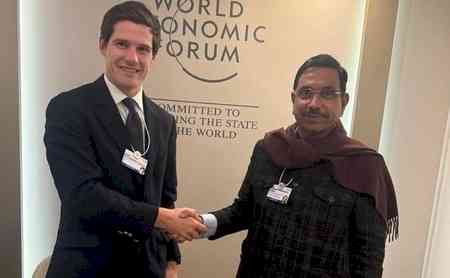
Davos, Jan 22 (IANS) India’s energy transition has been deliberately designed as a tool for industrial growth, job creation and global competitiveness, particularly for emerging economies, said Union Minister for New and Renewable Energy, Pralhad Joshi, here on Thursday.
Addressing a high-level session on “Energy: The Great Funding Gap” at the World Economic Forum Annual Meeting, the Minister underlined that under the leadership of Prime Minister Narendra Modi, India has transformed its clean energy transition into a people-centric development movement, while simultaneously strengthening energy security and lowering costs for industry.
The Minister stated that India has already achieved 267 GW of installed non-fossil energy capacity, with renewables now accounting for around 52 per cent of the country’s total installed power capacity, well ahead of earlier timelines.
He emphasised that India views the energy transition not merely as an environmental imperative, but as a growth enabler, supporting rapid industrialisation and making electricity more affordable for businesses and households alike.
Highlighting flagship decentralised renewable energy programmes, the Minister said that PM Surya Ghar: Muft Bijli Yojana has enabled the installation of rooftop solar systems in 2.7 million households in the last two years alone, with a target of 10 million households, which is expected to generate around 30 GW of power.
Under PM-KUSUM, more than 2.1 million farmers across the country have had their irrigation pumps solarised, significantly reducing dependence on subsidised grid power while enabling farmers to earn additional income by selling surplus electricity.
“These initiatives are not only providing affordable energy but are also turning consumers into ‘prosumers’, improving household incomes and rural livelihoods,” the Minister said.
By replacing high-cost subsidised electricity with low-cost solar power, the savings have translated into lower tariffs for industry and households, marking a historic shift in India’s power sector. Electricity tariffs are coming down because of the renewable energy revolution, he noted.
The Union Minister highlighted that India has built a strong domestic manufacturing base across the renewable energy value chain. He noted that the country has already established 144 GW of solar module manufacturing capacity, while solar cell manufacturing capacity has reached 27 GW and is expected to expand to around 50 GW in the near future.
He further stated that India is moving towards completing the entire manufacturing cycle, with planned manufacturing of wafers and ingots set to commence shortly.
Alongside solar manufacturing, the Union Minister underlined the rapid scale-up of wind energy, battery storage and pumped storage solutions, which are critical for ensuring reliability and grid stability. These efforts, he said, are not only strengthening India’s clean energy supply chains but are also generating large-scale employment and enhancing the country’s industrial competitiveness.
In bilateral diplomatic engagements, Joshi met Dr. Tareq Abu Ghazaleh, Minister of Investment, and Ms. Zeina Toukan, Minister of Planning and International Cooperation of Jordan, and discussed avenues for enhanced cooperation and investment partnerships.
The Union Minister also met Amon Murwira, Minister of Foreign Affairs and International Trade of Zimbabwe, and discussed deepening India–Zimbabwe cooperation in renewable energy.
Joshi met Dr. Fatih Birol, Executive Director of the International Energy Agency. The discussions covered strengthening the IEA’s focus on India-specific data, analysis and policy recommendations, as well as exploring innovative financing approaches to help lower the cost of capital.
—IANS
na/