Focus on building economically viable water projects: Maha CM tells World Bank
Chief Minister Devendra Fadnavis on Thursday emphasised that to ensure the financial viability and long-term sustainability of water projects, necessary land, right-of-way, and other clearances must be secured in advance.
 IANS
Oct 22, 2026 10:44
0
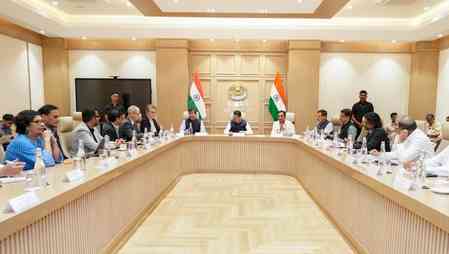
Mumbai, Oct 22 (IANS) Chief Minister Devendra Fadnavis on Thursday emphasised that to ensure the financial viability and long-term sustainability of water projects, necessary land, right-of-way, and other clearances must be secured in advance.
He also highlighted the need to reduce electricity costs through technologies such as solar energy and battery storage, and to make these projects financially self-sufficient by identifying consumers for treated wastewater.
He was speaking at the review meeting regarding Maharashtra's urban infrastructure and water projects with a delegation from the World Bank and the International Finance Corporation (IFC).
The meeting focused on project implementation, financing, technical solutions, and completing projects within targeted timeframes.
CM Fadnavis stated that cooperation with the World Bank extends beyond financial assistance; it is vital for driving institutional and systemic reforms. The World Bank's contribution is crucial in developing modern technology, efficient operational frameworks, and sustainable systems for future generations.
The state has previously collaborated with the World Bank across various sectors, and this partnership needs to be expanded further. To prevent delays in project execution, having land available, rights-of-way defined, and all statutory clearances obtained beforehand is critical, said the CM.
Frequently, after a project is approved, the unavailability of land or other hurdles delay the commencement of work by one to two years. Therefore, projects selected for financing must be fully shovel-ready for actual investment, Fadnavis noted.
He added that smaller cities also have a high demand for such infrastructure. Combining available resources and coordinating across institutions will lower financing costs, ensuring projects are economically viable and durable, he added.
According to the CM, electricity is a major operational expense for water projects. In many cases, operational bottlenecks stem not from technical failures, but from unaffordable power bills.
Recognising this, operating expenses must be factored in right from the planning stage. Utilising solar power projects, battery storage, and modern technology will help reduce power expenses, boosting the financial viability and long-term sustainability of water projects.
He noted that effective reuse of sewage-treated water is equally important. Identifying industrial and other consumers for treated water should form an integral part of project planning. This generates water demand, encourages recycling, and allows for partial recovery of project investments.
The Chief Minister said that existing policies regarding supplying treated water to industrial zones and power plants should be updated and refined to establish robust mechanisms for increased recycled water usage.
Although the project timelines presented during the meeting are ambitious, they are achievable through sound planning and inter-agency coordination. All concerned authorities must work within the established deadlines to expedite execution.
The Chief Minister expressed confidence that successfully executing the initial phase of planned projects will pave the way for broader, scaled-up implementation.
--IANS
sj/dan