“Energy Security is Inseparable from National Security”: Minister Dr. Jitendra Singh at PHDCCI 6th International Climate Summit 2026
Union Minister Dr Jitendra Singh said today, inaugurating the PHD Chamber of Commerce and Industry's (PHDCCI) 6th International Climate Summit 2026 on the theme “India's Energy & Food Security Mission,” held at Hotel Le Meridien, New Delhi.
 City Air News
Sep 2, 2026 08:25
0
City Air News
Sep 2, 2026 08:25
0
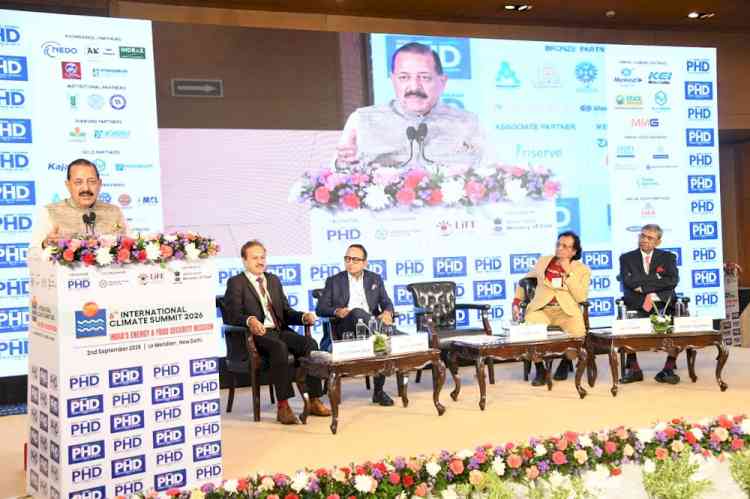
New Delhi, September 2, 2026: India's energy sector has been accorded unprecedented policy priority over the last decade, with the government simultaneously pursuing nuclear expansion, green hydrogen, biofuels and circular economy initiatives to secure the country's energy and food future, Union Minister Dr Jitendra Singh said today, inaugurating the PHD Chamber of Commerce and Industry's (PHDCCI) 6th International Climate Summit 2026 on the theme “India's Energy & Food Security Mission,” held at Hotel Le Meridien, New Delhi.
Dr Jitendra Singh, Hon’ble Union Minister of State (Independent Charge), Ministry of Science and Technology, said energy security is inseparable from national security, strategic autonomy and economic resilience, and stressed the need for an increasingly self-reliant, indigenous, affordable and technology-driven energy sector. Highlighting India’s multi-pathway strategy, he said the country is targeting 100 GW of nuclear capacity by 2047 and five SMRs by 2033, while advancing green hydrogen, biofuels, ethanol and sustainable aviation fuel. He noted that India’s startup ecosystem has grown from around 350 in 2014 to nearly 2.4 lakh, with biotechnology startups reaching nearly 13,000, while the bio-economy has expanded from USD 10 billion to nearly USD 200 billion. He also highlighted the Rs 1 lakh crore RDI Fund to boost private-sector participation in R&D and said PHDCCI can serve as a bridge between the government and non-government sector in India’s journey towards 2047.
While addressing the august gathering Dr Anil Kakodkar, Chancellor, Homi Bhabha National Institute, said India would require around 28,000 TWh of energy annually to achieve a developed-nation standard of living. He estimated renewables could contribute about 8,000 TWh, with the remaining demand requiring a diversified mix including nuclear and fossil energy supported by CCUS. He stressed the potential of bioenergy for meeting India’s cooking-fuel needs and called for accelerating the shift from uranium to thorium-based nuclear technologies, supported by recycling and closed fuel cycles, to strengthen India’s long-term energy security.
Chakravarthy T. Kannan, Secretary General, Quality Council of India, spoke on the role of a robust national accreditation ecosystem in scaling up India's manufacturing and localisation ambitions, drawing parallels with healthcare and export sectors. He said Quality Council of India's accreditation bodies, including the National Accreditation Board for Testing and Calibration Laboratories (NABL) and NABCB, currently work with over 30,000 hospitals across the country and are recognised internationally through mutual recognition arrangements with global bodies such as IAF and ILAC, allowing Indian certifications to be accepted across more than 150 countries. He offered to collaborate with PHDCCI to build similar multi-level accreditation frameworks for the energy and sustainability sectors.
Highlighting India’s rapid renewable energy expansion, the summit noted the growth of large-scale solar and battery storage projects, integrated solar-wind-hydro systems and agrivoltaic models that combine agriculture with solar power generation. Erik Solheim, President, Europe Asia Center, Brussels, said the traditional trade-off between economic growth and environmental protection was outdated, and that renewable energy can strengthen both economic resilience and energy security by reducing dependence on volatile oil markets.
Dr Vijay Kumar Saraswat, Former Member, NITI Aayog and former Director General, DRDO, highlighted the need to balance India’s rising energy demand with its climate commitments. He noted that India is on track to achieve 50% of installed power capacity from non-fossil sources by 2030, with nearly 300 GW already installed. He estimated the country’s net-zero investment requirement through 2070 at Rs 22.7 lakh crore, with an annual financing need of around Rs 450–500 billion. Calling for a pragmatic energy transition, he advocated low-carbon hydrogen beyond colour classifications, greater use of domestic resources through coal gasification and CCUS, reduced import dependence and greater private-sector participation in nuclear R&D.
Dr JP Gupta, Chair, Environment & Climate Change Committee, PHDCCI, announced the development of “Agni Kavach,” described as the world's first GPU-based, open-source AI-driven industrial risk and safety analysis software platform, developed indigenously to end India's dependence on foreign safety-analysis software that currently costs industry upward of Rs 1 crore annually per user in licensing and renewal fees. He said the platform, positioned as a start-up with unicorn potential within three to four years, is designed to serve process, oil and gas, fertilizer, nuclear, defence and disaster-management industries, and sought government support to scale its adoption, particularly among MSMEs where industrial accidents remain high.
Earlier, delivering the welcome address, Sanjay Singhania, Vice President, PHDCCI, said the summit brought together science and technology, government and industry to advance India's energy and food security mission. Citing global benchmarks, he pointed to Brazil's decades-long ethanol ecosystem linking agriculture, industry and fuel distribution, and Denmark's integration of waste-to-energy technologies, including utilising heat generated by data centres, as models India could match or exceed. He cited an Indore-based start-up that has scaled from biogas to compressed biogas, advanced biofuels and sustainable aviation fuel in collaboration with CSIR as an example of homegrown innovation. Mr Singhania said PHDCCI's role is to connect government, scientists, entrepreneurs and industry so that ideas translate into partnerships, investment and measurable outcomes.
Dr Jatinder Singh, Deputy Secretary General, PHDCCI, delivered the vote of thanks, commending the Minister for consistently supporting the summit over multiple editions and for translating policy commitments into action across science, technology and climate initiatives.
The summit also featured a series of technical sessions covering “Bioethanol, Bio Fuels, Bio Plastics and Chemicals,” “Coal Gasification – From Coal to Value,” “Small Modular Reactors: Scalable Nuclear Solutions for India’s Energy Transition,” and “Process Safety, Risk Management & Agni Kavach,” bringing together experts from government, industry, academia and research institutions to discuss technology, investment, safety and scalable solutions for India’s energy transition.
The programme also featured the release of the Knowledge Book and the unveiling of an Anion Exchange Membrane (AEM) electrolyzer developed by the Dr Bansi Dhar Institute.
The summit concluded with a call for stronger collaboration among government, industry, academia and technology institutions to accelerate indigenous innovation, strengthen energy security, reduce import dependence and build a resilient and sustainable energy ecosystem aligned with India’s 2047 development vision.