Delhi chokes as AQI breaches 450; GRAP-4 emergency curbs kick in across NCR
As stricter pollution norms under the Graded Response Action Plan (GRAP) Stage 4 came into force, emergency curbs were triggered across Delhi on Sunday as the city's air quality continued to deteriorate.
 IANS
Dec 14, 2025 05:11
0
IANS
Dec 14, 2025 05:11
0
New Delhi, Dec 14 (IANS) As stricter pollution norms under the Graded Response Action Plan (GRAP) Stage 4 came into force, emergency curbs were triggered across Delhi on Sunday as the city's air quality continued to deteriorate.
The Commission for Air Quality Management (CAQM), the Centre's anti-pollution panel, first invoked restrictions under GRAP-3 for Delhi and adjoining areas on Saturday afternoon and escalated them to GRAP-4 later the same evening after observing a sharp worsening of air quality.
Shortly after the decision, Delhi's Air Quality Index (AQI) stood at 431 at around 4 p.m. on Saturday and further climbed to 441 by 6 p.m., prompting the announcement of the strictest set of curbs under the GRAP framework.
"Keeping in view the prevailing trend of air quality and in an effort to prevent further deterioration of air quality in the region, the CAQM Sub-Committee on GRAP decides to invoke all actions as envisaged under Stage-IV of the extant GRAP -- 'Severe+' Air Quality (DELHI AQI > 450), with immediate effect, in the entire NCR. This is in addition to the actions under Stages I, II & III of extant GRAP already in force in NCR," the CAQM said in a statement.
Following the decision, the Delhi government directed all government and private schools to conduct classes up to Class 11, except Class 10, in a hybrid mode, combining physical and online teaching.
In addition, 50 per cent of staff in government and private offices have been asked to work from home.
"The remaining staff shall mandatorily work from home," the order said, while also urging all private establishments to implement staggered working hours wherever feasible.
Private offices have been further instructed to ensure strict compliance with work-from-home norms and to minimise vehicular movement related to office commutes.
However, certain essential services have been exempted from these directions.
"Hospitals and other public/private health establishments, Fire Services, Prisons, Public Transport, Electricity, Water, Sanitation and related municipal services, disaster management and related services, forest and environment departments/agencies engaged in air pollution control, monitoring, and enforcement activities (like teams deployed to curb biomass burning, dust control, GRAP measures, etc.), and other essential/emergency services shall be exempted from these directions," the order stated.
Under the graded response mechanism, GRAP-1 restrictions come into force when the AQI ranges between 201 and 300, categorised as 'Poor'. GRAP-2 applies when the AQI is between 301 and 400, classified as 'Very Poor'. GRAP-3 restrictions are imposed when the AQI is between 401 and 450, labelled 'Severe', while GRAP-4, the most stringent stage, is enforced when the AQI crosses 450, falling into the 'Severe Plus' category.
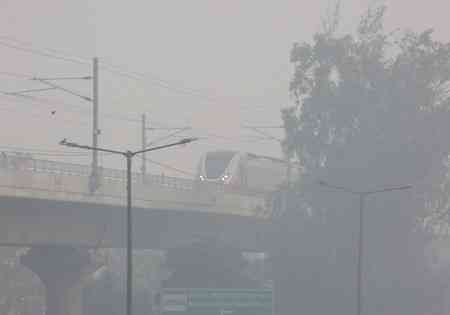
Meanwhile, air pollution in the national capital, which had already deteriorated into the 'severe' category, worsened further on Sunday as a thick blanket of toxic smog enveloped the city, pushing air quality to hazardous levels and affecting visibility in several areas.
According to data released by the CPCB, Delhi's average AQI climbed to 461 at 7 a.m. on Sunday, up from 431 recorded a day earlier.
All 40 air quality monitoring stations across Delhi reported readings in the 'severe' category, with several locations nearing the maximum measurable limit. Rohini emerged as one of the worst-affected areas, recording an AQI of 499, followed closely by Bawana at 498. Vivek Vihar reported 495, while Ashok Vihar and Wazirpur registered AQI levels of 493 each. Narela recorded 492, and Anand Vihar stood at 491.
Other parts of the city also remained heavily polluted. ITO recorded an AQI of 485, Mundaka 486, Punjabi Bagh 478, Nehru Nagar 476, and both Chandni Chowk and Okhla registered readings of 470, reflecting widespread and persistent pollution across the Capital.
--IANS
sd/skp