CT Group of Institutions, Maqsudan Develops AI-Powered Gesture Recognition System to Empower the Deaf and Speech-Impaired
Demonstrating its commitment to innovation and research-driven learning, CT Group of Institutions, Maqsudan, Jalandhar has developed an innovative AI-Powered Gesture Recognition System to facilitate seamless communication for individuals with speech and hearing impairments. The intelligent solution recognizes hand gestures in real time and instantly converts them into both text and speech, enabling users to communicate more effectively in everyday situations.
 Rajat Kumar
Jul 28, 2026 08:59
0
Rajat Kumar
Jul 28, 2026 08:59
0
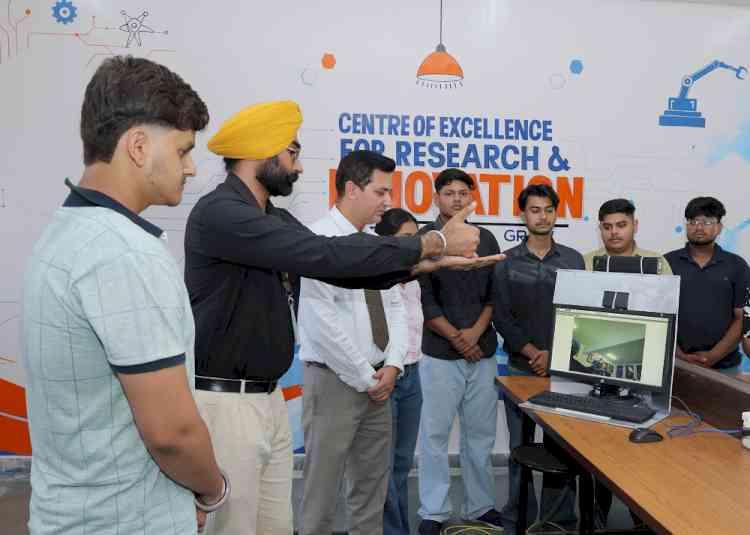
Jalandhar, July 28, 2206: Demonstrating its commitment to innovation and research-driven learning, CT Group of Institutions, Maqsudan, Jalandhar has developed an innovative AI-Powered Gesture Recognition System to facilitate seamless communication for individuals with speech and hearing impairments. The intelligent solution recognizes hand gestures in real time and instantly converts them into both text and speech, enabling users to communicate more effectively in everyday situations.
Built using modern Artificial Intelligence and Computer Vision technologies, the system leverages TensorFlow, OpenCV, MediaPipe, Random Forest, NumPy, Pillow, Pandas, Joblib, PiCamera2, and Socket Programming to accurately detect and classify hand gestures. Live video captured through the camera is processed to extract hand landmarks, which are then analysed by a trained machine learning model to generate the corresponding text and voice output within seconds.
Designed for real-time performance, the solution provides a simple and user-friendly interface with minimal response time. The integrated text-to-speech functionality ensures that recognized gestures are immediately converted into audible speech, making conversations more natural and efficient.
The system has wide-ranging applications in healthcare, educational institutions, government offices, customer service centres, public spaces, and homes, where effective communication with deaf and speech-impaired individuals is essential. It also has the potential to be integrated into assistive devices and smart environments, promoting greater accessibility and inclusivity.
The project demonstrates how Artificial Intelligence can be applied to solve real-world social challenges through affordable and practical technological solutions. By combining machine learning, computer vision, and real-time processing, the system aims to reduce communication barriers and empower individuals with speech and hearing disabilities.
Appreciating the efforts of the team, Charanjit Singh Channi, Chairman, CT Group of Institutions, said that technology should always be used to create meaningful social impact. He congratulated the faculty members and students for developing an innovative solution that reflects the institution's commitment to research, innovation, and community welfare.
Dr. Manbir Singh, Managing Director, CT Group of Institutions, said that the institution continuously encourages students and faculty members to work on research projects that address real-life challenges. He added that such innovations not only enhance technical expertise but also contribute towards building a more inclusive society.