CSITM hosts a panel discussion on ‘The New Age of Financial Crime: Can Technology Keep Us One Step Ahead?’
Industry experts and IIMB faculty discuss emerging financial crime risks and technology-led solutions
 City Air News
Nov 26, 2026 10:35
0
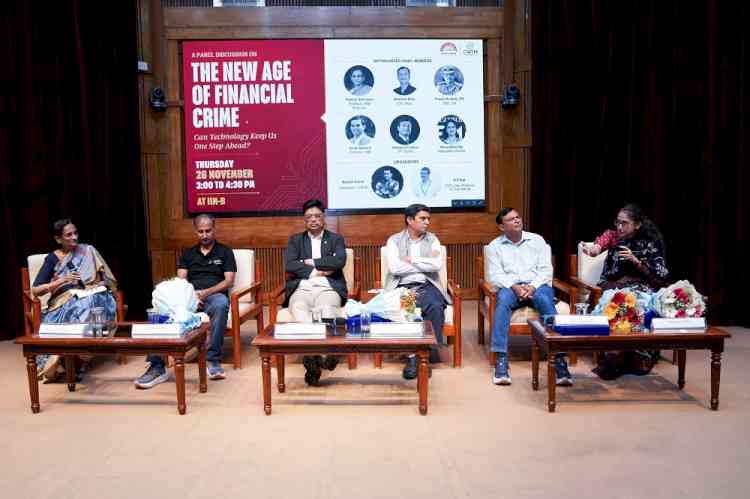
Bangalore, November 26, 2026: India's digital payments have widened financial access, but they have also created new openings for fraud. Against this backdrop, the Centre for Software & IT Management (CSITM), IIM Bangalore, in partnership with PayU, hosted the panel discussion ‘The New Age of Financial Crime: Can Technology Keep Us One Step Ahead?’ on Thursday, with the 65 finalists of the ‘Follow the Money Innovation Challenge’ in attendance. Prof. Mayank Kumar, Chairperson, CSITM, said the Centre's work this year centres on cybersecurity and cybercrime mitigation. A short video presented their products under development: Cyberlens, which cites its sources for every answer, and Saavdhan, which flags suspicious messages and explains each warning in plain words.
Panel Discussion: The New Age of Financial Crime: Can Technology Keep Us One Step Ahead?
Prof. Padmini Srinivasan, Chairperson, Centre for Corporate Governance and Sustainability (CCGS), and faculty in Finance and Accounting, IIMB, moderated the panel discussion. She observed that digital payments now reach everyone from vegetable vendors to corporates, and that speed and convenience have also enabled fraud. She also cited a case from the previous week in which about ₹70 lakh was moved to some 500 accounts within minutes.
The discussion drew on several figures. Prof. Arnab Mukherji, Chairperson, PGPPM and faculty in Public Policy, IIMB, said Indian data shows financial fraud rising over six years from ₹551 crore to a couple of times that amount. Mayurakshi Ray, Cybersecurity expert and Independent Director, cited a report projecting global cybercrime of 20 trillion in 2026, 150 per cent above 2022. Narendra Babu, CTO, PayU, said his company handles seven to ten million transactions a day and applies sophisticated AI models to isolate the roughly 200 that are fraudulent, with more time and data improving accuracy.
Narendra Babu, CTO, PayU, said that bill payments that once took half a day now take seconds, but the time needed to exploit a vulnerability has fallen to minutes, with attackers' technology ahead of the industry. He noted that "money transfer is a one-way thing that you just transfer, and you lose control of that", and that payment firms are reintroducing human approval. He advised learning to distrust and passing awareness to older relatives. "Technology for sure will catch up, but it just needs a little bit of time."
Dr. Pronab Mohanty, Director General of Police, CID, Karnataka, said Aadhaar, UPI and easy bank access had made payments easy, and easy for fraudsters to misuse. Describing the perpetrators as having "computer semi-literacy", he said the crime is now largely run as "a community enterprise". He urged victims to call the 1930 helpline "as quickly as possible", ideally within two hours. His three main precautions were: do not click unknown links, do not scan QR codes in the expectation of receiving money, and never share OTPs or passwords.
Prof. Arnab Mukherji, Chairperson, PGPPM, IIMB, said estimates link a 10% rise in online activity to a gain of a few percentage points in GDP, and that these estimates become relevant again when thinking about how to be defensive and responsive. Citing a Nobel laureate's 1968 book, ‘Crime and Punishment’, which treats the criminal as a rational agent, he said the offender is now often "a network, maybe an organized entity", so policy turns on what the regulatory ecosystem allows offenders to get away with. He also cautioned that digital arrest scams erode trust, which anchors society, and said there is a mandate to get people more equipped, like first aid.
Shantanu Preetam, VP and India Country Head, PayPal, said that checkout decisions are made in a fraction of a second, leaving risk checks well under 100 milliseconds, so protection must be built as a continuous, network-wide effort rather than a one-off check. On personal habits, he said greed is the human trait most easily exploited, and that promises of 30 to 40 per cent returns should prompt caution, since genuine promoters would earn such returns themselves. He added that higher credit limits mean greater exposure and recommended using the lock features banks now offer.
Mayurakshi Ray, cybersecurity expert and independent director, said payments digitisation had also led to the democratisation of crime, accelerated by AI. She cited a bank chief executive's account of 47 million rupees moved across 112 accounts in two hours. Regulators, she said, are "moving from protection to resilience", which calls for simulations and phishing drills.
Taken together, the panel's message was consistent: the speed that benefits users also benefits attackers; technology needs time to catch up, and awareness must bridge the gap. Until defences mature, vigilance, family-level awareness, prompt reporting and organisational resilience remain the first line of protection.
A PayU-led bootcamp preceded the Grand Finale, where finalist teams presented solutions to "The Bakery That Takes Bets" before a jury of industry experts and faculty. Team Slide 11, consisting of Dhruv Bhandari, Devarshee Jitendra Mude, Chalasani Chandra Sriyanth and Chinmay S, won first prize; Team Albatross Alliance, with students Sriyanshu Mishra, Samridhi Aggarwal, Pooja Karwa and Ridhima Shah, won second; and Team Enigma, with Gulshan Rajrishi and Supriti Das, won third.