Congress welcomes West Asia ceasefire, urges Centre to engage Oppn
The Congress party on Friday hailed the emerging ceasefire between the United States and Iran as a “vital step” toward de‑escalation of tension in West Asia and criticised targeted assassinations, unlawful wars, and civilian attacks as “unconscionable crimes” against humanity and global rules.
 IANS
Apr 10, 2026 11:29
0
IANS
Apr 10, 2026 11:29
0
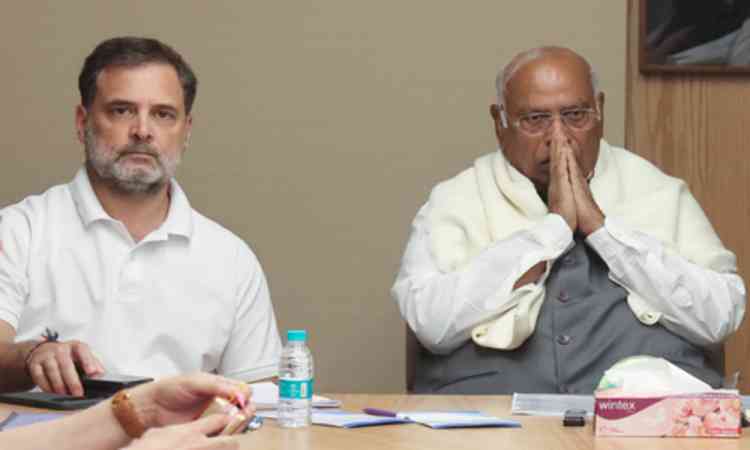
New Delhi, April 10 (IANS) The Congress party on Friday hailed the emerging ceasefire between the United States and Iran as a “vital step” toward de‑escalation of tension in West Asia and criticised targeted assassinations, unlawful wars, and civilian attacks as “unconscionable crimes” against humanity and global rules.
In a resolution adopted by the Congress Working Committee, the party also urged the Bharatiya Janata Party‑led Union government to engage with the Opposition to “recreate India’s historic identity as a proactive global peace proponent”, it stated.
“The BJP government must take the Opposition into confidence, urgently recalibrate and adopt a unified national approach to restore India’s historic role as a principled, proactive, and credible voice for peace and a just international order,” it said.
The Congress Working Committee further invoked foundational international laws, including the Geneva Conventions, the International Covenant on Civil and Political Rights, the United Nations Charter’s Article 2(4), which prohibits the use of force against state sovereignty, and Article 2(3), which mandates peaceful dispute resolution.
In India, “Successive governments since 1947 have upheld these global principles, drawing on a foreign policy tradition rooted in Vasudhaiva Kutumbakam (‘the world is one family’), Mahatma Gandhi’s doctrine of Ahimsa (non‑violence), and Prime Minister Jawaharlal Nehru’s policy of non‑alignment,” it claimed.
Pointing out that this commitment is included in Article 51 of the Constitution, “which calls for respect for international law and treaty obligations”, the party stated that “India has consistently and constructively intervened against apartheid in South Africa, in the Korean War through the Neutral Nations Repatriation Commission, in its support for anti‑colonial movements across Asia and Africa, as a principled voice of the Non‑Aligned Movement and the Global South, reflected in sustained diplomatic efforts to resolve conflicts in numerous conflicts such as Hungary, Egypt, Vietnam, Iraq, Afghanistan etc., and from its contributions to humanitarian relief and United Nations peacekeeping operations.”
Citing India’s interventions during apartheid and the Korean War, the Congress Working Committee statement said that as the founder of the Non‑Aligned Movement at the 1961 Belgrade Summit, India supported decolonisation in Asia and Africa, hosting the 1983 Summit.
“It (India) mediated crises like the 1956 Suez (Hungary‑Egypt linkage), Vietnam peace efforts, and post‑2003 Iraq reconstruction diplomacy. India’s United Nations peacekeeping contributions, over 280,000 troops in 50 missions since 1948, including current deployments in Lebanon and South Sudan, remain unmatched (United Nations Peacekeeping data, 2025),” it said.
The party also blamed the Union government for “ceding strategic and diplomatic space”, and for handing “Pakistan the room to rehabilitate its global image, and whitewash its track record of fomenting regional instability through support for cross‑border terrorism targeting India, Afghanistan, and Iran”.
The Congress further pointed out the rising costs due to maritime trade uncertainty in West Asia, which has affected the economy.
“The ceasefire offers India a chance to reassess escalating costs. Since the October 2023 Israel‑Hamas war, India’s energy imports from West Asia (40 per cent of oil, per Petroleum Ministry 2025 figures) faced disruptions, spiking LPG and fertiliser prices, evident in 2024 shortages amid Red Sea attacks (Reserve Bank of India reports),” it added.
“Strained ties with Iran and regional proxies weakened India’s Indian Ocean security provider role, while Global South leadership eroded amid perceived Western alignment (2024 BRICS Summit analyses),” said the statement further.
--IANS
jb/dan