Chinese fishing fleets pose maritime security threat to Indian Ocean region: Report
China’s expanding use of fishing fleets and maritime militia in the Indian Ocean Region (IOR) reflects a deliberate strategy aimed at normalising coercive presence and undermining established maritime norms.
 IANS
Feb 3, 2026 08:45
0
IANS
Feb 3, 2026 08:45
0
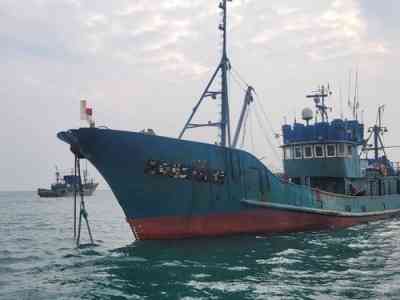
Naypyidaw, Feb 3 (IANS) China’s expanding use of fishing fleets and maritime militia in the Indian Ocean Region (IOR) reflects a deliberate strategy aimed at normalising coercive presence and undermining established maritime norms.
Through the weaponisation of civilian vessels and exploitation of legal ambiguities, Beijing is exporting instability, environmental degradation, and strategic pressure into a region vital to regional security, posing a direct maritime threat to the IOR rather than a peripheral fisheries concern, a report said on Tuesday.
According to a report in Myanmar media outlet 'Mizzima News', amid mounting pressure on the international order from geopolitical rivalry and climate-driven resource scarcity, China’s conduct in the IOR mirrors a recurring and troubling pattern.
“Under the guise of civilian economic activity, Beijing is extending its maritime footprint through heavily subsidised distant-water fishing fleets that operate in close coordination with state and military institutions. What appears on the surface as fishing is, in practice, a grey-zone strategy, blending economic exploitation, intelligence gathering, and coercive presence to reshape maritime realities without triggering open conflict. The Indian Ocean is now emerging as the next testing ground for this model,” the report detailed.
“China has been struggling to maintain food and economic security, which has led it to expand its fishing operations beyond the South and East China Seas and far into the Indian Ocean. Its large ‘civilian’ distant-water fishing (DWF) fleets, affiliated to varying degrees with Chinese government agencies, are militarily trained, and seen as China extending its maritime power – challenging international rules and using non-traditional maritime forces,” it added.
China’s Distant-Water Fishing (DWF) fleets, the report said, have come under growing international scrutiny over environmental damage, including overfishing, ecosystem damage, shark finning—as well as human rights abuses such as forced labour, violence, debt bondage on vessels, -- alongside illegal, unreported, and unregulated (IUU) fishing. China’s assertions of responsible behaviour contrast sharply with a documented pattern of “deception, coercion, and rule evasion”.
The report emphasised that China has weaponised its massive fishing fleet to advance its goals while operating below the radar, avoiding escalation. It added that China also presents a major normative threat to a weakening world order. While Beijing advocates for the code of conduct in the South China Sea (SCS), the actions of its maritime militia undermine the United Nations Convention on the Law of the Sea (UNCLOS), eroding maritime governance and establishing a precedent that favours coercion over compliance.
The report further said, “What China is exporting to the Indian Ocean is not fishing capacity, but a tested model of maritime coercion, refined in the South China Sea and now adapted for a new theatre.”
--IANS
scor/as