CBRN Threats are No Longer Theoretical Concerns but a Critical and Evolving Challenge for Modern Economies like India: Roli Singh
CBRN Threats are No Longer Theoretical Concerns but a Critical and Evolving Challenge for Modern Economies like India: say Roli Singh, Chairperson, National Authority Chemical Weapons Convention (NACWC)
 City Air News
May 18, 2026 09:10
0
City Air News
May 18, 2026 09:10
0
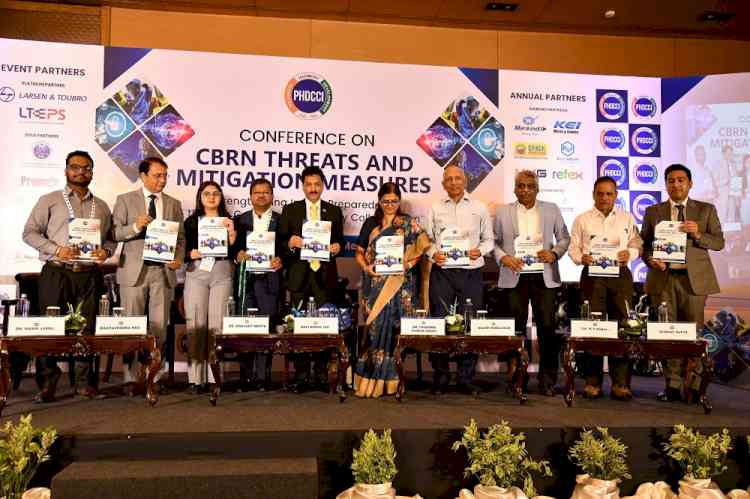
New Delhi, May 18, 2026: Addressing the PHD Chamber of Commerce and Industry Conference on “CBRN Threats and Mitigation Measures”, Roli Singh, Chairperson, National Authority Chemical Weapons Convention (NACWC), stated that Chemical, Biological, Radiological and Nuclear (CBRN) threats are no longer theoretical concerns but have emerged as critical and evolving challenges for modern economies like India amid rapid industrialisation, technological advancement, and growing geopolitical uncertainty.
Highlighting risks arising from terrorism, non-state actors, cyber-enabled disruptions, illicit trafficking of chemicals, industrial accidents, and misuse of dual-use technologies, she stressed the urgent need for stronger preparedness, integrated risk management, and deeper collaboration among government, industry, academia, emergency responders, and security agencies.
She noted that advances in biotechnology, synthetic biology, digitisation, and interconnected supply chains have created unprecedented opportunities while simultaneously increasing vulnerabilities, particularly in the areas of biosecurity and cyber-physical infrastructure protection. Reaffirming India’s commitment to responsible chemistry and compliance with the Chemical Weapons Convention, she underscored the importance of balanced, science-driven, and industry-friendly regulatory systems that support innovation while ensuring safety and security.
Emphasising that preparedness must extend beyond regulations to include real-time response systems, district-level disaster integration, training of first responders, medical preparedness, and industry-government coordination, she concluded that “preparedness, partnership and prevention”, supported by responsible innovation, are the key pillars for building a resilient and secure CBRN ecosystem in India.
Dr. Upendra Kumar Singh, Distinguished Scientist and DG – Soldier Support Systems (SSS), Defence Research and Development Organisation, highlighted the growing complexity of global security challenges amid rapidly shifting geopolitical dynamics, weakening international institutions, and increasing risks of unconventional warfare. He emphasized that modern conflicts now extend beyond military power into economic, technological, biological, and cultural domains, making CBRN threats a multidimensional challenge involving national security, public health, environmental safety, disaster management, and industrial preparedness.
Referring to incidents such as Chernobyl disaster, Fukushima Daiichi nuclear disaster, the COVID-19 pandemic, Ebola outbreaks, chemical disasters, and the potential misuse of radioactive materials and dual-use technologies, he underlined the urgent need for stronger preparedness, indigenous capability development, and coordinated action among government agencies, industry, academia, and healthcare institutions.
He noted that DRDO is actively advancing indigenous research in early warning systems, detection technologies, protective equipment, medical countermeasures, AI-based sensor networks, and field-deployable CBRN solutions tailored to Indian environmental conditions. Stressing the growing demand for indigenous technologies and industry participation, he called upon Indian industries and research institutions to collaborate closely with DRDO to bridge critical capability gaps and strengthen India’s resilience against future chemical, biological, radiological, and nuclear threats.
Col. KV Kuber, Director – Aerospace & Defence, Ernst & Young, drew compelling parallels between the Mahabharata and modern-day geopolitical realities, warning that the world today faces rising risks of escalation, retaliation, and psychologically driven decision-making by powerful leaders.
Emphasising how prolonged conflict can dehumanise even the greatest warriors, he noted that while the probability of a full-scale nuclear war remains low, the danger of tactical nuclear use, miscalculation, and deterrence breakdown is higher than at any time since the Cold War due to collapsing arms control mechanisms, growing geopolitical tensions, and the modernization of arsenals. Drawing lessons from history, Hiroshima, and contemporary conflicts, he underlined that modern warfare increasingly demands not only military strength but also institutional restraint, rapid response capability, and calibrated escalation management to preserve global stability.
Nilesh Parulekar, VP & Head – Electronic Products and Systems (Strategic), Larsen & Toubro Precision Engineering & Systems, emphasised the transition from research-driven development to a business-oriented approach within the defence electronics industry. He advocated greater collaboration among Indian industries to develop globally competitive products rather than working in isolation, while stressing the need for a holistic vision involving industry, academia, users, and policymakers to align standards, investments, and expectations.
Raghavendra Rao, GM – India Operations, Proengin, emphasised that CBRN threats today extend far beyond conventional warfare and increasingly include industrial accidents, toxic chemical releases, asymmetric warfare, and emerging technological risks. Highlighting that response time in chemical and biological incidents is measured not in hours but in seconds, he stressed the urgent need for proactive preparedness, rapid detection, and coordinated response mechanisms.
Welcoming delegates to the conference, Dr. Ranjeet Mehta, CEO & Secretary General, PHDCCI, stated that modern warfare is no longer confined to borders and conventional weapons, as a single chemical, biological, or radiological attack can severely disrupt economies, healthcare systems, and critical infrastructure. Stressing that preparedness against such threats is a national imperative rather than solely the responsibility of defence forces, he called for active participation from citizens, industry, academia, policymakers, and security agencies alike.
Highlighting India’s rapidly growing economy, thriving startup ecosystem, and vast SME sector, he underlined the importance of proactive preparedness and preventive strategies to safeguard national growth and resilience amid evolving global conflicts and emerging unconventional threats. He also stressed the need for deeper collaboration between academia and industry to transform research into deployable commercial and strategic solutions.
Vaibhav Gupta, Co-Chair, Defence & HLS Committee, PHDCCI and Director, MKU Ltd, concluded the inaugural session by highlighting the importance of innovation-led development and stronger collaboration between industry and government to build a robust national preparedness ecosystem. He also emphasised the need for harmonisation of Indian testing and certification standards with international benchmarks to enhance global acceptance of indigenous products and strengthen export competitiveness.
With participation from defence experts, industry leaders, policymakers, and thought leaders from across the country, the conference emerged as a significant platform for generating actionable recommendations and policy inputs. PHDCCI committed to compiling and submitting a comprehensive report to policymakers to support India’s long-term CBRN preparedness and national security framework.
On the occasion, a Knowledge Report on CBRN Defence was unveiled by the distinguished guests.
The inaugural session was followed by Technical Sessions on:
• “CBRN Threat Perception in India & Need for a Comprehensive National CBRN Intelligence, Preparedness and Policy”
• “Emerging Technologies in CBRN Detection, Prevention and Response”