Bangladesh: Jamaat-e-Islami Ameer says a woman can never be the party chief
Bangladesh Jamaat-e-Islami Ameer Shafiqur Rahman has said that any woman cannot be chief of the radical party owing to religious obligations and "biological limitations".
 IANS
Jan 30, 2026 11:18
0
IANS
Jan 30, 2026 11:18
0
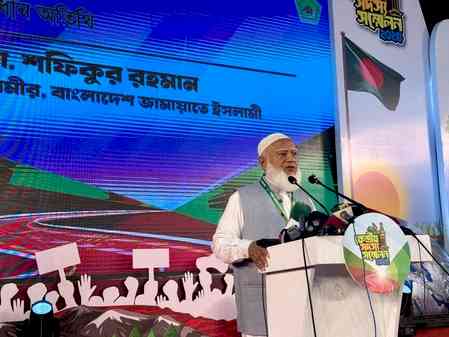
Dhaka, Jan 30 (IANS) Bangladesh Jamaat-e-Islami Ameer Shafiqur Rahman has said that any woman cannot be chief of the radical party owing to religious obligations and "biological limitations".
When asked during an Al Jazeera interview whether a woman could ever lead the party, Shafiqur Rehman responded, "It’s not possible. It’s not possible because Allah made everyone in its own entity. Because you [a man] will never be able to bear a child."
He further mentioned that men will not be able to breastfeed a child ever, Bangladesh-based The Daily Star reported while quoting an Al Jazeera report. The Jamaat party chief added: "This is God-given. And there are some differences between men and women. What Allah made, we cannot change it."
On being asked about the number of women contesting the upcoming Bangladesh polls from Jamaat-e-Islami, he responded, "Not a single one." However, he termed it a matter of timing and political culture of Bangladesh.
"You will not see any substantial number [of women] in other parties also, because this is the cultural entity in Bangladesh. [But] we are getting prepared for that," he said.
The interviewer mentioned that women have served as Bangladesh's Prime Minister in the past. In response, Shafiqur Rehman - reported The Daily Star quoting Al Jazeera - reiterated his stance, saying, "Even most of the countries in the world did not consider this feasible. This is the reality of the world."
Earlier this week, a report detailed that the 13th Parliamentary elections in Bangladesh, scheduled to be held on February 12, stand out for two features - no participation of Awami League, which is country's oldest political party and the small number of women contesting in the polls.
Bangladesh's interim government led by Muhammad Yunus banned Awami League for alleged misrule, resulting in the party not being able to contest polls. Furthermore, less number of women are contesting polls due to rising lawlessness and intolerance of women under Yunus-led government, a report in Eurasia Review stated.
While supporters have criticised the ban on the Awami League as its absence will raise questions on the legitimacy of the polls, the civil society and political parties have accepted Yunus-led government's decision to remove the oldest political party and its supporters from the political canvas of Bangladesh.
"Women have had the right to vote in Bangladesh. They have contested elections and produced two women Prime Ministers- Sheikh Hasina of the Awami League and Khaleda Zia of the Bangladesh Nationalist Party (BNP). However, the number of women candidates in the February 12 elections is paltry," senior journalist P K Balachandran wrote in 'Eurasia Review'.
"Although 51 registered political parties are contesting the election, more than 30 of them — including Bangladesh Jamaat-e-Islami — have not nominated even a single woman candidate. Of the 2,568 nomination papers submitted, only 109 had been filed by women, accounting for just 4.24 per cent of the total," he stated.
After representations and revision of the list, 1,981 candidates, including 76 females, were contesting polls, with women making up only 3.84 per cent of the total. According to the Election Commission, there are 64.81 million men voters and 62.87 million women voters on the register.
Of the 51 parties that were contesting in the polls, only a few have fielded women candidates. The Bangladesh Nationalist Party (BNP) had nominated women for 15 constituencies, however, the candidatures of only 11 were validated. Nine women are contesting from Bangladesh Samajtantrik Dal-Marxist, six each from the Jatiya Samajtantrik Dal (JSD) and the Insaniat Biplab Bangladesh, five each from the Ganasamhati Andolan and the Jatiya Party, and three each from Ganaodhikar Parishad (GOP). Only three women from a total of 44 candidates were contesting from the National Citizen Party (NCP), which emerged from the mass uprising in 2024.
The Biplobi Workers Party has nominated two women candidates while the Bangladesh Muslim League, the Communist Party of Bangladesh (CPB), the Bangladesh Supreme Party (BSP), the Bangladesh Samajtantrik Dal-Basosd, the Bangladesh Republican Party, the National People’s Party (NPP), the Aamjanatar Dal, the Islami Front Bangladesh, and the Bangladesh Labour Party, have all nominated one woman candidate each. No woman is contesting from the Jamaat-e-Islami, Islami Andolon Bangladesh, the Jatiya Party, the Gano Odhikar Parishad, the Bangladesh Khelafat Majlish and other smaller parties.
"Violence and harassment of women is a reason for women keeping away from active electoral politics. The HRW quoted data to show that gender-based violence increased between January and June 2025 compared to the same timeframe in 2024. Dr. Fauzia Moslem, president of the Bangladesh Mahila Parishad (Women’s Council of Bangladesh or BMP), attributes this increase to a rise in the rhetoric of Islamic radical groups seeking to restrict women’s free movement and participation in society," Balachandran opined.
--IANS
akl/as