AI and Robotics Set to Reshape Printing and Packaging Industry, Global Experts Tell International Conference at GJUST
The printing and packaging industry is entering a major technological transformation, with Artificial Intelligence (AI), robotics, machine vision, data analytics and digital twins emerging as important tools for improving productivity, quality, sustainability and competitiveness. This was the central message emerging from the International Conference on “AI and Robotics: Revolutionizing Printing & Packaging”, held from 24 to 26 September 2026 at Guru Jambheshwar University of Science & Technology (GJUST), Hisar.
 City Air News
Sep 30, 2026 08:22
0
City Air News
Sep 30, 2026 08:22
0
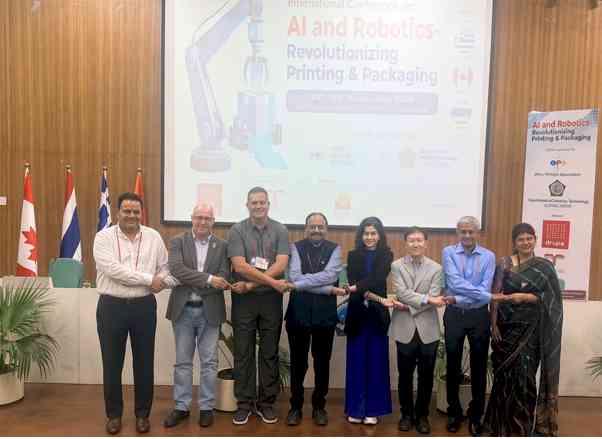
The printing and packaging industry is entering a major technological transformation, with Artificial Intelligence (AI), robotics, machine vision, data analytics and digital twins emerging as important tools for improving productivity, quality, sustainability and competitiveness. This was the central message emerging from the International Conference on “AI and Robotics: Revolutionizing Printing & Packaging”, held from 24 to 26 September 2026 at Guru Jambheshwar University of Science & Technology (GJUST), Hisar.
Conceived and initiated by the Offset Printers Association (OPA) under the vision and leadership of Prof. Kamal Mohan Chopra, and organised in association with the Department of Printing Technology, GJUST, the three-day international conference brought together academicians, industry leaders, printing professionals, technologists, researchers and students from India and abroad. The conference examined how the convergence of AI, robotics, intelligent automation, machine vision, data analytics and sustainable manufacturing is transforming the traditional printing and packaging ecosystem.
Six distinguished keynote speakers from India, Canada, Greece and Thailand presented perspectives covering technological innovation, intelligent manufacturing, quality assurance, business transformation, education, human capital and India's technological priorities. A recurring message throughout the conference was that technology should not be adopted merely because it is new. Its real value lies in solving genuine production and business challenges, improving quality and productivity, reducing waste, strengthening human capability and creating sustainable industrial value.
Prof. Dr Rajendrakumar Anayath highlighted the need for indigenous, affordable and MSME-accessible AI and robotics solutions suited to India's printing clusters. His presentation identified AI applications in prepress and press operations, collaborative robotics, 100% inspection, predictive maintenance through digital twins and sustainability through technological sovereignty as important areas for future development.
Erwin Driever of Canada demonstrated the practical potential of combining robotics and AI in print manufacturing, particularly in environments involving repetitive physical operations and large volumes of structured production data. He outlined a progression from augmenting human work to automating administrative functions, strengthening data collection and applying advanced analytics, with greater integration of AI and robotics offering opportunities for increasingly intelligent plant operations.
K G Suresh focused on AI-powered vision inspection and intelligent sorting, demonstrating the potential of continuous quality monitoring at high production speeds. His presentation showed how the evolution from rule-based machine vision to AI-enabled inspection can help move quality assurance from sampling towards comprehensive inspection.
Prof. Dr Anastasios E. Politis of Greece described the industry's transformation as a “Printing Odyssey”, linking AI with Industry 4.0/5.0, circular economy principles and digital transformation. He emphasised the importance of preserving expert knowledge through digital technologies and digital twins, while arguing for a human-centred approach to technological development.
Prof. Dr Aran Hansuebsai of Thailand urged the industry to look “Beyond Printing”, pointing towards higher-value applications such as packaging, labels, personalisation, sustainable solutions and connected products. He emphasised that technology adoption needs to be accompanied by business-model transformation, education and development of new professional skills.
Alexandra Vergopoulou of Greece provided a contrasting philosophical perspective through the theme “AI Dystopia”, stressing the continuing importance of human sensory perception, experience and judgement in printing. She highlighted human capital development as an essential component of an increasingly automated industry.
Across the presentations, speakers consistently emphasised that AI and robotics should extend human capability rather than be viewed solely through the lens of replacing human labour. Human judgement, experience, creativity, professional knowledge and skills development were identified as central to successful technological transformation. The conference identified several measurable outcomes against which technological transformation should ultimately be assessed, including reduced waste, improved quality, faster changeovers, greater productivity, lower downtime, improved resource utilisation, operational consistency and enhanced customer value.
Sustainability also emerged as an important dimension of industrial competitiveness. Circular design, waste reduction, resource efficiency and energy optimisation were discussed as areas where environmental performance and economic value can reinforce each other. The conference also underlined that there is no single technological roadmap for every market. For India, in particular, the affordability, scalability and local relevance of advanced technologies for the country's MSME-dominated printing and packaging ecosystem were highlighted as important considerations.
An important institutional outcome of the conference was the collaboration between the Offset Printers Association and the Department of Printing Technology, GJUST. The conference demonstrated how industry and academia can work together to promote industry-oriented research, curriculum development, professional and faculty development, student exposure to emerging technologies, joint innovation and technology transfer. The conference recommended a holistic approach to technological transformation, combining technology, business models, people, processes and sustainability. It also called for stronger data foundations, continuous professional development, AI and robotics-oriented curriculum reform, comprehensive AI-enabled quality assurance, affordable technologies for Indian industry and stronger academia–industry partnerships.
Adding a distinctive historical dimension to the conference, the organisers presented a special audiovisual tribute to the “Legends of Printing” before the technical sessions. The presentation honoured Johannes Gutenberg, Alois Senefelder and Karl Klič, whose innovations transformed successive eras of printing, while also recognising Benny Landa, a living pioneer of digital printing. Landa's participation and message created a symbolic link between the industry's historic technological breakthroughs, the digital printing revolution and the emerging age of AI and robotics. The tribute reinforced a central idea of the conference: printing has repeatedly reinvented itself through technological breakthroughs, and the current transformation through AI, robotics and intelligent automation represents another stage in that continuing journey.
The conference concluded that AI, robotics, machine vision, data analytics and digital twins are increasingly becoming practical technologies capable of influencing production, quality control, maintenance, sustainability and business models. At the same time, the collective message was that technology alone is not enough. Sustainable transformation will depend on the integration of intelligent technologies with human expertise, reliable data, appropriate business strategies, sustainable practices and relevant education and skills development.
The initiative of the Offset Printers Association, under the leadership of Prof. Kamal Mohan Chopra, together with the academic partnership of GJUST, created a platform where international expertise, Indian industry experience and academic perspectives could converge around the technological challenges facing the sector.
The conference ultimately placed printing and packaging within the wider framework of intelligent manufacturing and Industry 4.0/5.0, while emphasising that the future of the sector will continue to involve substrates, inks, machinery, materials and people—with AI and robotics making these activities more precise, efficient, intelligent, sustainable and valuable.
The Hisar conference thus emerged as a meeting point between the remarkable past of printing, its rapidly changing present and the intelligent future of the global printing and packaging industry.