After hours of heated debate, anti-paper leak Bill gets Lok Sabha nod
After an intense and often acrimonious debate spread over two days, the Lok Sabha on Wednesday passed the Public Examinations (Prevention of Unfair Means) Amendment Bill, 2026, by a voice vote, paving the way for stricter legal measures to combat paper leaks and examination-related malpractices.
 IANS
Jul 29, 2026 05:18
0
IANS
Jul 29, 2026 05:18
0
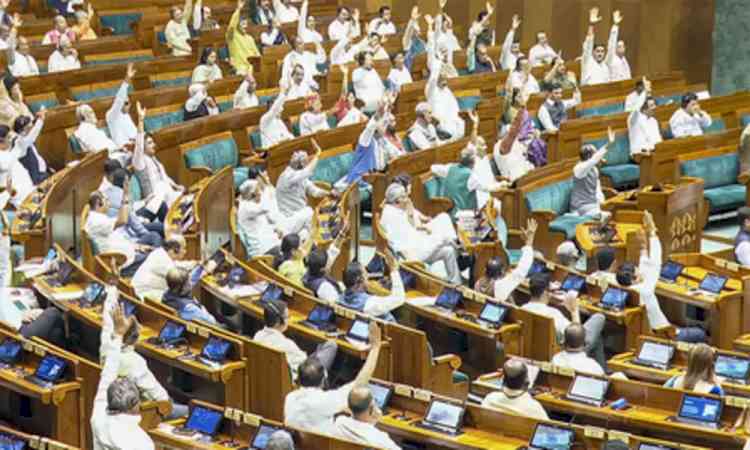
New Delhi, July 29 (IANS) After an intense and often acrimonious debate spread over two days, the Lok Sabha on Wednesday passed the Public Examinations (Prevention of Unfair Means) Amendment Bill, 2026, by a voice vote, paving the way for stricter legal measures to combat paper leaks and examination-related malpractices.
The legislation amends the Public Examinations (Prevention of Unfair Means) Act, 2024, and was passed following prolonged discussions that witnessed sharp exchanges between the treasury and Opposition benches.
While the NDA and its allies supported the Bill and called for wider reforms in the examination system, Opposition members questioned whether the proposed amendments addressed the fundamental reasons behind recurring examination failures and paper leaks.
The amended law seeks to strengthen transparency, accountability, and integrity in public examinations through tougher punitive provisions while safeguarding the interests of students.
Among its major provisions are enhanced penalties, including imprisonment of up to 10 years, fines of up to Rs 10 crore, confiscation of assets of those found guilty, and a mechanism aimed at ensuring that judgments in such cases are delivered within three months.
The passage of the Bill also comes against the backdrop of the large-scale 'Sansad Chalo' protest organised by the Cockroach Janta Party (CJP) in New Delhi on July 20.
Hundreds of students had gathered to protest against the NEET paper leak and other examination-related irregularities, demanding the resignation of then Union Education Minister Dharmendra Pradhan. Pradhan later stepped down from his post on July 25.
Participating in the debate, Leader of Opposition (LoP) Rahul Gandhi said that every political party should respect the "expression of the future generation of this country", adding that the Jantar Mantar protest should make every Indian proud.
"I would like to say that I was very excited, reassured by what the future of this country did on our streets. This was not anger. This was not violence. This was not hatred but an expression of the future generation of this country. I believe that all political parties must respect this expression, including my friends in the BJP," Gandhi said.
"If my friends in the BJP would go and ask their own children what they felt about what their brothers and sisters were doing, they would find agreement among their own children. There is nothing wrong with what has happened, and every Indian should be proud."
The marathon discussion, however, descended into heated exchanges after Gandhi accused the RSS of influencing the country's education system and targeted Union Home Minister Amit Shah over the alleged use of pellet guns and excessive police action against protesting students in Delhi.
The BJP strongly objected to Gandhi's remarks, particularly his allegation that the Home Minister had ordered action against the protesters.
Responding on behalf of the government, Union Parliamentary Affairs Minister Kiren Rijiju challenged Gandhi to either substantiate his allegations with evidence or apologise before the House, saying such claims should not be made without proof.
Replying to the debate later, Union Minister of State for Personnel Jitendra Singh also rejected Gandhi's allegations and remarked that the Congress leader appeared to lack a basic understanding of administrative procedures.
Referring specifically to Gandhi's allegations against Amit Shah, Singh said, "When Rahul Gandhi claims that Amit Shah ordered action against students, he has failed to provide any evidence to support the allegation. For basic information, no minister can issue such orders. Such decisions are taken by a magistrate, District Magistrate (DM), or Sub-Divisional Magistrate (SDM). This is basic administrative knowledge, and it appears he lacks even this understanding."
"There was no firing; only tear gas was used. He also claimed that the Home Minister travels with 30 vehicles, which suggests he may be mistaken even in his calculations. He further alleged that the Home Minister was abroad, but there is no evidence to support that claim. Amit Shah has not gone abroad. Making statements without facts or evidence is not the conduct expected from the Leader of the Opposition," Singh added.
Defending the legislation, Singh said the government had incorporated suggestions received from multiple stakeholders while finalising the amendments.
"We have amended certain clauses of the Bill to include many inputs from various stakeholders," he said.
Explaining the revised penal provisions, Singh said the maximum fine for service providers under the 2024 law had been increased from Rs 1 crore to Rs 5 crore.
He added that the punishment for directors and senior management had also been enhanced, with imprisonment remaining between five and 10 years while the maximum fine had been raised to Rs 5 crore from the earlier Rs 1 crore.
He further said that the earlier punishment of three to five years' imprisonment and a fine of up to Rs 10 lakh had now been increased to five to 10 years in jail along with a fine of up to Rs 50 lakh.
Singh also highlighted that the punishment for in-charge personnel had been strengthened under the amended law, with imprisonment ranging from five to 10 years and fines increased to Rs 5 crore.
Congress MP Priyanka Gandhi, Samajwadi Party President Akhilesh Yadav, BJP's Anurag Thakur and Tejasvi Surya, and NCP's Supriya Sule were among those who participated in the debate.
For organised examination rackets and criminal syndicates involved in paper leaks, the amended Bill proposes a minimum prison term of seven years, up from five years, along with a fine of up to Rs 10 crore, significantly higher than the earlier ceiling of Rs 1 crore.
--IANS
sd/vd