5th Edition of Sustainable Textiles Summit 2026 successfully organized by PHDCCI
The Textiles Committee of the PHD Chamber of Commerce and Industry PHDCCI successfully organized the milestone 5th Edition of the Sustainable Textiles Summit 2026 at PHD House, New Delhi. The high-profile event was centered on the pivotal theme, "Advancing Textile Circularity: Scaling Innovation, Green Finance, and Inclusive Growth."
 City Air News
Oct 21, 2026 02:18
0
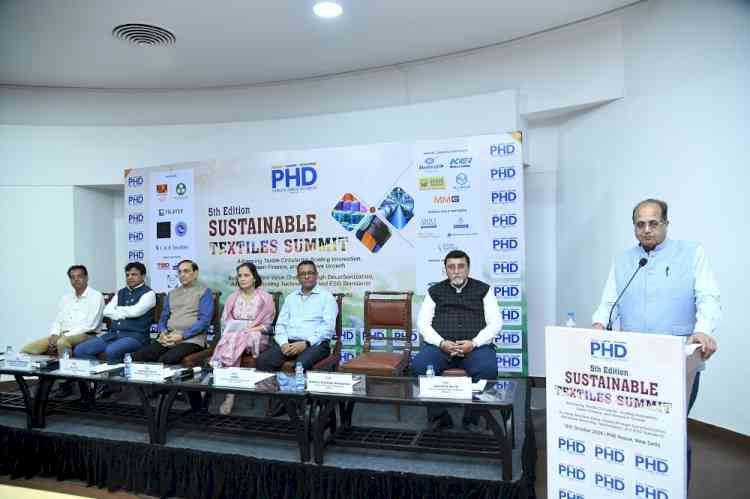
New Delhi, October 21, 2026: The Textiles Committee of the PHD Chamber of Commerce and Industry PHDCCI successfully organized the milestone 5th Edition of the Sustainable Textiles Summit 2026 at PHD House, New Delhi. The high-profile event was centered on the pivotal theme, "Advancing Textile Circularity: Scaling Innovation, Green Finance, and Inclusive Growth."
The summit brought together key industry stalwarts, policymakers, financial institutions, and global experts to establish a strategic roadmap for deep decarbonization, advanced recycling ecosystems, and robust ESG standards across the industry. The summit's prominent line of deliberations featured Madhu Sudhan Bhageria, Chair, PHDCCI Textiles Committee & CMD, Filatex India Ltd.; Murugan Thenkondar, President-Cellulose Fibres, Grasim Industries Limited, Aditya Birla Group; Archana Dutta, Programme Management Officer, United Nations Environment Program UNEP; Anil Jadhav, Regional Director South Asia and Middle East, ECOCERT India; and Gopal, Director, Ministry of Textiles, alongside R. K. Vij, Co-Chair, PHDCCI Textiles Committee & SG, Polyester Textiles Apparel Industries Association. Technical and institutional frameworks were further driven by Dr. Pankaj Kumar, National Project Coordinator, UNIDO; Shivendra Parmar, Assistant General Manager, TÜV Rheinland India Pvt. Ltd.; Dr. Arpan B. Kharva, Head - Research & Development, Capital Maharaja Group, Sri Lanka; Tanmeet Thukral, Private Sector Specialist, The World Bank; Himanshu Shukla, Scientist – C/Deputy Director, Textile Department, Bureau of Indian Standards BIS; Rohan A Gaikwad, Growth Director, Without; Bansari Nag, National Project Coordinator, International Labour Organization ILO Country Office for India; and Dr. Swapna Mishra, CEO, Textile Sector Skill Council.
Delivering the welcome address, Madhu Sudhan Bhageria highlighted that sustainability in textiles must embrace a comprehensive lifecycle approach encompassing fibre production, manufacturing, processing, and consumption. He strongly advocated that the financial cost of sustainability must be shared equitably across the global value chain rather than falling solely on manufacturing units in producing countries. Shri Murugan Thenkondar added that economic viability rests firmly on resource efficiency, urging businesses to reduce water and energy consumption through modern recycling technologies.
Addressing the regulatory shift from intent to proof, Anil Jadhav noted that impending European mandates, including the Digital Product Passport and the Green Claims Directive, are swiftly reshaping global supply chains. He remarked that consumers today demand credible evidence, independent audits, and complete traceability over mere voluntary labeling. Acknowledging this global shift, Chief Guest Gopal stated that while the ecological challenge is real, India possesses a highly capable recycling ecosystem, expanding startups, and technical depth to capture the global green market. He called for supportive policy frameworks that align clean technologies with decent work conditions and structural empowerment for workers, particularly women.
The subsequent technical sessions focused heavily on technological, standard-driven, and financial outcomes. Key discussions highlighted UNIDO's green manufacturing pathways, TÜV Rheinland’s independent verification structures, and Capital Maharaja Group’s R&D into alternative next-gen materials. Furthermore, the financial and operational mechanics were charted out via green infrastructure financing models from The World Bank, quality assurance markers from the Bureau of Indian Standards BIS, and commercial upcycling of post-consumer waste by industry innovators.
The high-impact summit witnessed active participation from a broad spectrum of industry stakeholders, including MSMEs, academic researchers, global apparel brands, standard-setting agencies, and green energy professionals. The close strategic involvement of leading international institutions, namely UNEP, UNIDO, ILO, and The World Bank, reflected the international seriousness and global consensus driving the industry's transition toward highly resilient, eco-conscious supply chains. The summit collectively concluded that achieving scalable textile circularity requires technology, finance, statutory standards, and workforce upskilling to operate in absolute synchronicity.