200 nations to gather in Turkey's resort city to scale up clean energy, climate finance
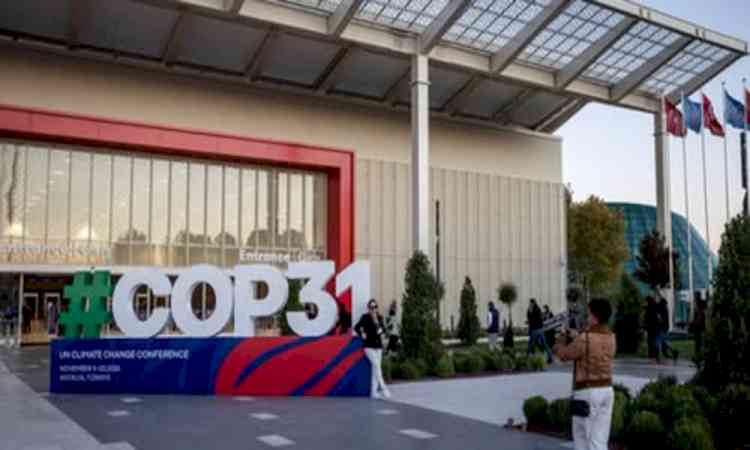
As leaders, scientists, civil society representatives, activists and others from nearly 200 countries, comprising India, are gathering for two weeks in Turkey's Mediterranean resort city of Antalya for the 31st Conference of Parties to the United Nations Climate Change Conference (COP31), beginning on Monday, with aim to accelerate clean energy, scale up climate finance and strengthen resilience.
 IANS
Nov 8, 2026 06:38
0
Vishal Gulati
New Delhi, Nov 8 (IANS) As leaders, scientists, civil society representatives, activists and others from nearly 200 countries, comprising India, are gathering for two weeks in Turkey's Mediterranean resort city of Antalya for the 31st Conference of Parties to the United Nations Climate Change Conference (COP31), beginning on Monday, with aim to accelerate clean energy, scale up climate finance and strengthen resilience.
The Conference of the Parties (COP), the highest-level global climate summit held annually under the United Nations Framework Convention on Climate Change (UNFCCC), is bringing together heads of state, Ministers, scientists, business leaders, and civil society representatives from around the world and serves as the primary platform for negotiating and advancing collective action to combat climate change.
This year's climate summit is being held in the backdrop of the this month's United Nations Environment Programme's (UNEP) report that says with global warming set to exceed 1.5 degrees Celsius, adaptation finance falls far short of needs, implementation is constrained by institutional barriers, and losses and damages are mounting.
UNEP's "2026 Adaptation Gap Report: Ready? Not" finds that expanded, effective and well-financed adaptation will be crucial to reduce risks, strengthen resilience and support more inclusive development.
However, international public adaptation finance flows from developed to developing countries are far below estimated needs of $305 billion annually by 2035.
Even if the COP30 aspiration to triple international public finance flows to developing countries by 2035 is achieved, this would only cover 20-29 per cent of what they need to deal with intensifying climate impacts.
At COP31, the World Metrological Organisation (WMO) will support countries by providing authoritative scientific observations and information on the state of the global climate system, including through the launch of its flagship State of Climate update 2026, a science-based annual assessment of climate indicators and impacts on the first day of the summit that will last till November 20.
Turkey holds the COP31 host Presidency, with responsibility to leads the global climate action agenda, while Australia has exclusive authority over the political negotiations, with Minister Chris Bowen serving as President of Negotiations.
Leading NGO Climate Action Network (CAN) Europe outlines the key political tests facing governments at this year's UN climate negotiations.
It says governments have already agreed on much of the direction of travel.
What is missing is delivery: transitioning away from fossil fuels, scaling up electrification powered by renewable energy, making the just transition real, and providing the finance developing countries need to implement climate action and protect people from worsening climate impacts.
The UN's annual review of national climate plans (aka NDCs) released on October 27 with 154 countries have lodged 2035 targets with the UN.
Submitted plans cover 71 per cent of global emissions, excluding land use.
"The good is that the quality of plans is much better, legislation is tighter, tracking is clearer. The bad is that the progress in lowering projected emissions from the 1.5 degree Celsius targets and remains substantially off track," the UN warned.
What are expectations from COP31?
"No single COP can fix this global crisis, but each takes meaningful steps forward," UN climate chief Simon Stiell said on September 21.
Despite the shadow of record heat, lethal glacier collapse and extreme weather, progress in Antalya will be incremental, observed a negotiator commenting on adaptation finance, where action is needed as UNEP adaptation report exposes climate finance injustice, India's Lead Negotiator at the Paris Agreement and former Director General of International Solar Alliance, Ajay Mathur, told IANS.
"If we want to hit $300 billion in adaptation finance by 2035, we need a clear baseline and a monitoring mechanism that reflects real needs on the ground. Public money has to go where markets can't, deep adaptation, urban resilience and small enterprise.
"I look at Article 6 carbon markets not just as an accounting device, but as the honey, the nucleus around which international capital can flow for domestic decarbonisation. In India, we've now institutionalised this through our carbon market, the CCTS (Carbon Credit Trading Scheme). The key question now is how we make it work."
Believing that this is not an ordinary COP, Aarti Khosla, Director of Climate Trends, told IANS, "We are not in an ordinary year. It's taking place against a backdrop of deep geopolitical fragmentation, cost-of-living pressures being felt across the world, and tightening national and international budgets."
"We're also facing one of the strongest El Ninos, the world has seen this year, and that too cannot be treated as ordinary, whether it's floods, droughts, wildfires, landslides, melting glaciers, or extreme heat. The latest science is unambiguous: we are in an era of overshoot, and exceeding 1.5 degree Celsius is now unavoidable."
A starling fact: Nearly two billion people worldwide still lack access to clean cooking, with major consequences for climate, health, household costs, and livelihoods.
At COP31, Solar Cookers International (SCI) will highlight how solar cooking can be part of the solution and share results from programs putting this approach into practice.
For young minds there will be Children and Youth Pavilion (CYP), a fully youth-led initiative within the UN Climate Change Conference.
First established at COP27, the pavilion provides a dedicated space for children and young people to connect, exchange perspectives and bring their experiences and priorities into the international climate debate.
It remains the only space at COP with a fully youth-led infrastructure.
At COP31, the pavilion brings together 10 young spokespersons from around the world, ranging in age from 14 to 31.
They represent a wide range of backgrounds and expertise, including Indigenous climate advocacy, environmental research, policy, community organising and youth-led initiatives.
Their work addresses issues such as climate justice, biodiversity, clean energy, circular economy, resilient cities, climate finance and youth participation.
(Vishal Gulati can be contacted at [email protected])
--IANS
vg/khz