10th Arthroplasty Arthroscopy Summit 2026; highlights cutting-edge advancements in orthopaedic care, with focus on the latest techniques reshaping joint treatments
Apollo Hospitals, Secunderabad; hosted a one-day 10th Arthroplasty Arthroscopy Summit 2026, under the aegis of the Telangana Orthopaedic Surgeons Association (TOSA) and Twin Cities Orthopaedic Society (TCOS), today at the Apollo Institute of Medical Sciences and Research, Jubilee Hills.
 City Air News
Sep 6, 2026 08:35
0
City Air News
Sep 6, 2026 08:35
0
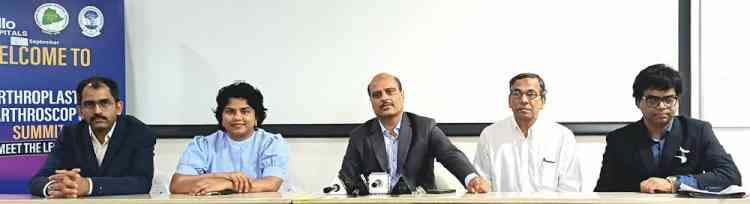
Hyderabad, September 6, 2026: Apollo Hospitals, Secunderabad; hosted a one-day 10th Arthroplasty Arthroscopy Summit 2026, under the aegis of the Telangana Orthopaedic Surgeons Association (TOSA) and Twin Cities Orthopaedic Society (TCOS), today at the Apollo Institute of Medical Sciences and Research, Jubilee Hills. Dr N. Somashekar Reddy, Organizing Chairman, AAS and Sr. Ortho & Joint Replacement Surgeon, Apollo Hospitals, Hyderabad and Dr Mithin Aachi, Course Director, AAS and Senior Ortho & Joint Replacement Surgeon, Apollo Hospitals, Secunderabad; briefed media about the latest techniques discussed at the summit.
The Summit was attended by over two hundred and fifty orthopaedic surgeons from across India including several young ortho professionals. It brought together senior faculty representing multiple orthopaedic subspecialties to discuss challenging clinical scenarios and practical recommendations that could be applied in everyday patient care.
Dr Mithin Aachi, Course Director, AAS and Senior Ortho & Joint Replacement Surgeon, Apollo Hospitals, Secunderabad; said, Robotic Knee Replacement was highlighted as an excellent treatment option, with technology continuing to evolve rapidly. However, the Congress emphasised the need for long-term evaluation of patient outcomes and a careful assessment of its cost-effectiveness, particularly in the Indian context. Another key discussion centred on the role of injections for knee pain in patients with severe arthritis who are candidates for knee replacement. The consensus was that injections are unlikely to provide meaningful or lasting benefit in cases of advanced arthritis, where knee replacement may be the more appropriate treatment option. The Congress also deliberated on the latest keyhole procedures for ACL tears, including the use of newer synthetic ligament technology as an alternative to conventional ligament repair, and explored how these advancements could be made accessible and cost-effective for Indian patients. The latest clinical guidelines and advancements in knee and ligament treatment were also discussed extensively during the Congress.
Dr N. Somashekar Reddy, Organizing Chairman, AAS and Sr. Ortho & Joint Replacement Surgeon, Apollo Hospitals, Hyderabad; said, The Congress focused on the latest evidence-based developments in orthopaedic treatment and on disseminating this knowledge among orthopaedic specialists from six states. The scientific sessions also provided an opportunity to critically evaluate emerging techniques, assessing their clinical efficacy, safety and long-term outcomes, while distinguishing genuinely beneficial advances from those that lack sufficient evidence or meaningful clinical value and should therefore be approached with caution.
Dr Satish Mutha, Hinduja Hospitals Mumbai & President Elect of Mumbai Orthopaedic Society; said, We regularly conduct medical education programmes, but this Congress was unique in its discussion-driven and highly interactive format. The sessions encouraged healthy scientific debate, with several emerging developments, evolving treatment modalities, and areas of clinical controversy being discussed in depth. The objective was not merely to present new techniques, but to critically evaluate the available evidence, understand their benefits and limitations, and arrive at informed clinical perspectives. This made the Congress particularly enriching and fruitful. We believe this model of open, evidence-based discussion and knowledge sharing has great potential and would like to see similar programmes replicated across the country.
Dr Samundeeswari, Care Sports Injury Centre, Chennai; said, I specialise in joint replacement and arthroscopic surgery, including minimally invasive treatment for ligament and other joint-related conditions. The Congress examined the appropriate integration of emerging robotic-assisted surgery in India to improve outcomes while remaining cost-effective and accessible. It also addressed the long-term role of intra-articular injections in younger patients with knee osteoarthritis, including their indications and potential to delay knee replacement. Other topics included arthroscopic synthetic ligament augmentation or reconstruction for ACL injuries and cell-based therapies, including autologous stem-cell approaches, for knee osteoarthritis, with discussion of the current evidence, benefits and limitations. Advances in shoulder arthroplasty, including implant design, surgical techniques and the emerging use of robotic assistance to improve planning, precision and functional outcomes, were also highlighted.
The discussions spanned a broad range of contemporary orthopaedic practice, including Joint Replacement, Arthroscopy and Sports Injuries, Joint Preservation and Cartilage, Spine Surgery, Trauma, Periprosthetic Joint Infection (PJI), Shoulder and Elbow, Foot and Ankle, Orthopaedic Oncology, Regenerative Orthopaedics and other emerging areas.
The Summit spotlighted cutting-edge advancements in orthopaedic care, with a special focus on the latest techniques reshaping joint treatments. Key highlights included new insights into the role of robotics in joint replacements, groundbreaking single-stage procedure for cartilage lesions in the knee aimed at preventing the onset of arthritis. Additionally, discussions covered the most advanced techniques in joint preservation and minimally invasive keyhole approaches in shoulder surgery, setting new standards for patient outcomes.
The Summit explored several important and evolving areas of contemporary orthopaedic practice, including the role of robotic technology in joint replacement. While robotics offered greater surgical precision and reproducibility, whether these technical advantages consistently translated into superior long-term patient outcomes and meaningful cost-effectiveness remained an area of ongoing evaluation.
The discussions also addressed Platelet-Rich Plasma (PRP) in osteoarthritis (OA). The Summit emphasised that PRP should not be considered a proven cure or a cartilage-regenerating treatment for severe osteoarthritis, where advanced joint degeneration may require definitive treatment such as Total Knee Replacement in appropriately selected patients.
Another area of discussion was the evolving role of synthetic ligaments and internal bracing. These technologies showed promise in selected ligament repairs and augmentation procedures, although appropriate indications, patient selection and their long-term benefits continued to evolve.
The overarching consensus at the Summit was clear that, innovation should be embraced, but technology must be matched to the right patient and the right clinical indication, guided by scientific evidence, surgical experience, patient expectations and value.